
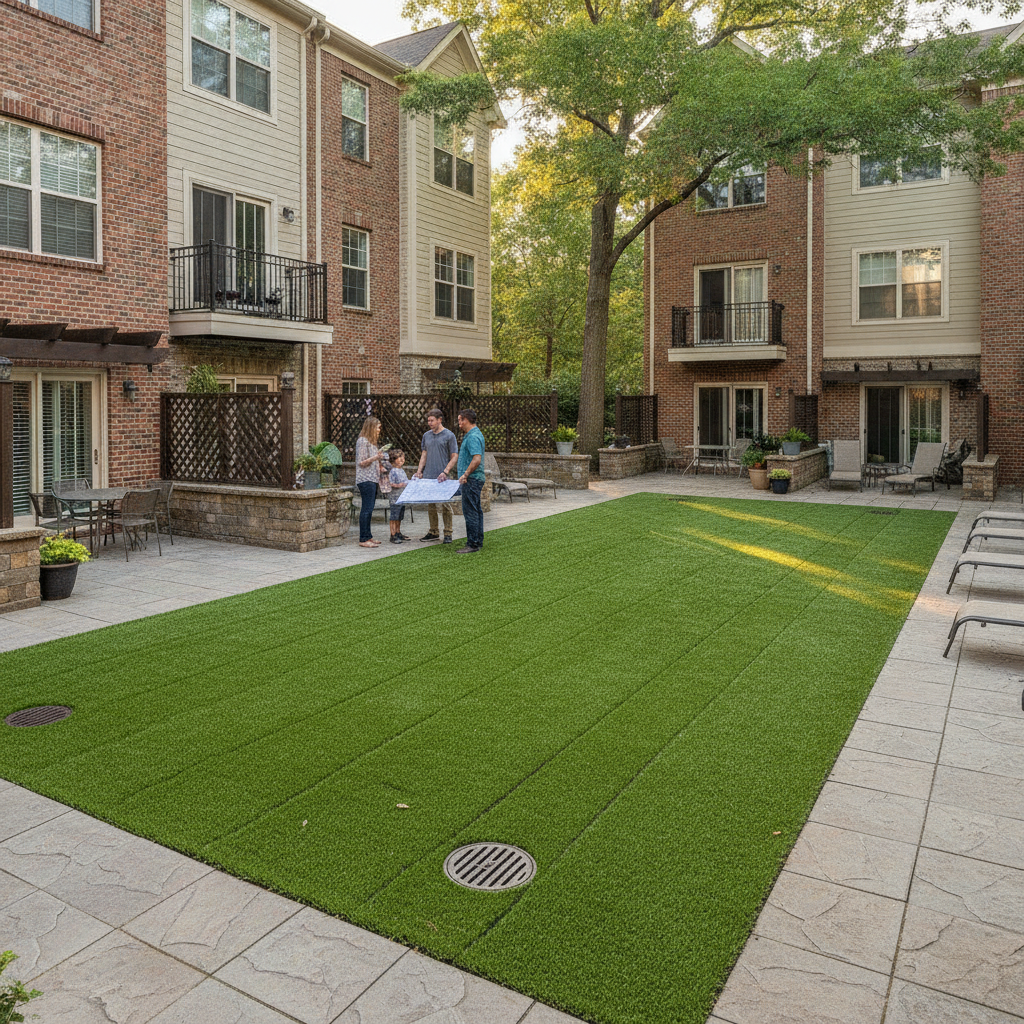
How Do You Install Artificial Turf on a Townhome or Condo Association’s Shared Courtyard in Falls Church, VA? What HOA Boards and Property Managers Need to Know
Yes — a shared courtyard in a townhome or condo community can absolutely be converted to artificial turf, and in Falls Church, VA, it’s becoming one of the more practical upgrades HOA boards are pursuing right now. But the process looks meaningfully different from a single-family backyard install. You’re not just managing one homeowner’s preferences. You’re coordinating drainage across adjacent units, navigating a collective approval process, and making a surface decision that every resident who walks through that space will live with for the next 15 to 20 years. Done right, it’s a genuinely low-maintenance upgrade that slashes landscaping costs and eliminates the muddy, patchy mess that most shared natural grass areas become after a few seasons of foot traffic. Done wrong — usually when a board rushes to the cheapest bid — it creates drainage failures, uneven seaming, and community complaints that are expensive to undo.
Why Shared Courtyards Are a Completely Different Animal Than Backyard Turf
Most turf companies in the DMV area have a standard workflow for residential backyards. They pull sod, excavate a few inches, lay crushed aggregate, compact it, roll out turf, secure the edges. That process works well for a single-family home in Burke or Springfield. But a shared courtyard in a Falls Church townhome cluster introduces variables that most installers don’t have a clean protocol for.
First, there’s the drainage question. A shared courtyard is often surrounded on two or three sides by building foundations, unit entrances, and hardscape. Water has to go somewhere, and in a dense community layout, that somewhere needs to be engineered — not assumed. Northern Virginia’s spring rains are genuinely heavy. The region averages over 40 inches of annual rainfall, and a mid-April storm can drop two inches in a few hours. If the sub-base beneath your new turf isn’t graded correctly to direct that water toward existing stormwater infrastructure, you’ll end up with pooling near unit doorways — and an HOA board meeting no property manager wants to host.
Second, shared spaces experience foot traffic patterns that are nothing like a private yard. You have residents cutting across the same path morning and evening, kids playing in concentrated zones, dog walkers running the same route daily. That kind of repetitive, directional traffic demands a denser turf with higher face weight — typically 60 to 80 ounces per square yard — and a base layer compacted to a higher standard than a lightly used residential lawn. If the sub-base shifts under repeated foot traffic, you’ll see rippling and seam separation within two to three years.
The HOA Approval Process: What’s Different When the Whole Community Owns the Space
For a single homeowner in an HOA-governed community, the approval process usually means submitting an architectural review request and waiting for a board decision. For a shared common area, the board itself is the decision-maker — but that doesn’t mean the process is simpler. In many condo and townhome associations, any expenditure above a certain threshold requires a vote of the full membership, not just a board resolution. Some associations in Fairfax County require a two-thirds majority for capital improvements, which artificial turf almost always qualifies as.
That means your installer needs to come to that membership meeting prepared. Boards and property managers should ask their turf contractor to provide a written project summary that includes the proposed product specifications, drainage engineering plan, expected lifespan, maintenance requirements, and warranty terms — all in plain language that homeowners without a construction background can read and vote on with confidence. This is something Grassify routinely prepares for HOA clients, and it makes a real difference in how smoothly the approval process goes.
It’s also worth verifying whether your association’s governing documents include any language about natural vegetation requirements in common areas. Some older associations in the Falls Church and Arlington areas have CC&Rs that pre-date synthetic turf’s widespread adoption and may need a formal amendment or variance approval before work can begin. This is not a reason to avoid the project — it’s just a step that belongs on your planning checklist early, not late.
What the Base Prep Actually Involves for a Multi-Unit Property
This is where most competitor quotes start to diverge from each other — and where the cheapest bid often falls apart in execution. For a shared courtyard install, proper base prep means:
- Excavation to 3–4 inches across the full footprint, including careful clearance around existing hardscape edges, unit doorways, and any tree root systems
- Installation of a Class II permeable aggregate base — typically crushed granite or decomposed granite — compacted in lifts using a plate compactor to achieve a stable, non-shifting foundation
- Grading to positive drainage away from building foundations, with a minimum 1–2% slope directed toward designated stormwater outlets
- Weed barrier fabric over the compacted base to prevent organic material from migrating up through the aggregate over time
- Seam placement planning that minimizes visible joints in the highest-traffic corridors — experienced installers orient seams parallel to the primary foot traffic direction and avoid placing them at entryways or high-visibility focal points
For properties with existing concrete or paver paths running through the courtyard, the turf installation needs to transition cleanly at those edges. That means using non-corrosive bender board or aluminum edging secured with galvanized nails into a stable sub-base — not just tucked under and hoped for. Freeze-thaw cycles in the DMV are real. Any edge that isn’t properly anchored will lift after the first hard winter.
Pet Considerations in Multi-Unit Courtyards — A Gap Most Installers Ignore
Falls Church has a high concentration of dog owners, and in townhome communities, shared green space almost always doubles as the de facto dog relief area. This is one of the most underaddressed topics in competitor content we’ve seen — and it’s a genuine planning problem if you don’t get ahead of it.
Standard landscaping-grade turf with a basic drainage backing will not hold up to concentrated pet use from multiple dogs across dozens of units. Within six to twelve months, you’re looking at odor buildup that no amount of hosing down will fix, because the ammonia compounds from urine have soaked into an inadequate drainage layer and have nowhere to go.
The solution for pet-active shared spaces is a dedicated pet-system turf installation that includes a multi-layer drainage design rated for 400+ inches per hour, a zeolite deodorizer infill layer, and an antimicrobial infill component. This isn’t a luxury upgrade — in a multi-unit courtyard where multiple dogs are using the same surface daily, it’s the only configuration that will stay odor-free and sanitary over a 15-year product lifespan.
Cost and Timeline Expectations for a Shared Courtyard Project
Shared courtyard projects typically run in the $12 to $20 per square foot range installed, depending on the complexity of drainage engineering, the product specified, and site access conditions. Many townhome courtyards in Falls Church, Arlington, and Springfield have constrained access — no room for a full-size skid-steer, gates too narrow for standard equipment, or pathways that require materials to be hand-carried in. These logistics add time and sometimes cost, and any quote that doesn’t account for site access isn’t a complete quote.
Timeline from signed contract to project completion is typically two to four weeks for a courtyard under 3,000 square feet, assuming HOA approval is already in hand and materials are in stock. The installation itself — excavation, base prep, turf installation, edge finishing — usually takes two to three days for a crew of three or four.
For HOA boards planning their annual budget cycle, it’s worth getting a site assessment and preliminary proposal in hand well before you need to present to the membership. That gives you accurate numbers for the vote and time to get competing proposals if you want them. Grassify serves the full Fairfax County area, including Falls Church, and we provide written proposals with full drainage engineering documentation at no cost.
Frequently Asked Questions
Does our HOA need a permit to install artificial turf in a shared courtyard in Falls Church, VA?
In most cases, residential-scale turf installations in common areas don’t require a building permit in Fairfax County or Falls Church City. However, if the project involves significant regrading, stormwater redirection, or any structural modifications, a grading or land-disturbance permit may apply. Your installer should be able to confirm permit requirements based on the specific site plan before work begins.
How do we handle the approval process when our governing documents require a full membership vote?
Start by getting a written project summary from your installer that covers product specs, drainage design, warranty terms, and expected maintenance. Present it at a board meeting first to build consensus, then bring it to a membership vote with a clear cost breakdown and long-term maintenance savings comparison versus natural grass upkeep. Most memberships respond positively when they see the full picture — especially the elimination of ongoing mowing, irrigation, and fertilizer costs.
What happens to the turf warranty in a shared space where multiple residents are responsible for maintenance?
Grassify’s lifetime installation warranty on seams, edges, and base integrity applies to the installed work regardless of ownership structure. Product warranties from the manufacturer are tied to the product itself and typically run 15 to 20 years. We document the maintenance requirements in writing at project closeout so the HOA has a clear record of what’s needed to keep the warranty valid — which is essentially periodic brushing, debris removal, and rinsing pet areas.
Can we phase the installation across multiple budget years if the full project is too large for one cycle?
Yes, and we design phased projects regularly. The key is planning the drainage infrastructure for the full footprint in phase one, even if you’re only surfacing part of the area. Trying to retrofit drainage later is significantly more disruptive and expensive than engineering it correctly at the start.
What pile height and product do you recommend for a high-traffic shared courtyard?
For a shared courtyard with mixed use — foot traffic, some pet activity, kids playing — we typically recommend a 35mm to 40mm pile height with a face weight of 70+ ounces per square yard. That gives you a natural-looking surface that holds up under concentrated use without matting down quickly. Our Lush Life product is a strong fit for this application, with UV-stabilized fibers and a dense thatch layer that handles multi-directional traffic well.
Ready to Move Your Shared Courtyard Project Forward?
If your HOA or property management company is exploring artificial turf for a shared courtyard in Falls Church, Springfield, Arlington, or anywhere across Northern Virginia, Grassify is equipped to handle every phase of the project — from the initial site assessment and drainage engineering plan through HOA documentation support, full installation, and long-term maintenance guidance. Our crews are licensed, insured, and background-checked, and we stand behind our installation work with a lifetime warranty on seams, edges, and base performance.
Get in touch with the Grassify team for a free on-site consultation and written proposal tailored to your community’s specific footprint, access conditions, and budget cycle. Request your free consultation here.


