
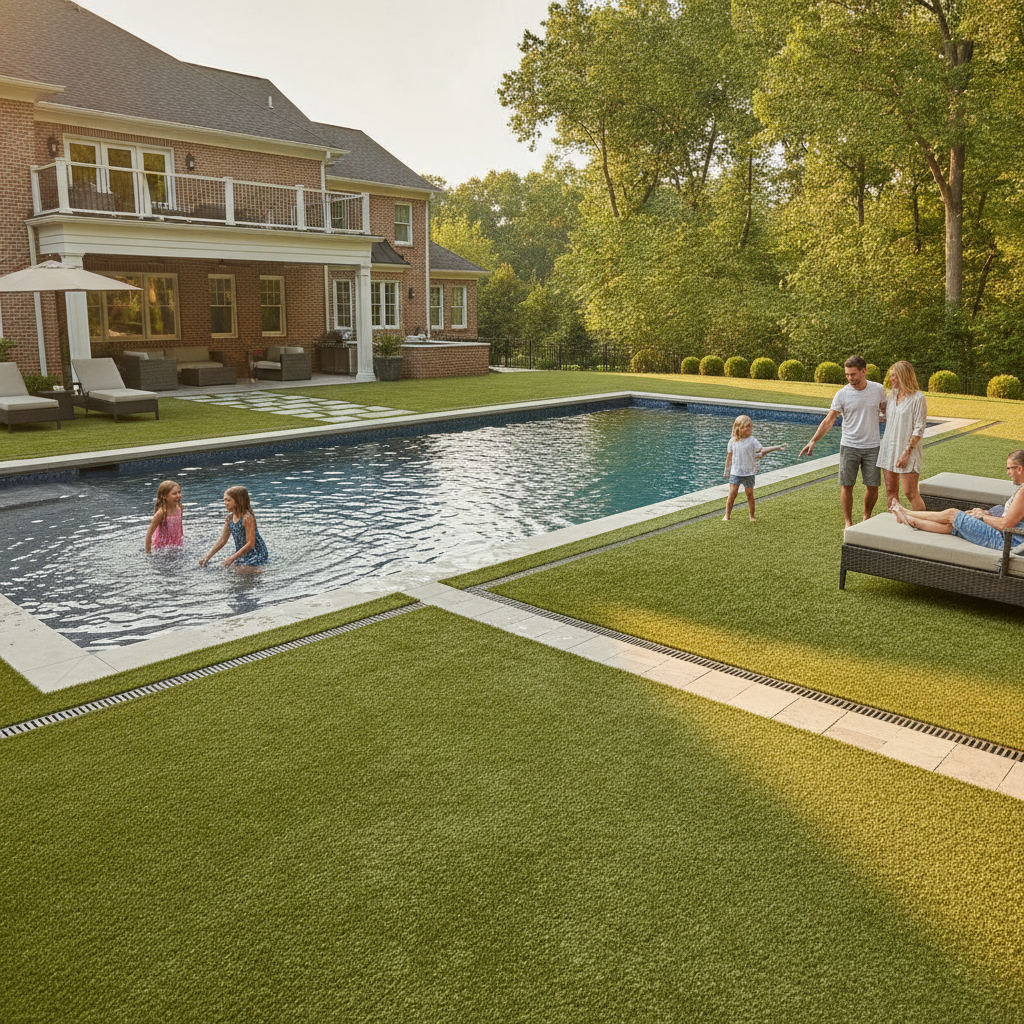
How Do You Choose Artificial Turf for a Pool Deck or Patio in Potomac, MD? What Homeowners Need to Know About Heat, Drainage, and Slip Resistance
If you’re planning to install artificial turf around your pool or patio in Potomac, MD, the single most important thing to understand upfront is this: pool deck turf is a fundamentally different product than backyard lawn turf, and installing the wrong type is not just a performance mistake — it’s a safety hazard. The wrong backing can trap water and breed mildew. The wrong fiber can reach surface temperatures that burn bare feet. And the wrong installation method can turn a beautiful pool surround into a slip-and-fall liability within one Maryland summer.
Potomac homeowners tend to invest heavily in their outdoor spaces — large lots, mature landscaping, custom pools — which makes it even more frustrating when a turf installation falls short because a contractor treated a pool deck like any other grass replacement job. Here’s what actually separates a pool-ready turf installation from a standard lawn job, and what you need to ask before anyone starts cutting material on your property.
Why Standard Lawn Turf Fails Around Pools and Patios
Most synthetic grass products are engineered for residential lawn replacement. Their backings are designed for soil sub-bases, their drainage is calculated for rain — not for the constant splash, chemical runoff, and foot traffic that a pool surround generates. When you put a standard lawn product in a pool environment, here’s what typically happens:
- Moisture traps under the backing. Splash water and pool runoff don’t drain fast enough through a lawn-grade backing, leading to standing moisture beneath the turf that breeds mold and creates odor problems within a single season.
- Chlorine and chemical exposure degrades the material. Pool water contains chlorine, algaecides, and pH-balancing chemicals. Standard turf backings aren’t designed for repeated exposure and will break down faster — sometimes voiding any manufacturer warranty.
- Surface temperatures become dangerous. Darker-toned synthetic grass products absorb heat aggressively. On a typical DMV summer afternoon, the wrong turf can reach surface temperatures of 150°F or higher — far too hot for bare feet walking from a pool to a lounge chair.
- Wet fiber becomes slippery. Not all synthetic grass textures provide adequate traction when wet. Around a pool, that’s a serious fall risk, especially for children.
These aren’t hypothetical problems. They’re the most common complaints we hear from homeowners in Potomac, Great Falls, and Bethesda who had pool deck turf installed by a general landscaper or a low-bid contractor who wasn’t pool-specific in their approach.
What Pool Deck Turf Actually Requires: Product Specifications That Matter
When we spec a pool deck or patio turf installation, the product requirements look very different from a residential lawn job. Here’s what you should be looking for — and asking about — before signing any contract.
Chlorine-Resistant Backing
The backing of the turf — the material that holds the fibers in place — must be specifically rated for chemical exposure. Pool-grade turf products use a polyurethane or TPE (thermoplastic elastomer) backing that resists degradation from chlorine and other pool chemicals. If a contractor can’t tell you the specific backing material and its chemical resistance rating, that’s a red flag.
Drainage Rate: This Number Matters More Than You Think
Lawn turf products typically drain at 30–60 inches per hour. That’s adequate for rainfall but inadequate for a pool surround where water volume is concentrated and constant. For pool deck applications, you need a product with a drainage rate of at least 100–130 inches per hour, ideally higher. The backing should be perforated or flow-through by design — not just relying on the gaps between fiber tufts.
At Grassify, our pool deck turf solutions are engineered specifically for splash zones, with drainage systems that handle concentrated water volume without backing up or pooling.
Heat-Resistant Fiber Technology
This is the specification gap that most competitors in the DMV area don’t address clearly. Standard polyethylene fibers absorb heat. In a Potomac summer — where July and August routinely bring 90°F days with high humidity — that means turf surface temperatures can exceed 140°F on dark or medium-toned products. Heat-resistant turf products use a combination of lighter-toned fiber coloring, UV-reflective coatings, and in some cases, ThermoPlastic Rubber (TPR) infill that dissipates heat more effectively than standard silica sand or crumb rubber.
If a contractor doesn’t bring up surface temperature unprompted when discussing a pool deck installation, ask them directly: what is this product’s surface temperature performance in direct summer sun, and what infill system are you using to manage heat?
Slip Resistance and Texture
Pool deck turf needs a fiber texture that provides traction when wet. This typically means a flatter, denser pile profile — often in the 20mm–30mm range — rather than the taller, more open pile heights (38mm–50mm) used for lawn aesthetics. The infill system also contributes to grip: a silica sand infill packed to the right density helps stabilize fibers and provides surface friction underfoot.
Base Prep on a Pool Deck: Concrete vs. Soil Sub-Base
Many Potomac-area pools have existing concrete or paver decks surrounding them. Installing turf over an existing hard surface is a different process than installing over native soil, and both approaches have specific requirements that general landscapers often get wrong.
Over concrete, the existing surface must have adequate slope (minimum 1–2% grade) for water to move toward drains. If the concrete has low spots that hold water, that problem doesn’t go away when you lay turf on top — it gets worse. Any cracks or surface irregularities in the concrete also telegraph through to the finished turf surface over time. The installation process includes cleaning and profiling the concrete, verifying drainage grade, applying a weed barrier where needed at seams and edges, and securing the turf perimeter with appropriate mechanical fasteners rather than landscape staples (which don’t hold reliably on hard surfaces).
Over native soil — common when a pool is surrounded by a planting bed or lawn area — the base prep requirements are more involved: excavation to the right depth, compacted aggregate base (typically 3–4 inches of crushed stone), and sometimes a layer of decomposed granite for fine leveling before the turf goes down. Getting this right matters especially in Montgomery County and Fairfax County, where clay-heavy soil composition can compromise drainage if the base isn’t properly engineered.
The Gap Competitors Are Missing: Infill Selection for Pool Environments
Across the competitor sites we regularly review in this market, there’s almost no specific guidance on infill selection for pool and patio turf. Most sites either skip infill discussion entirely or give generic lawn-focused recommendations. For pool deck installations, infill choice is actually one of the most consequential decisions in the project — and it’s worth understanding why.
- Standard crumb rubber infill is not appropriate for pool environments. It can leach compounds when repeatedly wetted and dried with chemically treated water, and it absorbs heat aggressively — the last thing you want underfoot on a hot pool deck.
- Silica sand infill is a solid base choice for pool deck turf — it’s inert, doesn’t react with pool chemicals, and provides good drainage and grip. However, it also absorbs and radiates heat, so it shouldn’t be the only consideration on south-facing or fully exposed decks.
- Acrylic-coated sand or cooling infill products (sometimes called “cool infill” in the industry) use a reflective coating on sand granules to reduce surface temperature. These are worth the modest cost premium on exposed pool decks in climates like ours.
- Zeolite infill, which we commonly use in pet turf installations for odor control, is not specifically needed in pool environments — but it doesn’t hurt and can be useful if you have dogs who also use the pool area.
HOA Considerations for Pool Areas in Potomac and Montgomery County
Many Potomac-area communities — particularly in planned neighborhoods and HOA-governed developments — have architectural guidelines that apply not just to front yards but to any visible exterior surface, including pool surrounds visible from neighboring properties or common areas. Before starting a pool deck turf project, it’s worth pulling your HOA’s architectural standards document and checking for any language around hard surface materials, synthetic ground coverings, or pool surround aesthetics.
In our experience working across Montgomery County, most HOA boards are receptive to pool deck turf when presented with product specifications and a written installation plan — especially when the product clearly looks high-end rather than budget. The conversation goes much smoother when you come to the board with documentation rather than waiting for a complaint after installation.
Frequently Asked Questions: Pool Deck Turf in Potomac, MD
Is artificial turf slippery when wet around a pool?
It depends entirely on the product. Pool-specific turf products with shorter pile heights (20mm–30mm) and silica sand infill provide solid traction when wet. Standard lawn turf with tall, sparse pile can be slippery. Always ask your installer to confirm the product’s wet traction performance before purchase.
Will pool chemicals damage artificial turf?
Not if the product uses a chlorine-resistant polyurethane or TPE backing. Standard latex-backed lawn turf can degrade with repeated chemical exposure. This is one of the most important specification differences between pool-rated and lawn-rated products.
How hot does artificial turf get around a pool in a DMV summer?
In direct sun, standard synthetic grass can reach 130°F–160°F surface temperature on a 90°F day. Pool-rated products with heat-resistant fiber and cool infill typically perform 20°F–40°F cooler. Misting systems, shade structures, or simply rinsing the turf with pool water also reduce surface temp quickly.
Can I install pool deck turf over an existing concrete deck?
Yes, in most cases — provided the concrete has adequate drainage slope and no major structural deterioration. Cracked or uneven concrete should be repaired before turf installation. The turf is mechanically fastened to the concrete perimeter and secured at seams, so no adhesive is needed across the full surface.
What does pool deck turf installation typically cost in Potomac or the DMV area?
Pool deck and patio turf installations typically run $14–$22 per square foot installed, depending on the product, base condition, and site complexity. Pool-rated products sit at the higher end of that range due to material specifications. That said, the ROI compared to resealing concrete or replacing pavers every few years is significant.
Ready to Get It Right Around Your Pool?
Pool deck turf done correctly is genuinely one of the most satisfying upgrades a Potomac-area homeowner can make — it’s safe, it looks beautiful, and it eliminates the muddy, slippery, maintenance-heavy alternatives. Done wrong, it’s an expensive problem that takes a full reinstallation to fix.
Grassify has been installing pool deck and patio turf across the DMV — from Potomac and Bethesda to Great Falls, Burke, and beyond — with a focus on product specifications and base engineering that actually match the environment. Every pool deck installation we do carries a lifetime warranty on seams, edges, and base. Our crews are licensed, insured, and background-checked.
If you’re ready to plan your pool deck or patio turf project, contact Grassify today for a free on-site consultation. We’ll evaluate your deck surface, drainage grade, sun exposure, and site-specific needs — and give you an honest product recommendation before you spend a dollar.


