
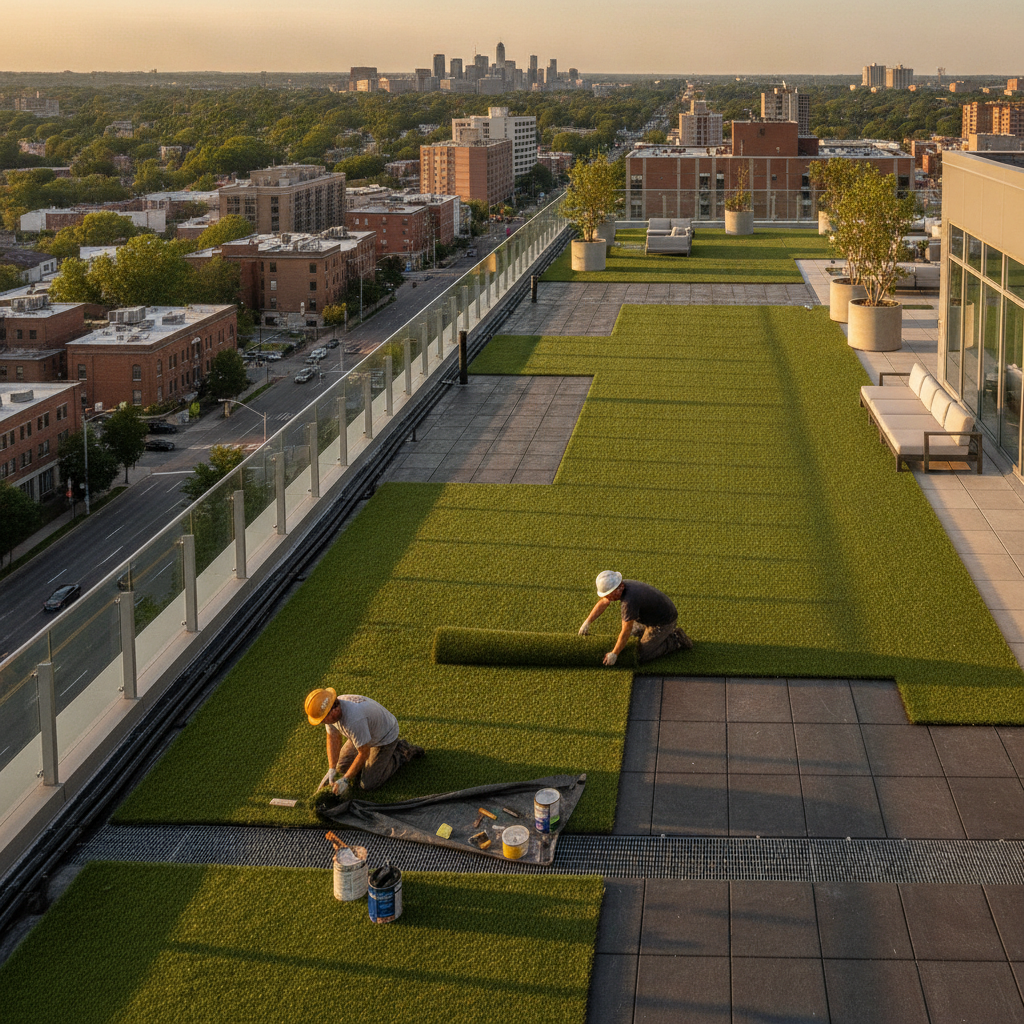
How Do You Install Artificial Turf on a Roof Deck or Elevated Terrace in Silver Spring, MD? What Condo Owners and Building Managers Need to Know About Structural Weight, Drainage, and Heat
Yes, you can install artificial turf on a roof deck or elevated terrace in Silver Spring, MD — but it’s one of the most technically demanding turf applications out there, and the approach is fundamentally different from installing turf in a backyard. The three factors that trip people up most often are structural load limits, drainage engineering, and surface heat. Get any one of those wrong and you’ve got a project that looks great in photos but causes real problems within a season or two. Here’s what condo owners, building managers, and HOA boards in Montgomery County need to understand before moving forward.
Why Roof Deck Turf Is Not the Same as a Backyard Installation
Most turf companies in the DMV area know how to do a solid ground-level installation. Base prep, compaction, drainage rock, bender board — that’s standard work. Roof decks and elevated terraces are a completely different conversation. You’re working on a structure that has a rated load capacity, often with waterproofing membranes that cannot be punctured, existing drain points that dictate where water has to go, and in many Silver Spring and Bethesda high-rise buildings, building management rules that restrict what can and can’t be fastened into the deck surface.
None of the major turf competitors serving the Maryland suburbs have published meaningful guidance on this. Most of their content stops at “great for balconies and patios” without addressing the engineering decisions that actually determine whether a rooftop turf project succeeds or creates a liability. That gap is exactly why we’re covering it here.
Step One: Structural Load Assessment — Before You Buy a Single Square Foot
Every roof deck and elevated terrace has a live load rating, typically measured in pounds per square foot (psf). In most mid-rise and high-rise residential buildings in Silver Spring, Rockville, and the broader Montgomery County area, roof deck live loads commonly fall between 40 and 100 psf. You need to know that number before you plan anything else.
Here’s why it matters: artificial turf itself is relatively lightweight — the turf rolls and infill together typically add 2 to 5 lbs per square foot depending on infill type. The problem comes when you add a drainage layer, foam padding, any raised decking system, planters, furniture, and the weight of people actually using the space. It adds up faster than most people expect. A 500-square-foot rooftop terrace with turf, furniture, and a gathering of guests can approach or exceed the rated capacity of an older structure if nobody has done the math.
At Grassify, we won’t start a roof deck turf project without a structural load review. If you’re working with an HOA-managed building in Silver Spring or a condo association in Bethesda, your building manager or structural engineer needs to sign off on the total anticipated load before we pull materials. This isn’t overcaution — it’s what separates a professional installation from one that creates problems down the road.
Drainage Engineering on an Elevated Surface: The Most Critical Technical Step
At ground level, a well-engineered turf base uses compacted aggregate and perforated drain channels to move water into the soil below. On a roof deck, there is no soil below — there’s a waterproofing membrane, structural deck, and usually a building’s internal drainage system. Every drop of water that hits your rooftop turf needs to exit through existing roof drains or scuppers, and it needs to do so without pooling or backing up against walls and curbs.
The right installation approach uses a low-profile drainage mat — sometimes called a flow-through drainage layer — installed directly on the deck membrane before the turf goes down. This creates a continuous channel between the turf backing and the deck surface so water can move freely to existing drain points. The turf product itself must have a permeable backing with adequate flow-through capacity. We typically specify products rated for at least 30 to 40 inches of drainage per hour on elevated applications, which handles even the heaviest summer downpours the DMV throws at us.
Critically, the turf installation cannot block or cover existing roof drains. This is a building code and waterproofing warranty issue, not just a performance issue. Any installer who proposes to cover roof drains with turf — even partially — is telling you they haven’t done enough rooftop work. Walk away from that proposal.
If you’re planning a pool deck or patio turf installation at grade level, the drainage approach is quite different and somewhat simpler — but the same principle of respecting existing drainage infrastructure applies everywhere.
Heat Management on Rooftop Turf in a DMV Summer
This is the issue most people don’t think about until their first July with the turf installed. Roof decks are exposed to full sun from above and reflected heat from surrounding concrete and masonry — a combination that can push standard synthetic grass surface temperatures significantly higher than turf at ground level, where shade from trees and buildings provides some relief.
For Silver Spring and Washington, D.C. rooftop installations, we specifically recommend heat-resistant turf products engineered with lighter-colored or multi-tonal fibers that reflect rather than absorb solar radiation. Some of our product lines incorporate heat-dissipating technology at the fiber level that can reduce surface temperatures by 15 to 20 degrees Fahrenheit compared to standard turf. We also recommend pairing those products with cooling infill options — silica sand stays cooler than crumb rubber under direct sun — and planning for a simple water-misting routine during peak summer afternoons for rooftop spaces used for entertaining.
The honest answer is that no synthetic turf product eliminates heat entirely in full-sun conditions. What good product selection and installation does is make the surface genuinely comfortable for extended use rather than something you can only tolerate for a few minutes at noon in August.
Fastening and Membrane Protection: What You Can and Can’t Do
Roofing membranes are expensive to repair and catastrophic to puncture. The standard ground-level turf installation technique — nailing or stapling turf into a compacted base — cannot be used on a roof deck without voiding the building’s waterproofing warranty and risking membrane damage.
On elevated decks, turf is typically secured through a combination of perimeter weighting, adhesive bonding compatible with the membrane type, and specialized edge profiles that grip without penetrating the deck surface. In some buildings in Silver Spring and Bethesda, building management requires that the entire installation be removable without leaving adhesive residue or fastener marks — in which case a ballasted system using perimeter paver borders or weighted edge channels is the right approach.
This is another reason rooftop work requires a specialist rather than a general landscaper. The wrong adhesive on a TPO or EPDM membrane can cause delamination of the waterproofing layer, which is a problem the building owner may not discover until months later during a rain event.
HOA and Building Management Approval in Montgomery County
If you’re a condo owner in a Silver Spring or Rockville high-rise, you almost certainly need building management or HOA board approval before installing any surface treatment on your terrace. Most condo associations in Montgomery County treat the terrace as a limited common element — meaning you have exclusive use of it, but the building association retains authority over structural modifications and surface materials.
The approval process typically requires a materials specification, a drainage plan showing that existing roof drains will not be obstructed, confirmation that the installation method won’t penetrate the membrane, and sometimes a certificate of insurance from the installing contractor. Grassify provides complete documentation packages for HOA and building management submissions, which is a step that most general installers skip entirely.
For more on how we approach the installation process from permitting through final inspection, our installation guide walks through the documentation and planning steps in detail.
What Does Rooftop Turf Actually Cost in the DMV?
Expect elevated deck turf installations to run at the higher end of the typical $12 to $25 per square foot range for synthetic grass. The additional cost comes from the drainage mat layer, membrane-safe fastening methods, heat-resistant product specifications, and the additional labor involved in working on an upper floor with restricted access — material hoisting, elevator logistics, and in some buildings, security escort requirements add real time to the job. The investment tends to be very defensible for condo owners and building managers because it converts a harsh, underused concrete deck into a genuinely livable outdoor space with minimal ongoing maintenance.
Frequently Asked Questions About Roof Deck Turf in Silver Spring and the DMV
Will rooftop turf installation void my building’s waterproofing warranty?
It can, if the installation penetrates or improperly adheres to the waterproofing membrane. A qualified installer uses membrane-compatible adhesives or ballasted edge systems specifically designed for elevated applications. Always confirm with your building’s waterproofing warranty documentation and share the proposed installation method with the warranty holder before proceeding.
How do I find out my roof deck’s load rating?
Your building’s structural drawings, which should be on file with the building management office or the original architect of record, will specify the live load rating. For older buildings in Silver Spring and Rockville, a structural engineer can perform a load assessment if original drawings are unavailable. This step is non-negotiable before installation.
Can I install turf on my individual condo terrace in Silver Spring without HOA approval?
In most cases, no. Terraces in condo buildings are typically classified as limited common elements, meaning the association has jurisdiction over modifications. Installing turf without approval could result in a removal order and potentially make you liable for any damage to the building’s waterproofing system.
How does rooftop turf hold up through DMV winters?
High-quality UV-stabilized synthetic turf handles freeze-thaw cycles well at the fiber level. The bigger concern on a roof deck is ensuring the drainage mat doesn’t trap standing water that freezes and expands against the membrane. Proper drainage slope and perimeter clearance around drains prevents this. We engineer for it specifically on every elevated installation.
Is there a minimum square footage that makes rooftop turf worth the investment?
Not in a strict sense, but the fixed costs of a compliant elevated installation — drainage mat, membrane-safe edge systems, documentation prep — mean that very small terraces under 150 square feet can have a higher per-square-foot cost. For most condo terraces and rooftop common areas in Silver Spring and surrounding Montgomery County, the square footage is large enough to make the economics work very comfortably.
Ready to Turn Your Roof Deck Into Something Worth Using?
Rooftop and elevated terrace turf is one of the most rewarding transformations we do at Grassify — a bare concrete deck that nobody uses becomes the most-used space in a condo or commercial building. But it has to be done right from the structural assessment forward. If you’re in Silver Spring, Bethesda, Rockville, Washington, D.C., or anywhere across the DMV and you’re seriously considering turf for an elevated surface, let’s talk through the specifics of your project before you commit to anything.
Request a free consultation with Grassify and we’ll walk through your deck’s load capacity, existing drain layout, building management requirements, and the right product spec for your space. No generic sales pitch — just an honest assessment of what your project actually needs.


