
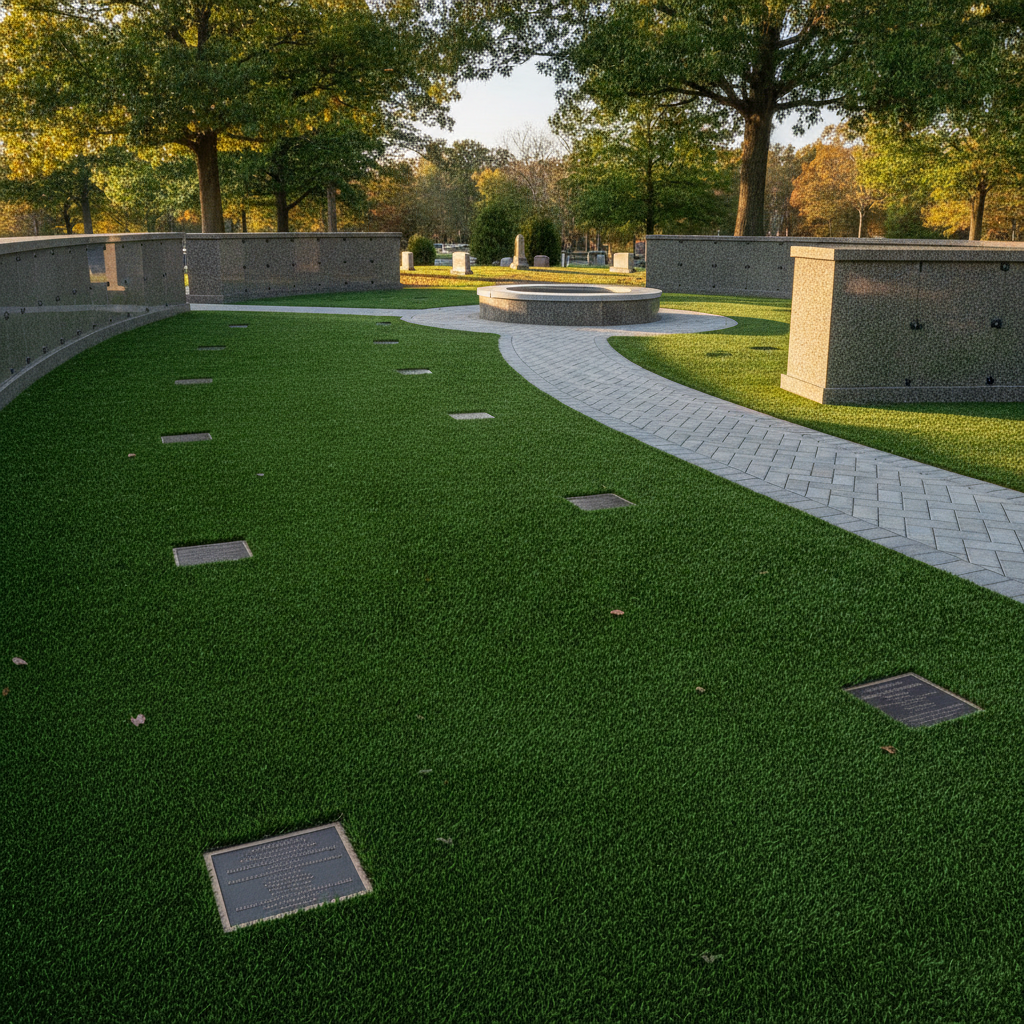
How Do You Install Artificial Turf on a Cemetery Plot or Memorial Garden in Burke, VA? What Families and Cemetery Managers Need to Know
Yes — artificial turf can be installed around and between cemetery plots, on memorial garden surrounds, and along columbarium pathways, and it holds up remarkably well in the DMV’s demanding climate. If you’re a family in Burke, VA trying to keep a loved one’s gravesite looking cared for year-round without making weekly trips to pull weeds and re-sod dead patches, or if you’re a cemetery manager in Fairfax County looking to cut mowing hours and reduce water bills, synthetic grass is worth a serious look. This is a niche application that most turf installers either haven’t encountered or simply don’t advertise — which is exactly why we’re covering it in detail here.
Why Families and Cemetery Managers Are Looking at Artificial Turf
Natural grass around memorial plots in Northern Virginia is genuinely difficult to maintain. Fairfax County’s clay-heavy soil drains poorly after spring rains, which means muddy, waterlogged ground around headstones for weeks at a time. Summer heat dries patches out completely by July. Groundskeeping crews are expensive, and families who live more than a few miles away simply can’t visit every week to keep things tidy.
At the same time, the visual standard at a well-maintained cemetery is high — nobody wants to see dead grass or bare soil surrounding a marker. Artificial turf solves both problems. With the right installation, it stays consistently green through February freezes and August heat alike, drains standing water within minutes, and requires almost no active maintenance beyond the occasional rinse.
This is an underserved application in the turf industry. Most competitor installers in the DMV area focus exclusively on residential lawns and commercial playgrounds. We’ve done cemetery and memorial work, and the technical requirements are different enough from a standard backyard install that it’s worth walking through the specifics.
What Makes Cemetery Turf Installation Different from a Standard Lawn Job
Working Around Existing Monuments and Markers
The most obvious challenge is precision cutting. Turf panels need to be cut cleanly around headstones, grave markers, flower vases, and flush-mounted plaques — often with only a few inches of clearance on each side. This isn’t a job for general landscapers using box-cutter blades and no template work. Seaming errors here are permanent and highly visible. A clean, tight perimeter cut against a granite or marble marker requires experience with detailed pattern work and proper seam adhesive.
At Grassify, we use custom template cuts and stainless-steel stapling systems at all monument edges to prevent lifting over time. That matters especially through Northern Virginia’s freeze-thaw winter cycles, when repeated frost heave can pop improperly anchored edges away from monument bases within a single season.
Base Prep in Clay Soil Conditions
Much of Fairfax County — including areas around Burke, Springfield, and Fairfax — sits on dense clay soil. Clay holds water. If you install synthetic grass directly over compacted clay without engineering the drainage base properly, you’ll end up with a waterlogged, spongy surface that smells and doesn’t drain after rain. This is true in any yard, but it’s especially problematic in a cemetery context where the soil composition around burial plots may be disturbed, uneven, or inconsistent.
Proper base prep for cemetery plot surrounds typically involves excavating 3–4 inches of existing soil, laying a compacted Class II aggregate base (usually crushed granite), and then adding a weed barrier before the turf goes down. That aggregate base layer is what creates the drainage pathway — when rain hits, water moves through the turf backing, through the infill, and into the gravel layer where it disperses laterally rather than pooling. In a cemetery context where you can’t reroute runoff easily, getting this right on the front end matters.
Pile Height and Color Selection for Memorial Applications
For cemetery and memorial settings, we typically recommend a shorter pile height — in the 30mm to 35mm range — rather than the fuller 45mm–50mm heights that work well in residential lawns. A shorter pile reads as more manicured, lays flat between monuments without bunching, and gives a more formal, respectful visual tone. Color matters too: a natural mid-green with slight variation (rather than a uniform Kelly green) tends to blend more naturally in an outdoor burial garden setting.
UV stabilization is non-negotiable here. Cemetery turf sits in full sun for years with no shade canopy from buildings. UV-stabilized polyethylene fibers rated for 15+ years of color retention are the standard — anything less will fade to an unpleasant yellow-green within two or three Northern Virginia summers.
Practical Considerations for Cemetery Managers in Fairfax County
If you’re managing a cemetery, memorial park, or columbarium space — whether privately owned or affiliated with a religious institution — the case for artificial turf is largely economic. Consider what it costs annually to run mowing equipment across irregular terrain between headstones, re-sod dead patches each spring, and handle irrigation in summer. A properly installed synthetic grass surface eliminates nearly all of that ongoing labor across the installed area.
The upfront cost for commercial-grade synthetic grass runs roughly $12–$18 per square foot installed, depending on the complexity of the layout and site prep required. For a typical family plot surround (say, 80–120 square feet), that’s a one-time investment that pays back quickly when weighed against years of grounds maintenance costs — or the ongoing expense of a family hiring a service to tend the site.
For larger-scale cemetery applications — entire lawn sections, pathway borders, or columbarium courtyards — Grassify offers commercial-grade outdoor turf solutions designed for high-durability, low-maintenance surfaces across large footprints. These products carry the same UV stabilization and drainage engineering as our residential lines, scaled for institutional use.
Can Families Independently Install Turf Around a Specific Plot?
This depends entirely on the cemetery’s rules. Many private cemeteries in Northern Virginia allow families to maintain the immediate surround of their plot — planting flowers, placing decorative elements, and in some cases, modifying the ground cover. However, most cemeteries require approval before any ground-level modification, and some restrict alterations entirely to preserve a uniform appearance.
If you’re a family considering this, your first call should be to the cemetery administration to request their written policy on plot personalization. If they permit it, ask specifically whether synthetic grass is allowed and whether a licensed contractor must perform the work. Coming in with a professional installer and a clean, formal-looking product sample will usually go further than a DIY proposal.
For families navigating institutional approval processes — which isn’t entirely unlike the HOA approval process many Burke and Springfield homeowners face for residential turf — Grassify can help you prepare documentation, product specs, and drainage detail sheets that administrators need to sign off on the project.
Our residential turf installation service for Fairfax County follows the same precision base prep and seaming standards we bring to memorial applications — there’s no shortcut on craftsmanship regardless of the site type.
Alexandria, Springfield, and Beyond: Where We’ve Done This Work
Memorial and cemetery turf isn’t just a Burke, VA question. We’ve fielded inquiries from families and institutional grounds managers across Alexandria, Springfield, and broader Fairfax County. The common thread is always the same: natural grass in Northern Virginia’s climate is a maintenance burden that feels especially wrong in a space meant for quiet reflection. Synthetic grass, done properly, removes that burden without looking artificial or out of place.
If you’re a property manager or grounds director at a cemetery, memorial park, veterans’ memorial garden, or columbarium in Northern Virginia or the broader DMV area, we’re glad to come out for a site evaluation at no charge and walk through what a pilot installation might look like for one section before committing to a larger project.
Frequently Asked Questions
Is artificial turf appropriate for use around burial markers and headstones?
Yes. With proper precision cutting and anchoring at monument edges, synthetic grass installs cleanly around headstones, flush plaques, and upright markers. It’s important to use a licensed installer who has experience with detailed perimeter work — the tolerance for error around stone monuments is very low.
Will cemetery turf hold up through Northern Virginia winters?
It will if the base is engineered correctly. The freeze-thaw cycles in Fairfax County can push up improperly anchored edges, particularly around hard surfaces like monument bases. Using stainless steel fasteners and proper edge adhesive rated for temperature cycling prevents lifting. The turf fiber itself is not damaged by frost or ice.
How does drainage work in a cemetery turf installation?
A properly built aggregate base beneath the turf allows rainwater to pass through the synthetic grass backing and drain laterally through the gravel layer. This prevents standing water from pooling around markers after heavy spring rains, which is a persistent problem with natural grass on Fairfax County’s clay-heavy soils.
Do cemeteries in Northern Virginia typically allow artificial turf on individual plots?
Policies vary by cemetery. Some private cemeteries allow it with approval; others require uniform grounds maintenance by their own staff. You’ll need to request the cemetery’s written policy before moving forward. Grassify can provide formal product documentation and drainage specs to support your approval request.
What pile height and color should be used for a memorial garden setting?
We recommend 30mm–35mm pile height for cemetery applications — shorter than a typical residential lawn, which gives a more formal, manicured look between monuments. Choose a natural mid-green with realistic color variation rather than a uniform bright green, and confirm that the product is UV-stabilized for 15+ years of color retention before committing to any product.
Ready to Talk Through a Cemetery or Memorial Garden Project?
Whether you’re a family in Burke hoping to restore a plot surround, or a cemetery manager in Fairfax County evaluating turf as a grounds maintenance solution, Grassify is glad to visit your site and talk through what’s realistic — at no charge. We’re a licensed, insured, locally operated turf installer with over a decade of experience across Northern Virginia and the DMV area, and we bring the same standard of base prep and seaming quality to every application, regardless of size.
Contact Grassify to request a free site evaluation and consultation. We’ll come out, walk the space, and give you a straight answer about what it would take — and what it would cost — to get it done right.


