
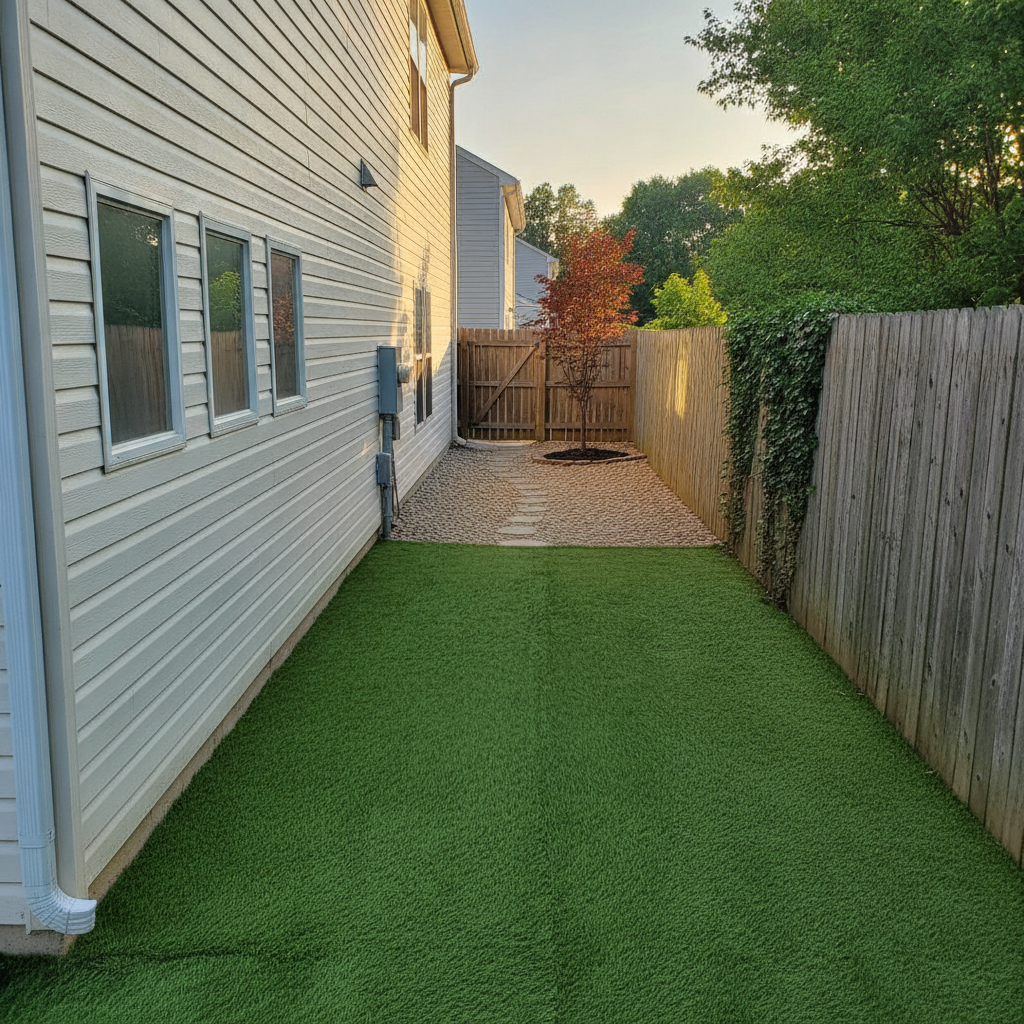
How Do You Install Artificial Turf on a Side Yard or Narrow Walkway in Fairfax, VA? What Homeowners Need to Know About Tight-Space Turf Design
Yes — a side yard or narrow walkway is absolutely worth turfing, and it’s one of the more practical investments a Fairfax, VA homeowner can make. These spaces are almost always problems: too shaded for grass to thrive, too tight for a mower, and too prone to turning into muddy, compacted troughs after every rainstorm. Synthetic grass solves all three of those issues at once. But installing turf in a narrow or confined space isn’t the same as laying it across a wide-open backyard. It requires a different approach to drainage engineering, base compaction, edging, and seam placement — and if any of those steps are done poorly, a 36-inch-wide strip of turf will look worse than the mud it replaced.
Why Side Yards and Narrow Walkways Are Such a Common Problem in Fairfax County
Fairfax County’s older neighborhoods — and that includes communities across Burke, Springfield, and central Fairfax — were built on lot layouts that left narrow corridors between homes as functional afterthoughts. You’ve probably got three to six feet of space between your foundation and the property line, often with a fence on one or both sides. Natural grass can’t survive there. The combination of compacted clay soil, roof overhang shade, limited airflow, and foot traffic from trash bins and HVAC access turns these strips into bare-dirt channels within a season or two.
What makes this worse is that these same corridors act as drainage channels during Fairfax County’s heavy spring rains. Water from downspouts, roof runoff, and neighboring impervious surfaces all flows through the side yard. If your base prep doesn’t account for that, you’re setting up a turf installation that will heave, pool water, or fail at the edges within a few years.
The Drainage Engineering That Makes or Breaks a Narrow Turf Install
This is the section that most competitors and DIY guides skip over — and it’s the most important part of a side yard or walkway turf installation. A narrow space concentrates water flow. Unlike a wide backyard where runoff disperses gradually across a large surface area, a side yard channels water in a linear path. If your base layer doesn’t redirect or absorb that flow, you’ll end up with standing water under the turf, which creates odor, edge lifting, and infill displacement over time.
The right approach depends on what you’re working with:
- Positive slope to the street or a drainage exit: A compacted Class II crushed aggregate base with a 1–2% cross-slope toward the low end handles most situations. The turf’s perforated backing (quality products drain at 30+ inches per hour) handles surface water; the base channels it out.
- Low-lying corridor that traps water: A French drain or perforated pipe running the length of the strip, buried beneath the aggregate base, is often the right call. This isn’t optional in Fairfax County’s clay-heavy soils — it’s essential.
- Downspout discharge in or near the corridor: Downspout extensions should be redirected before turf goes in, not after. Installing turf around an active downspout discharge point without an underground drainage solution is a mistake that leads to base erosion and seam failure.
At Grassify, every side yard installation starts with a site drainage assessment before we ever talk about turf selection. If the drainage problem isn’t solved at the base level, no amount of product quality will save the finished surface.
Base Prep in Confined Spaces: Why Equipment Access Changes Everything
One of the most underappreciated challenges in side yard turf installation is that standard compaction equipment — plate compactors, skid steers, even some walk-behind rollers — may not fit in a space that’s 36 to 48 inches wide with a fence on one side and a foundation on the other. This is where less experienced crews cut corners. If you can’t get proper compaction equipment into the space, the base will settle unevenly after the first few rainstorms, and your turf will develop low spots, edge gaps, and seam separation.
The solution isn’t to skip compaction — it’s to use correctly sized equipment and hand-compact areas that machinery can’t reach. This takes more time and labor, which is why narrow installs often cost more per square foot than open-yard work. If a quote seems surprisingly low for a confined-space project, the base prep is probably where the savings are coming from.
See how Grassify approaches base preparation and site assessment for every residential installation.
Seaming and Edging in Narrow Strips: Where Amateur Installs Fail
In a standard wide-yard installation, seams can often be placed in low-visibility locations and blended with careful nap direction matching. In a three-foot-wide walkway, there’s nowhere to hide a bad seam. Depending on the turf roll width and the length of your corridor, you may need a lengthwise seam running straight down the center of the walkway — which is the most visible seam placement possible.
Proper seam execution in a tight space requires:
- Matching nap direction precisely so both sides of the seam catch light the same way
- Using a seaming tape and adhesive rated for the DMV’s freeze-thaw temperature cycles — bond failure at 10°F in January is a real risk with low-grade materials
- Adequate stapling or nailing into bender board or a solid perimeter edge to prevent seam lifting over time
- A clean factory edge cut on both pieces, not a field cut, wherever possible
Grassify backs all seam and edge work with a lifetime installation warranty. That includes narrow-strip installations where seam placement is unavoidably conspicuous.
HOA Considerations for Side Yard Turf in Fairfax
If you live in an HOA-governed community in Fairfax County — and a significant portion of Fairfax County homeowners do — you’ll want to check your Architectural Review Committee (ARC) guidelines before installation. Some HOAs have specific rules about whether artificial turf is permitted on side yards, what it must look like from the street, and whether it can extend to the front property line. Side yard turf is sometimes subject to scrutiny because it may be partially visible from the street depending on fence height and lot configuration.
Grassify has navigated HOA approvals across dozens of Fairfax County communities. We can help you understand what documentation your ARC typically requires — product spec sheets, drainage plans, pile height and color specifications — and prepare your submission before work begins. That saves you the frustration of installing first and dealing with a compliance letter afterward.
Learn more about Grassify’s work across Fairfax County residential communities.
Product Selection for Narrow Walkways and Side Yards
Not every turf product is right for a side yard application. Here’s what matters most in a confined walkway context:
- Pile height: 30mm–38mm is typically the sweet spot for a walkway. Taller piles (45mm–50mm) look lush in a wide lawn but can feel awkward and compress heavily under foot traffic in a narrow path where every step hits the same line.
- Blade shape and density: A diamond or C-shaped blade holds its upright position under repeated foot traffic better than flat blades, which mat down faster in high-traffic corridors.
- Backing permeability: Look for a drainage rate of at least 30 inches per hour through the backing itself. In a corridor that channels roof runoff and storm water, permeability through the turf face matters as much as what happens at the base level.
- Color: A realistic mid-green blend with varied blade tones reads as natural even in a tight, fenced space. Avoid overly bright or uniform green products — in a narrow space with walls or fencing on both sides, unrealistic color is immediately obvious.
If the side yard also serves as a dog access route — which is common in Northern Virginia townhomes and single-family homes with fenced backyards — you’ll want a turf product with antimicrobial infill and a drainage system designed for pet use. Grassify’s pet-friendly turf installations include a 5-layer drainage system and zeolite deodorizer infill that keeps odor from building up in a confined space where airflow is limited.
What Does a Side Yard or Narrow Walkway Turf Installation Cost?
Narrow-strip installations typically run $15–$22 per square foot installed in the Fairfax area, depending on drainage complexity, access constraints, and the specific product selected. That’s often higher per square foot than a wide-open backyard install at $12–$18 per square foot — because labor costs don’t scale down proportionally with square footage when access is tight and base compaction requires more hand work. A 4-foot-wide by 40-foot-long side yard is 160 square feet, but it may require the same crew time as a 300-square-foot open-yard project due to the access and seaming challenges involved.
The long-term value calculation still works strongly in turf’s favor: no mowing a space too tight to maneuver, no reseeding a strip that refuses to grow grass, and no mud tracked through your side gate every time it rains.
Frequently Asked Questions: Side Yard and Narrow Walkway Turf in Fairfax, VA
Can artificial turf hold up in a side yard where I drag trash bins every week?
Yes — a properly installed turf with a durable diamond or C-blade product and a well-compacted base holds up well under repeated wheeled traffic. Trash bin drag is not a dealbreaker for synthetic grass. Over years, you may see some infill displacement along the heaviest-traffic line, which is corrected with a quick brush and infill top-off during routine maintenance.
My side yard has a downspout emptying into it. Can I still install turf?
Yes, but the downspout drainage needs to be addressed as part of the installation — not ignored. We typically redirect the downspout to a pop-up emitter past the turf zone or install a catch basin connected to an underground drain that exits the turf area. Installing turf over an unaddressed downspout discharge point is a base-failure waiting to happen.
Will my HOA in Fairfax County require approval for a side yard turf project?
It depends on your HOA’s governing documents. Many Fairfax County HOAs require ARC approval for any hardscape or softscape modification visible from common areas or the street. Side yards are sometimes partially visible depending on fence and lot configuration. We recommend submitting for approval before installation regardless — it’s a straightforward process when you have proper documentation.
How long does a side yard turf installation typically take?
For most residential side yards under 300 square feet, installation takes one day once the base prep is complete. If drainage work is needed — French drain, redirected downspout, or catch basin — that may add a half-day to a full day depending on complexity. We give you a realistic timeline in writing before work begins.
What’s the minimum width where artificial turf still makes sense?
We’ve installed turf in corridors as narrow as 24 inches. At that width, it’s essentially a paver-alternative surface and the product needs to be chosen carefully for durability underfoot. The more common sweet spot is 36–60 inches, where you get a surface that reads and functions as a true grass alternative rather than just a mat.
Ready to Fix That Problem Side Yard for Good?
If you’ve been walking past that muddy, bare corridor on the side of your house every day for the last three years, it’s time to do something about it. Grassify serves Fairfax and surrounding communities across Fairfax County, Springfield, Burke, and throughout Northern Virginia. We bring over a decade of DMV-area installation experience to every project — including the tight, awkward spaces that other installers would rather not deal with.
Request your free consultation at grassify.us/contact-us and we’ll come out, assess your side yard, and walk you through the right drainage solution, product options, and a transparent quote. No pressure, no hidden costs, no guesswork.


