
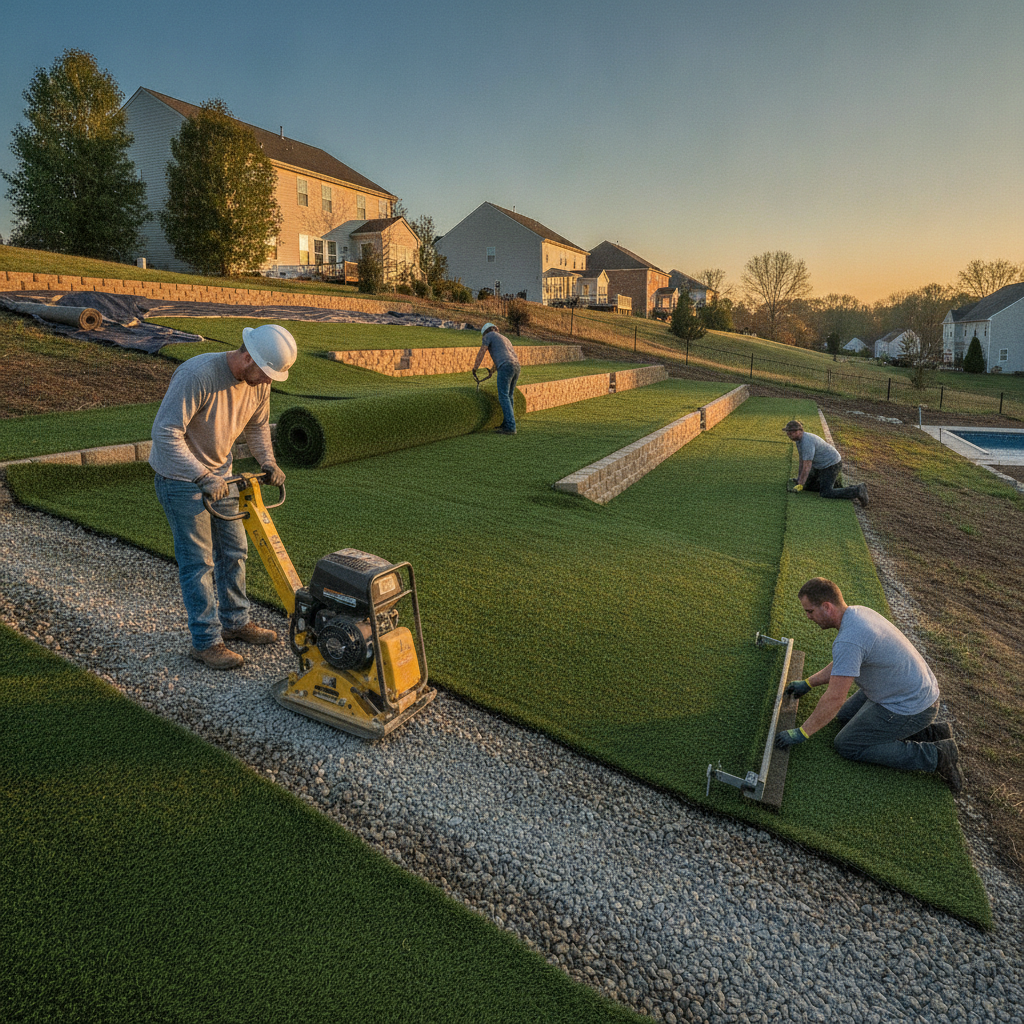
How Do You Install Artificial Turf on a Steep or Sloped Backyard Hill in Loudoun County, VA?
Yes — artificial turf can be installed on a steep or sloped backyard hill in Loudoun County, and when it’s done correctly, it’s one of the most practical and durable solutions available for graded terrain. But the operative phrase is done correctly. A sloped installation is fundamentally different from a flat backyard job. The base engineering, anchoring strategy, drainage planning, and seam placement all have to account for gravity, soil movement, and the freeze-thaw cycles that Northern Virginia winters put every landscape through. If a contractor treats your hillside the same way they’d treat a level lawn, you will have problems — and usually within the first year.
Homeowners across Loudoun County, particularly in communities around Ashburn and Leesburg where newer developments are graded with significant elevation changes, deal with backyard hills that are genuinely difficult to maintain with natural grass. Mowing a 30-degree slope is a safety risk. Watering it means runoff and erosion. Letting it go bare invites real soil loss. Artificial turf, installed with the right engineering underneath, solves all of that — permanently.
Why Slopes Change Everything About Turf Installation
On a flat yard, the base layer — typically 3 to 4 inches of crushed aggregate compacted to a firm, level surface — stays where you put it. Gravity helps you. On a slope, gravity works against you in almost every phase of the job.
Here’s what changes on angled terrain:
- Base material migration: On grades above roughly 15%, crushed aggregate can shift over time if it isn’t properly contained. This shows up as low spots, edge lifting, or rippling in the turf surface.
- Drainage direction: Water has to flow down the slope — but it can’t be allowed to channel underneath the turf, which would undermine the base. Proper drainage engineering redirects water through the base, not along the surface-to-base interface.
- Anchoring requirements: Flat installations rely on perimeter nailing and seam adhesive. On a slope, you need intermediate anchoring — additional nails or staples driven into the base at intervals across the face of the hill, not just along the edges.
- Seam placement: Seams on a hillside must run horizontally (across the slope), never vertically (up and down the grade). A vertical seam is a stress point that will open under the weight and movement of the turf over time.
- Infill behavior: Sand and other infill materials migrate downhill on steep grades unless the turf pile height and density are matched carefully to the angle of installation.
None of this is impossible to manage. It just requires a crew that actually understands slope-specific installation, not one that learned on flat suburban lawns and is figuring out the hill as they go.
What Proper Base Prep Looks Like on a Sloped Yard in Loudoun County
Start with this: the base is the job. The turf on top is almost secondary. If the base fails on a slope, the turf fails — there’s no way around it.
For a hillside installation, we typically follow this sequence:
- Excavation and vegetation removal: Strip the existing grass, weeds, and topsoil to a depth of 3 to 4 inches. On steeper grades, this sometimes means hand work because equipment can’t safely operate on the angle.
- Weed barrier fabric: A commercial-grade geotextile fabric goes down before aggregate. This is non-negotiable on a slope — without it, soil migrates up into the base layer over time.
- Crushed aggregate base: We use 3/4-inch crushed stone or decomposed granite, compacted in lifts. On slopes, compaction has to be done more carefully and in thinner lifts — typically 1.5 to 2 inches at a time — to avoid differential settling later.
- Bender board or steel edging at grade breaks: Wherever the slope transitions to a flat area — at the top of the hill, at the bottom, or at any retaining feature — a physical edge restraint goes in to prevent base migration across that transition.
- Drainage channel planning: On steep grades, we often install a perforated drain at the base of the slope to capture water that moves through the aggregate layer. This is especially important in Loudoun County, where spring rain events can be significant and soil saturation is a real issue.
This level of base prep is not what a general landscaping crew or a low-bid national franchise installer typically delivers. It takes more time, more material, and more expertise — and it’s the difference between a hillside installation that holds for 15 years and one that starts failing after the second winter.
Anchoring Systems: What Keeps the Turf From Sliding or Lifting
This is the section that most turf installers — including several operating in the Northern Virginia market — either skip or underexplain. On a flat lawn, perimeter nailing every 4 to 6 inches along the edge is usually sufficient. On a slope, that’s not enough.
For grades between 15% and 30%, we add intermediate field nailing — 6-inch landscape spikes driven through the turf backing and into the compacted base at 12 to 18-inch intervals across the face of the slope, not just the edges. On grades steeper than 30%, we use a combination of field nailing and seam tape reinforcement with construction-grade adhesive to lock the backing to the base layer. In extreme cases, we anchor to the top of the slope with a treated lumber header board that holds the top edge of the turf under tension.
Seam adhesive on a hillside also gets more attention than on flat work. We use two-sided seam tape combined with polyurethane adhesive rated for outdoor use, and we weight seams for 30 to 45 minutes while the bond sets. A seam that opens on a hillside doesn’t just look bad — it becomes a water infiltration point and a tripping hazard.
The Freeze-Thaw Problem Specific to Northern Virginia Installations
Loudoun County and the broader Fairfax County corridor don’t get the sustained deep freezes that parts of the Midwest or New England deal with, but the freeze-thaw cycle here is actually harder on base materials in some ways. We get repeated short cycles — freeze at night, thaw by afternoon — through December, January, and February. Each cycle causes the soil underneath the base to expand and contract slightly.
On a flat yard, this is manageable with proper base depth and compaction. On a slope, those expansion-contraction cycles create a slight heaving pressure that acts perpendicular to the face of the hill. Over time, on a poorly built base, this pushes the base material — and the turf above it — downhill, millimeter by millimeter, until you have visible distortion.
The solution is base depth and compaction quality, not just aggregate volume. A base that’s compacted to 95% Proctor density holds through freeze-thaw cycles. A base that’s just dumped and lightly tamped does not. This is a technical distinction that matters a great deal on a Loudoun County hillside, and it’s the kind of detail you should ask any contractor about directly before you sign anything.
For more on how we approach residential lawn turf installations across Northern Virginia, including base prep standards and drainage engineering, that page has detailed information on what our process looks like.
Erosion Control: The Real Reason Most Homeowners Consider Turf on a Slope
Let’s be direct about this: for many Loudoun County homeowners, the initial reason they’re looking at artificial turf on a hillside is that the natural grass has failed. Bare patches, ruts, mud tracking onto the patio, soil washing into the drainage swale — these are the things that actually drive the call.
Artificial turf, properly installed, eliminates all of that. The turf backing acts as a physical erosion barrier. The base layer stabilizes the soil beneath. The drainage system manages water volume without channeling. And unlike natural grass — which requires regular overseeding, fertilizing, and watering just to survive on a shaded or eroded slope — artificial turf requires almost no ongoing maintenance once it’s in.
What it does require is that the installation was done correctly in the first place. A turf installation that fails on a slope is in some ways worse than bare soil, because you have to remove the failed turf and redo the base before you can start over. The cost of doing it twice is always higher than the cost of doing it right once.
What to Ask Before Hiring a Contractor for a Sloped Turf Job
When you’re getting quotes for a hillside turf installation in Loudoun County or anywhere in the DMV area, ask these specific questions:
- How do you anchor the turf field — not just the perimeter — on a slope?
- What is your base compaction standard, and how do you verify it?
- How do you orient seams on a grade?
- What drainage provisions are you making at the base of the slope?
- Have you done hillside installations in this county, and can I see photos or talk to a past customer?
- What does your warranty cover on sloped installations specifically?
If a contractor can’t answer those questions in detail, that’s your answer about whether they’re the right fit for a sloped job. Grassify offers a lifetime installation warranty covering seams, edges, and base integrity — including on sloped installations — because we build the base to hold. Our installation guide outlines the full process in detail if you want to understand what a proper installation actually involves before you meet with anyone.
Cost Range for Hillside Turf Installations
Sloped installations cost more than flat ones — typically in the range of $16 to $25 per square foot depending on the steepness of the grade, access constraints, drainage requirements, and the turf product selected. That’s a wider range than a standard residential lawn installation because the variables on a slope are more significant. A gently graded hillside with good access is very different from a 40-degree embankment with no equipment access and poor drainage history.
What we can tell you is that the cost of a correctly built sloped installation, even at the higher end of that range, is almost always less than the cost of ongoing natural grass maintenance on a problem slope over a 10-year period — especially when you factor in erosion remediation, overseeding, fertilizing, and irrigation.
Frequently Asked Questions
Can artificial turf really hold on a very steep slope, or will it slide?
Yes, it can hold on steep grades when the anchoring system is properly engineered. Intermediate field nailing, construction-grade seam adhesive, and a correctly compacted base are what prevent movement. Grades above 45 degrees require additional engineering discussion, but most residential hillsides fall well within the range where turf is a stable, long-term solution.
Will water pool at the bottom of a turfed hillside after heavy rain?
Not if the drainage is planned correctly. A perforated drain at the base of the slope, combined with a permeable aggregate base layer, channels water away before it accumulates. Loudoun County’s heavy spring rain events are exactly why this drainage planning matters — it’s not optional on a hillside installation.
Does the turf get hot on a south-facing slope in summer?
South-facing slopes in full sun can get warm, yes. We recommend UV-stabilized turf products with heat-resistant fiber technology for exposed hillside installations. Infill selection also matters — certain infill materials retain heat more than others, and we match the infill to the application and sun exposure.
Do HOA rules in Loudoun County apply to hillside turf installations?
Many HOA-governed communities in Loudoun County — including several in Ashburn — have architectural review requirements that apply to any exterior modification, including turf. If your property is in an HOA, you’ll need approval before installation. We’ve navigated this process many times across Northern Virginia and can help you understand what documentation your HOA is likely to require.
How long does a hillside turf installation typically take?
For a typical residential hillside — say 500 to 1,500 square feet — plan for two to three days of installation time, depending on the complexity of the slope and access conditions. Base prep on a steep grade takes longer than on a flat yard, and we don’t rush the compaction phase regardless of schedule pressure.
Ready to Stop Fighting Your Hillside? Let’s Talk.
If you’ve got a backyard slope in Loudoun County, Ashburn, Leesburg, or anywhere else across Northern Virginia that’s been a maintenance headache, Grassify is the team that knows how to handle it properly. We’ve been building turf installations in the DMV area for over a decade, and sloped yards are a specialty, not an afterthought. Our crews are licensed, insured, and background-checked, and every installation comes with a lifetime warranty on seams, edges, and base integrity.
Request a free consultation and we’ll come take a look at your slope, give you an honest assessment of what it needs, and walk you through options that fit your property and your budget. No pressure, no upsell — just straight answers from people who know this terrain.


