
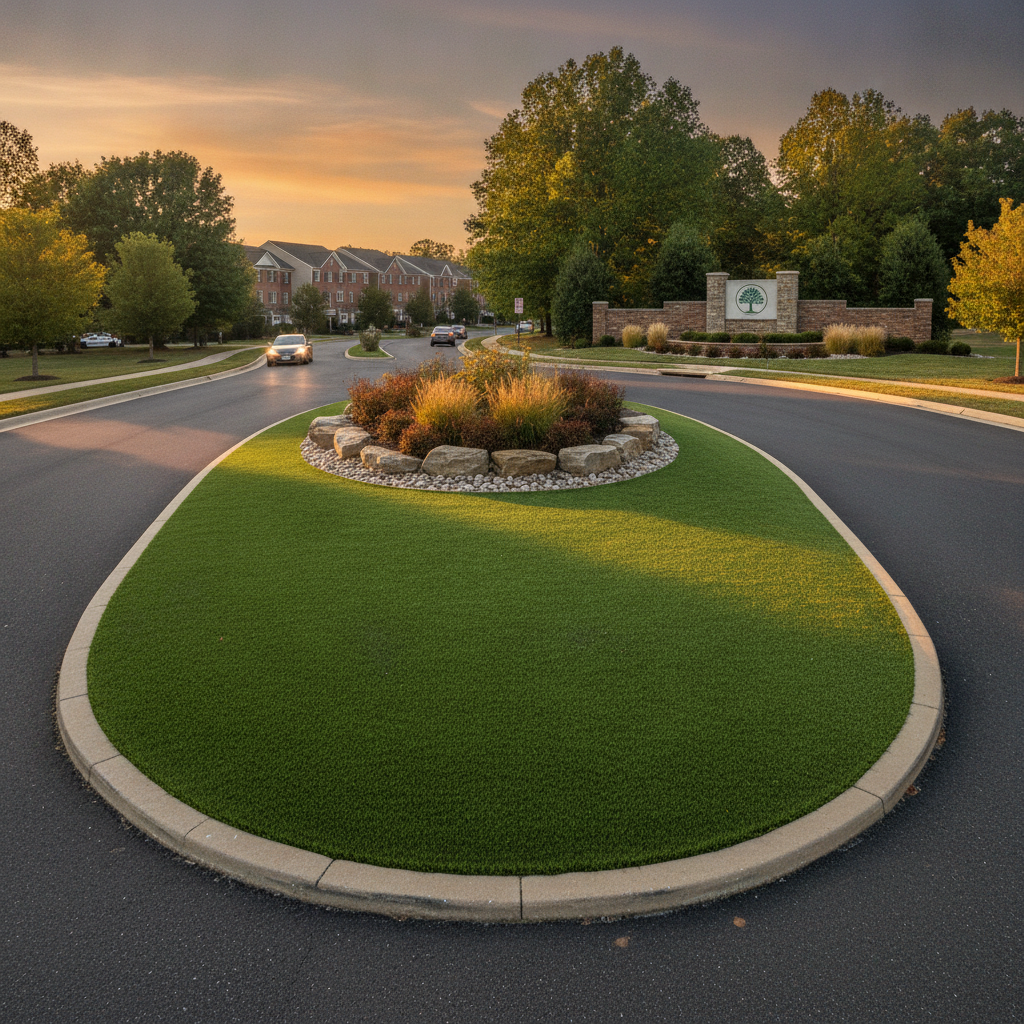
How Do You Install Artificial Turf on a Median Strip, Traffic Island, or HOA Common Area Entrance in Fairfax County, VA? What Community Managers and Homeowners Need to Know
If you manage a community association in Fairfax County — or you sit on an HOA board in Burke, Springfield, or Fairfax — you already know that entrance medians, traffic islands, and common-area landscape strips are some of the most thankless real estate on your maintenance budget. Natural grass in these spaces gets compacted by foot traffic and equipment, struggles with salt runoff from winter road treatments, and bakes out in the heat of a Northern Virginia summer. Mowing a 4-foot-wide median strip alongside moving traffic is genuinely dangerous for a crew. And yet this is often the first thing visitors and residents see when they enter the community. Artificial turf is an increasingly practical and durable answer — but the installation requirements for these spaces are meaningfully different from a backyard lawn. Here’s what you need to know before you sign anything.
Why Medians and Common-Area Entrances Are Harder Than a Backyard
When a homeowner installs turf in their backyard in Burke or Burke Centre, the main challenges are base prep, drainage engineering, and HOA approval. Those same factors apply here — but common-area and roadside installations add several layers of complexity that most general landscapers aren’t equipped to handle.
First, there’s the soil condition. Median strips and traffic islands in established Fairfax County communities are often underlaid with highly compacted subgrade — decades of construction traffic, irrigation work, and heavy mowing equipment have compressed the native soil. Standard turf base prep won’t cut it. You need a full excavation to a depth of at least 3 to 4 inches, removal of that compacted material, installation of a permeable geotextile weed barrier, and then a properly graded crushed aggregate base — typically a 3/4-inch crushed stone blend — before any turf goes down.
Second, drainage in roadside settings is non-negotiable. Fairfax County gets an average of roughly 42 inches of rainfall per year, and spring months can deliver multi-inch storms in a single afternoon. A curbside median that doesn’t drain fast enough will pool water, saturate the base, and heave or shift over a freeze-thaw winter cycle. The turf system needs to drain at a minimum of 30 inches per hour — and ideally 50 or more for narrow strips with limited runoff paths. At Grassify, we engineer the base slope to direct water toward existing curb drains and storm infrastructure rather than fighting it.
What Product Is Right for a High-Visibility Entrance or Median?
These are not places to cut corners on the turf itself. A community entrance is a 365-day-a-year marketing piece for your HOA. The turf needs to look genuinely good — dense, upright pile, natural color variation — and it needs to hold up to UV exposure, vehicle exhaust residue, and foot traffic from residents cutting across on their way to the mailbox.
For common-area lawn applications like these, we typically recommend a UV-stabilized product with a pile height in the 35mm–45mm range and a face weight of at least 60 ounces per square yard. You want a thatch layer that creates natural color depth, and you want the backing to be perforated for drainage rather than solid — solid-back turf has no place in a drainage-sensitive roadside setting. Grassify’s Lush Life product is purpose-built for exactly this kind of high-visibility lawn application, with the fiber density and UV resistance to stay sharp year after year in the DMV’s demanding climate.
HOA Approval and Fairfax County Permit Considerations
This is where community association projects get more procedurally complex than residential backyard jobs. If your HOA is both the installing party and the approving authority — meaning the board is authorizing work on common grounds it manages directly — you’re essentially approving your own project. But you still need to document that decision properly in your board minutes, and you should consult your governing documents to confirm the board has explicit authority to modify common-area landscaping materials.
Some communities in Fairfax County and neighboring Springfield are also located within jurisdictions that have specific requirements for commercial landscape changes along roadways. If your entrance median abuts a Fairfax County or VDOT right-of-way, any work within that right-of-way typically requires a land disturbance permit or an encroachment agreement with the relevant agency. Grassify’s installation team has navigated these requirements across communities throughout Fairfax County — we can tell you upfront whether your project is likely to trigger a permitting step and what documentation you’ll need.
What Installation Actually Looks Like in a Tight Common-Area Space
Narrow median strips and traffic islands often have restricted equipment access — there’s no room for a full skid steer, and working alongside active vehicle traffic requires a different site setup than a residential backyard in Burke Centre or Rolling Valley. Our crews work in staged sections on these projects, completing base prep and turf installation in manageable segments that keep the entrance functional for residents throughout the job.
Seaming quality is especially critical on median projects. Because these strips are long and narrow, there are often multiple seam lines running the length of the turf. Poor seaming — from an inexperienced crew or an out-of-state franchise installer who doesn’t know DMV soil conditions — will show within one or two freeze-thaw cycles. Grassify backs all seams, edges, and base installations with a lifetime warranty precisely because we stand behind the technical work, not just the product.
For large common-area installations, the typical cost range runs $14–$22 per square foot depending on the complexity of the base prep, the accessibility of the site, and the turf product selected. That’s a real number — not a low-ball estimate designed to win a bid and balloon during the job. Learn more about how Grassify serves communities across Fairfax County.
The Long-Term ROI Argument for HOA Boards
Community associations typically spend a significant portion of their annual landscaping budget on mowing, irrigation, overseeding, and re-sodding common-area turf — including those entrance medians that never quite look the way they did in the community’s original developer photos. Synthetic grass eliminates mowing costs entirely for those zones, cuts irrigation water use in those specific areas to near zero, and removes the recurring expense of seasonal re-treatment.
Fairfax County’s water utility rates have increased steadily over the past decade, and HOA boards are increasingly looking at turf as a capital improvement with a measurable payback period — often 5 to 7 years when you account for eliminated maintenance contracts and water bills. Done right, with a quality product and proper base engineering, a well-installed turf entrance can look better at year eight than a natural grass median looked at year two.
Frequently Asked Questions
Does Fairfax County have any restrictions on artificial turf in common areas or medians?
Fairfax County does not have a blanket prohibition on artificial turf in common areas. However, work within or adjacent to a VDOT or county right-of-way may require an encroachment permit or land disturbance authorization. Your installer should identify the applicable easements before work begins. Grassify handles this assessment as part of the pre-installation process.
How do you anchor turf on a narrow median that has curbing on both sides?
Curbed medians are actually easier to anchor than open-edge installations. We secure the turf perimeter using galvanized nails or staples driven into the aggregate base along the curb edge, then apply a bead of turf seam adhesive along the full border. The aggregate base provides solid purchase for mechanical fasteners, and the curb itself acts as a natural edge restraint. The result is a clean, finished border that won’t lift or curl.
Can turf hold up to road salt and winter runoff in Northern Virginia?
Yes, with the right product. UV-stabilized synthetic fibers are chemically inert and won’t degrade from road salt exposure the way natural grass does. The aggregate base, however, needs to be sized appropriately — fine-grained materials can be displaced over time by salt-laden runoff. We use a coarser crushed stone blend on roadside projects for exactly this reason. After a snow event, you can sweep salt residue off the turf surface without any harm to the fibers.
How long does a common-area turf installation take for an HOA entrance?
A single entrance median or traffic island — typically 200 to 600 square feet — can usually be completed in one to two days once the board has approved the project and materials are on site. Larger community entrance landscapes with multiple planting beds, curbed islands, and signage areas may run three to five days. We schedule around resident traffic and can stage the work to avoid blocking the main entrance lane during peak morning and evening hours.
Does the turf need to match what’s already in the community if some residents have private lawn turf?
Not necessarily — but it’s a reasonable visual consideration. Common-area and private residential turf don’t need to be identical products, but selecting a pile height and color tone that reads consistently from the street creates a more cohesive look. When we’re working with an HOA that has already approved turf for individual homeowners, we’ll review the existing installation and recommend a common-area product that complements rather than clashes. Contact Grassify and we can walk through your options during a free on-site consultation.
Ready to Stop Maintaining That Median and Start Enjoying It?
If your community association in Fairfax County, Burke, Springfield, or anywhere across the Northern Virginia suburbs is spending real money every year on a strip of grass that never looks quite right, it’s worth having a real conversation about synthetic turf. Grassify serves HOA communities, property managers, and community associations throughout the DMV — and we know the local soil conditions, permitting landscape, and HOA approval process because we’ve worked through it dozens of times right here. Reach out to schedule a free consultation and site assessment, and we’ll bring you a detailed proposal that reflects exactly what your entrance actually needs — not a generic quote built on square footage alone.


