
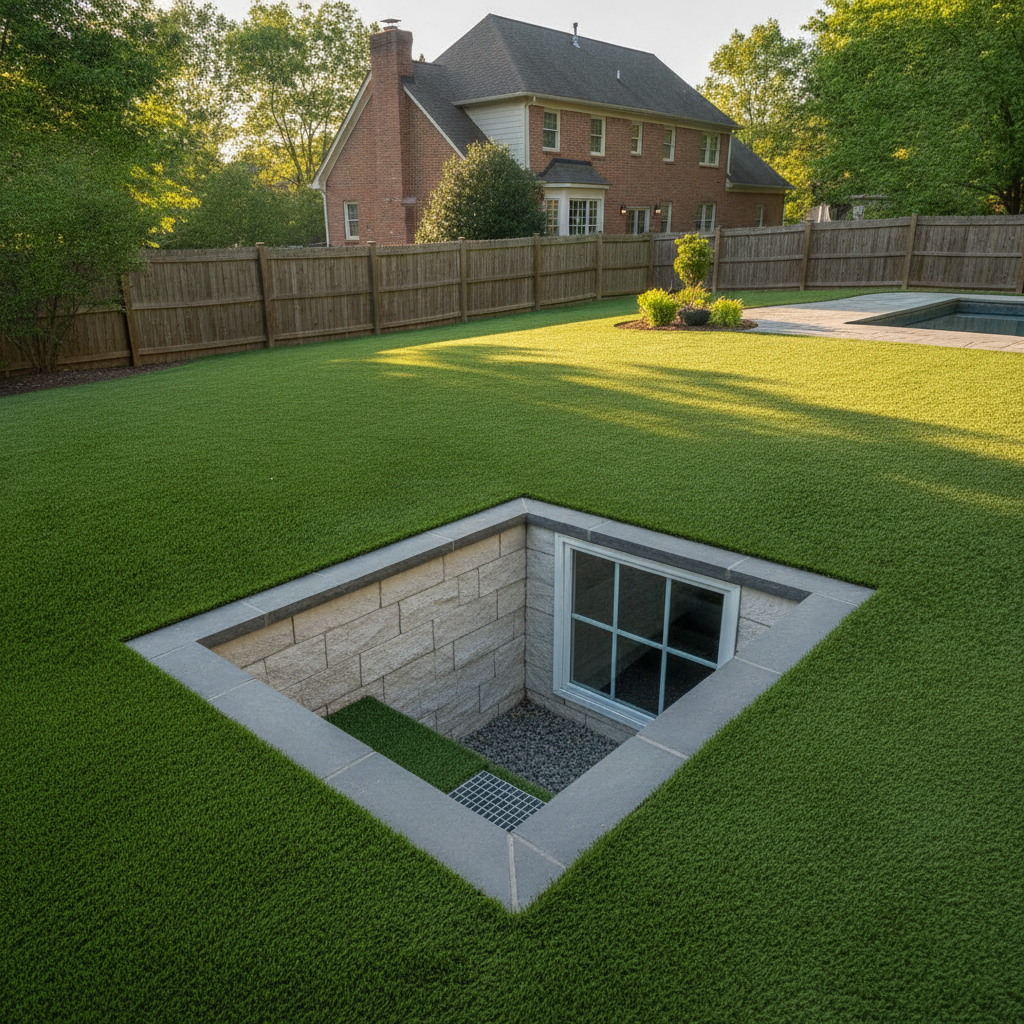
How Do You Install Artificial Turf on a Basement Egress Window Well in Burke, VA? What Homeowners Need to Know About Drainage, Safety, and Finishing
Yes, you can absolutely install artificial turf inside an egress window well — and in Burke, VA, it’s a smarter upgrade than most homeowners realize. That semi-circular or rectangular cutout below grade outside your basement window is one of the most problematic spots on a Northern Virginia property: it traps debris, holds standing water after heavy spring rains, grows algae in the summer humidity, and looks neglected year-round. A properly installed synthetic turf panel solves all of that at once. But the installation has to be done right, because a window well is not just a cosmetic surface. It’s a drainage point, a potential escape route in an emergency, and in many Fairfax County HOA communities, a visible exterior feature subject to architectural review.
Why Egress Window Wells Are a Drainage Problem in Northern Virginia
Burke and the surrounding Fairfax County suburbs see some of the heaviest seasonal rainfall on the East Coast. The region averages around 40–44 inches of rain per year, with the worst of it front-loaded into spring. An egress window well sits below the surrounding grade, which means it’s essentially a collection basin. Without proper drainage infrastructure underneath, water pools, soil erodes, and the well becomes a breeding ground for mold and mosquitoes — neither of which you want next to a basement window.
When homeowners try to fix this with simple gravel and a drain cover, they sometimes get partial relief. But a correctly installed turf system does more: it provides a finished surface over a properly graded aggregate base that channels water away from the foundation rather than letting it sit. The key phrase there is properly graded. A turf panel dropped onto flat ground inside a window well doesn’t drain — it just hides the problem. The base beneath the turf needs to slope toward the existing well drain or a newly installed French drain depending on the well’s existing infrastructure.
What the Installation Process Actually Looks Like
Egress window well turf installations follow the same fundamental steps as any ground-level turf job, but compressed into a tighter, more precise footprint. Here’s what a professional installation covers:
- Site assessment and measurement: Window wells vary in size, shape, and depth. Some are prefabricated galvanized steel half-rounds; others are poured concrete or brick-lined wells with flat floors. Measurements are taken to the quarter-inch, because a turf panel that’s even slightly oversized will buckle and trap moisture at the edges.
- Existing drain inspection: Most code-compliant egress wells in Fairfax County are required to have a drain at the base. We confirm it’s clear and functional before any work begins. A clogged drain under a turf panel is a foundation risk you can’t see until it’s already caused damage.
- Base layer preparation: Any organic material, old gravel, or degraded soil is removed. A compacted aggregate base — typically crushed angular gravel in the 3/8-inch range — is laid and graded to maintain a 1–2% slope toward the drain. This is what actually manages water; the turf just finishes the surface.
- Turf panel cutting and fitting: The panel is cut to fit the floor of the well and, in many cases, up the curved or straight walls partway to create a clean, finished look. Turf is secured with galvanized nails or adhesive depending on the wall surface material.
- Edge finishing: Exposed edges are secured and trimmed so there’s no lip, curl, or gap where debris can accumulate. This is where budget installs and DIY jobs usually fall apart — an unsecured edge in a window well gets pushed up by freeze-thaw cycles and needs to be reset every spring.
For window wells adjacent to pet areas or in homes with dogs, we can also layer in a zeolite deodorizer infill to handle any moisture-related odor — the same antimicrobial infill used in our pet-friendly turf installations.
Egress Safety: Turf Cannot Interfere With Emergency Exit
This is non-negotiable. Under Virginia’s residential building code — which references the International Residential Code — egress windows must maintain a minimum clear opening and must be operable from the inside without special tools or knowledge. The window well itself must allow a person to climb out in an emergency, which typically means the well must be large enough to stand in and the climbing surface cannot be a hazard.
A turf panel installed on the floor of the well does not block egress. What can create issues is turf that is too thick, buckles significantly, or has exposed seaming hardware that could cause a fall. For window wells deeper than 44 inches — Fairfax County code requires a ladder or steps in those cases — turf should not be applied to the ladder rungs or in a way that makes them less stable. A properly spec’d, professionally installed panel sits flush, stays flat, and provides better footing than bare concrete or slippery algae-coated gravel. Done right, it actually improves safety in a wet-weather scenario.
HOA Considerations for Window Well Turf in Burke and Springfield
Many of Burke’s established neighborhoods — including communities in Burke Centre, Rolling Valley, and Signal Hill — are HOA-governed. If your window well faces the street or a shared common space, it may technically fall under architectural review. In practice, most HOA architectural committees don’t have a specific policy on window well surfaces because it’s such a niche area, but that doesn’t mean approval isn’t needed.
Our standard recommendation: submit a brief description and a photo rendering to your HOA before installation. Keep it simple — describe it as “replacement of deteriorated gravel surface with synthetic turf panel for drainage improvement and safety.” Most boards approve it on the first pass. If your HOA is in Springfield or the broader Fairfax County area and has a stricter review process, we can help you assemble the documentation. It’s a lot easier to get a window well panel approved than a full backyard conversion.
For a broader look at what goes into residential turf work in this area, the residential lawn turf page covers how we approach base prep and product selection across different yard types and HOA communities throughout Northern Virginia.
Product Selection for a Window Well Environment
Not every turf product is appropriate for a below-grade, partially shaded, moisture-exposed environment. You want a UV-stabilized fiber that won’t degrade in indirect sun, a backing that resists mold and mildew, and a pile height short enough to stay flat without infill in a confined space. For most window wells, a 30–35mm pile height with a perforated drainage backing performs well. Heavier-pile products designed for open lawns tend to hold their shape less reliably in the constrained conditions of a window well, particularly after the freeze-thaw cycles we see in Northern Virginia winters.
Cost for a window well turf panel installation typically runs in the range of $200–$600 depending on well size, wall type, drain conditions, and any required base work. That’s a one-time cost versus annual cleaning, gravel replacement, and drain clearing that an unfinished well demands every year.
Frequently Asked Questions: Egress Window Well Turf in Burke, VA
Will turf in a window well make the basement feel darker?
No — a green turf surface actually reflects more natural light than dark gravel or bare dirt. Many homeowners in Burke and Fairfax report that the finished look brightens the view from the basement window rather than dimming it.
What happens to the turf during a heavy rainstorm?
When the base is properly graded and the existing well drain is clear, water passes through the turf’s perforated backing and drains normally. The turf itself sheds water quickly and dries within hours. Standing water is a base prep issue, not a turf issue.
Can I install this myself?
The turf panel itself is straightforward, but getting the base graded correctly and the edges secured against freeze-thaw movement is where DIY installs typically fail. A panel that lifts at the edges in January becomes a trip hazard and a water trap — the opposite of what you’re trying to achieve.
Does Virginia code require anything specific about egress window wells?
Virginia follows the International Residential Code, which requires egress window wells to have a minimum clear area and, for wells deeper than 44 inches, a permanently affixed ladder or steps. Turf on the floor of the well doesn’t affect these requirements, but any modification that restricts egress clearance would. A licensed installer will verify compliance before finishing the job.
How long does the turf last in a window well?
With proper base prep and UV-stabilized fibers, you can expect 15–20 years of service life. Because window wells see less foot traffic and direct sun than open lawn areas, the product often lasts toward the upper end of that range. Grassify backs all installations with a lifetime warranty on seams, edges, and base integrity.
Ready to Fix That Window Well for Good?
If you’ve been putting up with a waterlogged, debris-filled egress window well on your Burke or Fairfax County home, synthetic turf is a clean, durable, low-maintenance fix that lasts decades. Grassify’s crew handles everything from drain assessment to final edge finishing, and we’ll get it done right the first time. Request your free consultation today and we’ll come take a look, measure the well, and give you a straight answer on what it takes to get it done.


