
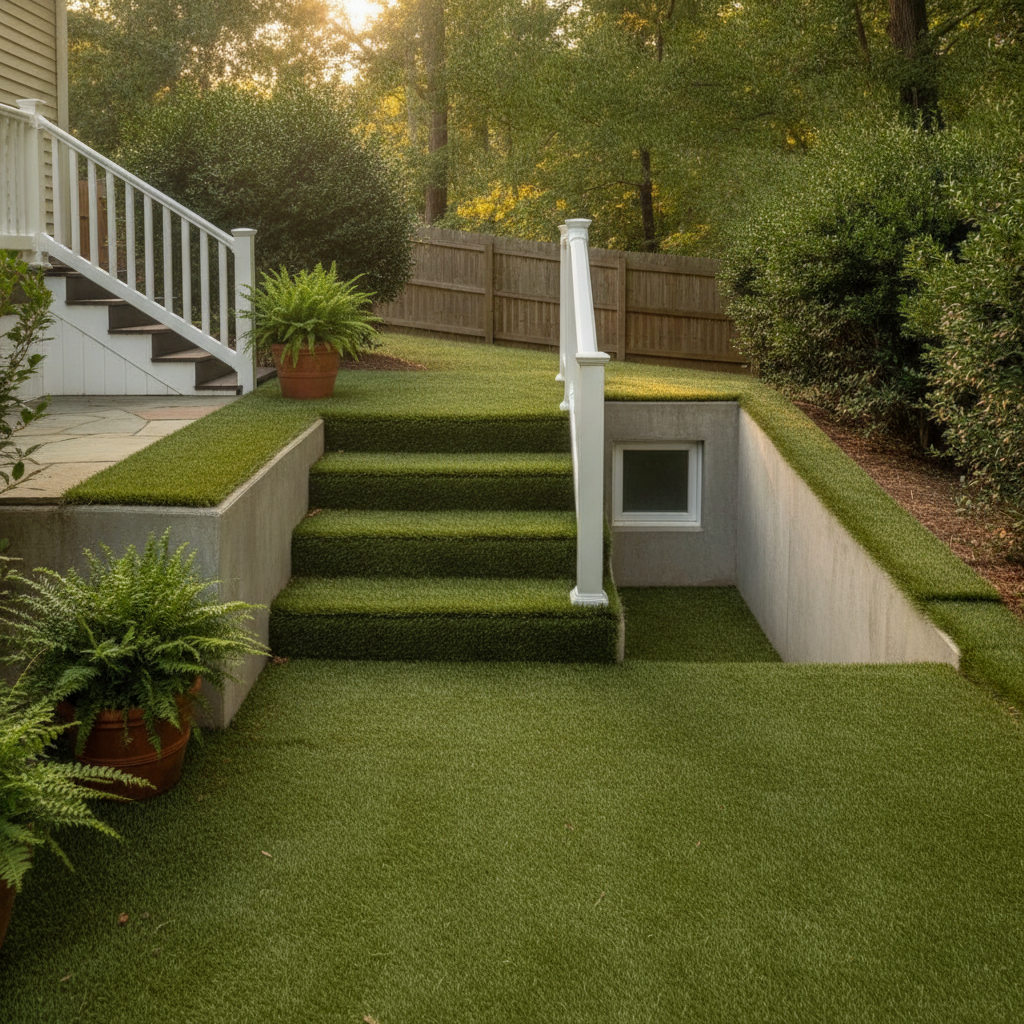
How Do You Install Artificial Turf on a Steep or Narrow Staircase Landing or Basement Egress Area in Burke, VA? What Homeowners Need to Know
Yes — artificial turf absolutely works on staircase landings, basement egress zones, and below-grade entry areas, and in Burke, VA, it’s one of the most practical upgrades a homeowner can make to those perennially neglected corners of the property. Whether you’re dealing with a concrete landing that’s cracking and staining, a bare-dirt egress pit that turns to mud every spring, or a narrow transition zone between your patio stairs and backyard that never seems to grow real grass, synthetic turf solves all three problems in a single installation. The key is understanding that these aren’t the same as a flat open lawn — drainage engineering, edge anchoring, slip resistance, and sub-surface stability have to be handled precisely, or you’ll be pulling it all back up within a season.
Why Staircase Landings and Egress Areas Are Harder Than They Look
Most homeowners assume a small surface means a simple job. That’s usually where the problems start. Staircase landings — especially those below-grade egress wells common in Fairfax County split-levels and walk-out basements — sit in areas with limited sunlight, high moisture concentration, and constrained airflow. Natural grass doesn’t survive there. Bare concrete chips, stains, and becomes dangerously slippery with algae and moss. And pea gravel, while functional, is uncomfortable underfoot and tends to migrate into the egress pit over time.
Artificial turf solves the aesthetic and functional problem, but only when it’s installed with these site conditions in mind. A landing that collects runoff from both the stairs above and the adjacent wall doesn’t just need a pretty surface — it needs an engineered drainage path that can move water out before it pools, freezes, or migrates under the backing.
What Base Prep Actually Looks Like for These Spaces
For staircase landings and egress areas in Burke and the broader Northern Virginia suburbs, here’s how a proper installation is built from the ground up:
- Excavation and slope grading: Even a surface that looks flat rarely is — and that’s usually why water pools there in the first place. The sub-base is graded to direct water away from the foundation wall, typically toward a French drain outlet or existing drainage channel.
- Crushed aggregate compacted base: A minimum 4-inch layer of compacted Class II road base aggregate is standard. In egress areas where frost heave is a concern — and Fairfax County’s freeze-thaw cycles absolutely qualify — going to 5 or 6 inches is worth the added investment to prevent surface lift and seam separation over winter.
- Weed barrier fabric: Laid over the compacted base before the turf goes down. This is especially important in partially shaded egress zones where organic matter collects.
- Leveling layer: A thin decomposed granite or coarse sand layer is screeded flat to provide a stable, smooth surface for the turf backing to bond to.
- Turf installation with perimeter anchoring: On landings with adjacent walls, curbs, or stair risers, the turf is secured with galvanized nails, adhesive banding, or a combination of both. No exposed edges — every border is finished clean against the adjacent surface.
This isn’t a job for a general landscaper working off a standard lawn quote. The drainage path design alone requires someone who understands how water moves through a confined sub-grade space — particularly in a region where spring rain events can drop two inches in a few hours.
Choosing the Right Turf for a High-Contact, Confined Surface
Pile height matters here. On a staircase landing, you want something in the 30mm–35mm range — dense enough to feel soft underfoot, but not so tall that it creates a tripping hazard at step edges or compresses unevenly under repeated foot traffic. A shorter, denser pile also drains more efficiently in a confined zone where you can’t rely on wide-area lateral drainage the way you can on an open backyard lawn.
Slip resistance is non-negotiable. Quality turf products designed for walkable surfaces have a textured, closed-loop backing that grips even when wet. If someone is stepping off a stair directly onto the turf surface — especially in the rain — the backing texture and infill combination need to be spec’d for that use case. This is one reason why residential lawn turf products and specialty surface products aren’t always interchangeable. For confined walkable surfaces, ask specifically about slip-resistance ratings on both the pile and backing before anything is ordered.
You can explore the full range of residential turf options at Grassify to get a sense of pile heights, densities, and backing specs before your consultation.
HOA Considerations for Egress and Entry Area Turf in Burke
If your home is in a Burke Centre, Rolling Valley, Cherry Run, or Signal Hill community — or really any HOA-governed neighborhood in Fairfax County — you’ll want to confirm your architectural guidelines before installation begins. Most HOAs in Northern Virginia focus their turf restrictions on front yard visibility, but egress zones and stair landings near the front or side of a property may still fall within review scope depending on how your CC&Rs define exterior alterations.
The good news: below-grade egress areas are often categorized differently than front lawns and are less likely to generate community pushback, since they’re not prominently visible from the street. That said, don’t skip the approval step. Getting a variance denied after installation is far more painful than a two-week review process upfront. Grassify can help you document the installation scope in a way that’s easy to present to an architectural review committee.
What It Costs and How Long It Takes
For most staircase landings and egress zones in the Burke and Springfield area, you’re looking at a surface area of anywhere from 20 to 80 square feet — small by comparison to a full backyard project, but the per-square-foot cost can run higher because of the precision base work, tight-access installation logistics, and custom edge finishing involved. Generally speaking, specialty surfaces like these fall in the upper range of the typical $12–$25 per square foot window for residential turf, with final cost depending on drainage complexity, sub-base depth required, and whether custom cutting around stair risers or wall angles is involved.
Installation typically takes one day for most egress-sized surfaces once materials are on site. Base prep may require a separate day if significant excavation or drainage work is involved.
Frequently Asked Questions
Can artificial turf be installed directly over an existing concrete landing?
Sometimes, yes — but only if the concrete is structurally sound, properly sloped for drainage, and free of major cracks or heaving. If the concrete is in poor condition, it often makes more sense to remove it, re-grade the sub-base, and start fresh. Installing turf over a deteriorating concrete surface just delays the problem and can compromise the flatness and longevity of the turf system above it.
Will the turf get slippery when it rains?
Not when it’s spec’d correctly. Quality turf products designed for walkable surfaces have drainage rates that exceed 400 inches per hour through the backing, meaning standing water dissipates almost immediately. The fiber texture and infill also provide grip comparable to a low-pile outdoor rug — significantly better traction than bare concrete or exposed wood when wet.
How does the turf hold up through Fairfax County winters?
The turf itself handles freeze-thaw cycles well — UV-stabilized synthetic fibers don’t crack or shrink with temperature swings. The base prep is what matters for winter performance. A properly compacted aggregate base in a confined egress zone won’t heave or shift the way a poorly prepared base will. That’s why Grassify uses a minimum 4-inch compacted sub-base on these surfaces, with deeper prep for areas that show signs of poor natural drainage.
Is this something I can DIY with turf rolls from a home improvement store?
You can lay turf on a landing yourself, but the drainage engineering, sub-base grading, and edge anchoring are where most DIY installs fail in this application. An egress zone that traps water under the backing will develop odor, buckling, and mold issues within a year. The surface looks simple, but the sub-surface work is where the investment actually lives.
Do I need a permit to install turf on a landing or egress area in Burke?
For surface-only turf installations on existing landings, Fairfax County generally does not require a building permit. However, if the project involves re-grading, adding drainage infrastructure connected to a storm system, or structural modifications to the egress well, you’ll want to check with Fairfax County’s Department of Land Development Services to confirm what applies to your specific site. Grassify can walk you through that process during your consultation.
Ready to Fix That Problem Surface for Good?
If you’ve been looking at a cracked concrete landing, a mud-collecting egress pit, or a bare stair transition zone every time you walk outside, the solution is simpler than you think — and it lasts. Grassify installs precision-engineered turf systems across Burke, Springfield, Alexandria, Fairfax, and throughout Northern Virginia, including tight-access and confined-surface applications exactly like these. Every installation comes with a lifetime warranty on seams, edges, and base prep.
Reach out to schedule your free on-site consultation at grassify.us/contact-us. We’ll come out, assess the drainage situation, measure the space, and give you a clear plan — no vague estimates, no upselling you on square footage you don’t need.


