
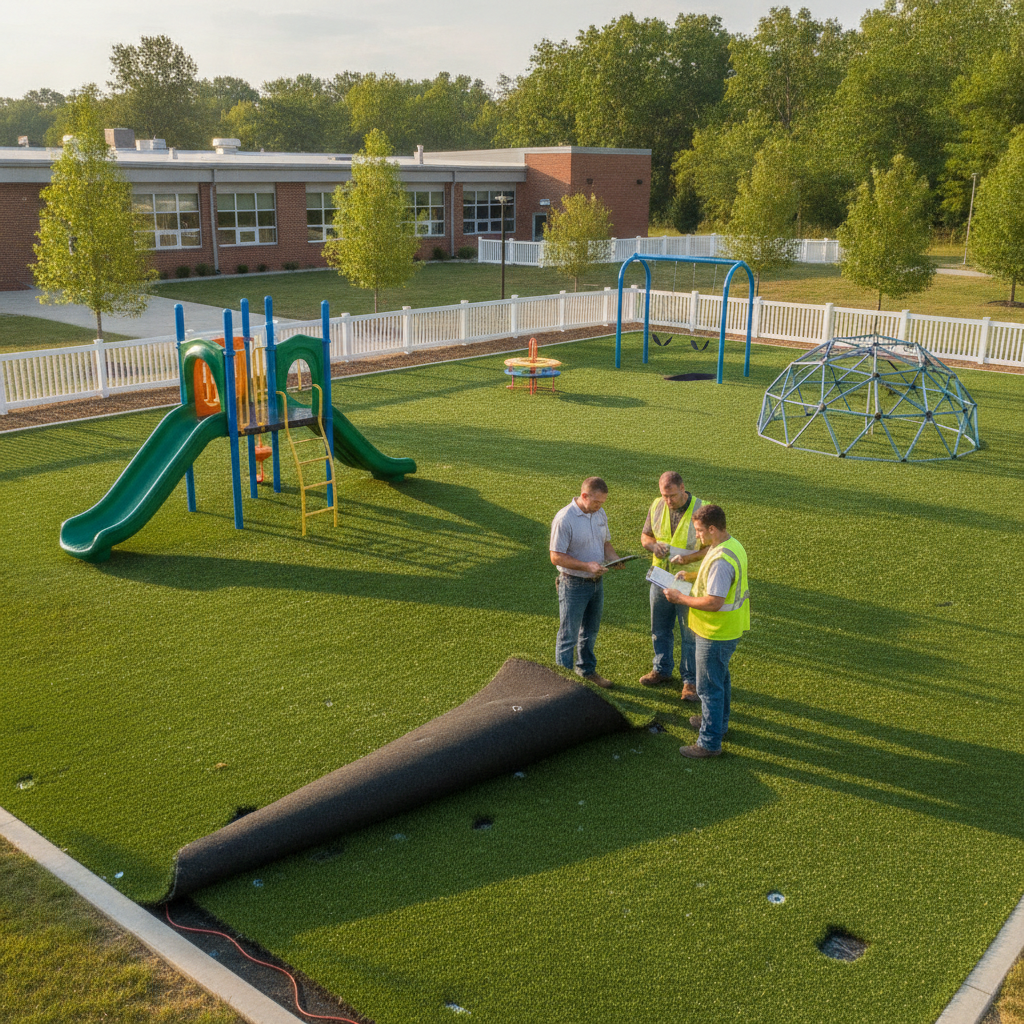
How Do You Install Artificial Turf on a Daycare or Preschool Playground in Rockville, MD? If you operate a licensed childcare facility in Rockville or anywhere across Montgomery County, the short answer is: carefully, with documentation in hand. Artificial turf for a daycare playground isn’t a weekend landscaping project — it’s a code-driven, safety-critical installation that has to satisfy state licensing inspectors, meet federal playground safety guidelines, and hold up under the kind of daily punishment only thirty preschoolers can deliver. Done right, it’s one of the best investments you’ll make for your facility. Done wrong, it creates liability exposure and a surface that may fail its next inspection.
Why So Many Childcare Operators in Montgomery County Are Making the Switch
Natural grass on a daycare playground sounds ideal until you watch it turn into a mud pit after the first heavy spring rain — which, in the DMV, means roughly six months of the year. Rockville gets the same wet, heavy weather as the rest of the Beltway corridor, and mud tracked into a childcare facility isn’t just messy. It’s a liability. It means daily cleanup, ruined shoes, slips near the door, and parents calling to complain.
Synthetic turf eliminates that cycle entirely. With a properly engineered base and a drainage system built for high-volume water flow, the surface sheds rain fast and returns to usable condition within minutes of a storm. No mud. No bare patches. No divots around the swing set where children land the same way, three hundred times a day. And unlike mulch or pea gravel, properly installed turf doesn’t migrate out of the play zone, doesn’t create choking hazards, and doesn’t require weekly raking to stay level.
That said, the product itself only matters as much as the installation underneath it. The turf is the final layer. The base engineering, the drainage, and the backing system are what determine whether this surface actually passes inspection and keeps children safe for the next decade.
What CPSC and IPEMA Certification Actually Means for Your Playground Surface
The U.S. Consumer Product Safety Commission publishes the Handbook for Public Playground Safety, which establishes critical fall height (CFH) requirements for playground surfaces. The IPEMA — the International Play Equipment Manufacturers Association — provides third-party certification that specific products meet those standards. If your turf system isn’t CPSC-compliant and IPEMA-certified, your Maryland childcare license renewal could be at risk, and your general liability insurer will want to know why you installed an uncertified surface under a climbing structure.
What does this mean practically? Every piece of play equipment on your playground has a maximum fall height — the highest point a child could fall from. The surface under and around that equipment must be tested and certified to absorb the impact energy of a fall from that height. For a standard preschool climber at six feet, you need a surfacing system with a CFH rating at or above six feet. The certification documents that come with a compliant installation are what you hand to the state licensing inspector when they ask what’s under the swing set.
At Grassify, the turf systems we install on children’s playground surfaces carry CPSC and IPEMA certification with documented CFH ratings. We provide that paperwork as part of every commercial playground installation — not as an afterthought, but as a deliverable you can file with your licensing records.
The Base System: Where Compliance Actually Gets Built
The IPEMA-certified turf backing accounts for impact absorption, but the base system underneath is what gives the whole installation its integrity over time. Here’s what a properly engineered daycare playground base looks like in a mid-Atlantic climate:
- Site excavation: Typically 4–6 inches of depth, depending on existing grade and drainage conditions. We evaluate the natural slope and soil composition before anything else.
- Compacted aggregate base: A layer of crushed angular aggregate — usually Class II road base — compacted in lifts to create a firm, stable foundation that won’t shift under foot traffic or through freeze-thaw cycles.
- Permeable drainage fabric: A geotextile weed barrier that allows water to pass through while preventing base material from migrating into the soil below.
- Shock pad or pad-backing system: For playground applications, an additional foam or rubber shock pad layer is installed directly beneath the turf to achieve the required CFH ratings. This is non-negotiable for climbers, swings, and elevated platforms.
- Turf installation with infill: The turf is rolled, seamed, secured, and infilled with the appropriate material — typically silica sand or an antimicrobial blend for child-contact surfaces.
Rockville’s freeze-thaw winters — the same cycle that stresses every installation in the DMV — can wreak havoc on a base that wasn’t compacted correctly. If the aggregate shifts through repeated winter cycles, seams open and edges lift. That’s how a playground surface becomes a tripping hazard by spring. Base prep isn’t where you cut costs on a licensed childcare facility.
ADA Accessibility and Surface Firmness Requirements
The Americans with Disabilities Act requires that accessible playground routes and surface areas meet firmness and stability standards so children using mobility devices can navigate the space. Properly installed synthetic turf with the right infill density satisfies ADA accessibility requirements in a way that mulch, pea gravel, and sand cannot — those loose-fill surfaces are notoriously difficult for wheelchair users and children with mobility challenges.
If your Rockville daycare or preschool serves children with disabilities or receives federal funding, ADA-compliant surfacing isn’t optional. It’s worth confirming with your installer that the product and installation method they’re proposing meets both the CPSC fall attenuation standard and the ASTM F1951 accessibility standard for playground surfacing. We document both for every eligible project we complete across the DMV.
Heat Management in a Montgomery County Summer
Synthetic turf surfaces can run warmer than the surrounding air temperature on a hot July afternoon, and this is a real consideration for a daycare playground where small children may be barefoot or sitting directly on the surface. Rockville summers are humid and genuinely hot, and responsible childcare operators should ask their installer directly about surface temperature management.
There are a few practical approaches: selecting lighter-colored turf products that reflect more heat than darker blades, using infill materials with better thermal properties, and scheduling outdoor playtime in the morning before peak heat hours. For covered or partially shaded playground zones, heat buildup is significantly reduced. We evaluate shade patterns on every daycare site we visit and factor that into product recommendations before the first roll of turf is ever cut.
Maintenance Expectations for High-Traffic Childcare Facilities
One of the biggest selling points of synthetic turf for daycare operators is reduced maintenance compared to natural grass. But reduced doesn’t mean zero. Here’s what ongoing care actually looks like on a busy preschool playground:
- Weekly grooming: A stiff-bristle brush or power broom keeps fibers upright and infill evenly distributed, especially in high-traffic landing zones.
- Routine debris removal: Leaves, food, and toys should be cleared regularly. A leaf blower handles most of this in minutes.
- Periodic sanitizing: Child-safe enzymatic cleaners handle spills, biological messes, and surface sanitizing without damaging the turf fibers or backing.
- Annual infill top-up: High-traffic zones may lose some infill density over time and benefit from a light top-up every year or two.
Compared to weekly lawn mowing, fertilizer applications, irrigation costs, and the annual re-seeding that most natural grass playgrounds require, the maintenance load on synthetic turf is genuinely lighter — and more predictable, which matters when you’re running a licensed facility on a tight operational budget.
Frequently Asked Questions from Daycare Operators in Rockville and Bethesda
How much does it cost to install artificial turf on a daycare playground?
Commercial playground turf installations with CPSC/IPEMA-certified backing and proper base prep typically run in the range of $15–$25 per square foot installed, depending on site conditions, equipment placement complexity, and the specific shock-pad system required. A realistic budget for a 2,000-square-foot preschool playground in the $30,000–$50,000 range is common for a full-featured installation. Contact Grassify for a site-specific estimate — square footage alone doesn’t tell the whole story.
Will the turf installation disrupt our daycare operations?
Most installations of this scale take three to five business days depending on site access and complexity. We work with childcare operators to schedule installations around your operational calendar — often during a planned closure, school break, or weekend window. We’ll give you a realistic timeline after the site assessment.
What documentation do I receive for my Maryland licensing file?
Grassify provides CPSC and IPEMA certification documents, critical fall height ratings for the installed system, and a written record of the base materials and depth used. These are the documents Maryland childcare licensing inspectors typically request when evaluating playground surfacing compliance.
Is the turf safe for children who might put it in their mouths?
All turf products we install on child-contact surfaces are lead-free and compliant with applicable consumer product safety standards. We use infill materials appropriate for child-use environments — typically silica sand or similar inorganic infill rather than crumb rubber on surfaces where young children will have direct, repeated contact.
Can turf be installed around existing playground equipment without removing it?
Yes, in most cases. We work around existing equipment footings and anchor points. If equipment needs to be temporarily removed for base excavation beneath high-use zones, we coordinate that with your contractor or equipment vendor. We’ve done this on dozens of active school and childcare sites across Fairfax County and Montgomery County without requiring full equipment teardowns.
Ready to Talk Through Your Rockville Daycare Project?
If you operate a daycare, preschool, or childcare center in Rockville, Bethesda, or anywhere across Montgomery County or the broader DMV, Grassify’s commercial turf team has the documentation, the certified products, and the installation experience to get your playground surface right the first time. We carry a lifetime installation warranty on seams, edges, and base integrity — and we show up on time, with licensed and background-checked crews, every time.
Reach out to schedule a free on-site consultation. We’ll evaluate your playground layout, review your equipment heights and fall zones, and walk you through exactly what a compliant, long-lasting installation looks like for your specific facility. No pressure, no guesswork — just a straight answer from someone who does this for a living.


