
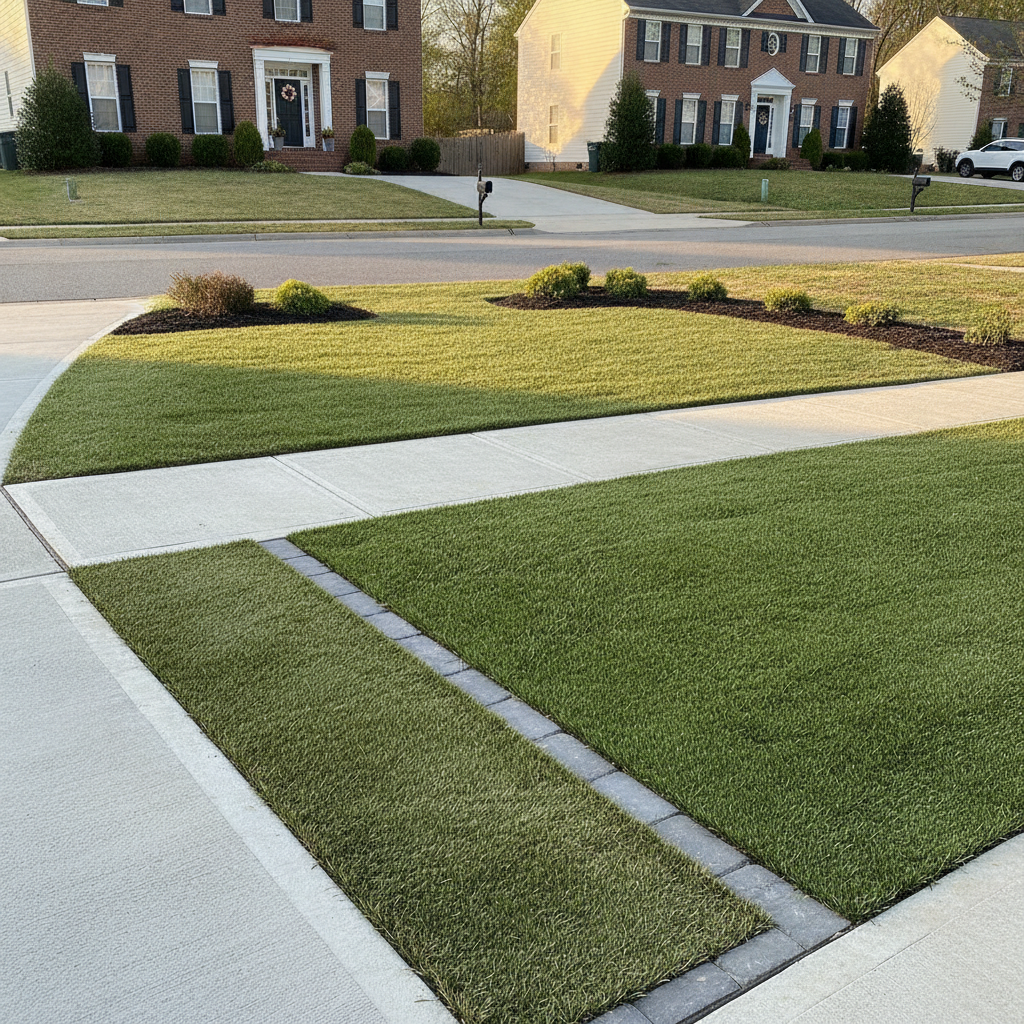
How Do You Install Artificial Turf on a Steep Driveway Apron or Front Yard Median Strip in Burke, VA? What Homeowners Need to Know About Curb Appeal, Drainage, and HOA Rules
That narrow band of grass running alongside your driveway or between the curb and sidewalk might seem like a minor detail — but if you’ve tried to maintain it through a Northern Virginia summer, you know how fast it turns into a patchy, muddy, mower-unfriendly headache. In Burke, VA, where HOA communities like Burke Centre, Rolling Valley, and Signal Hill keep a close eye on front yard appearance, a neglected driveway apron or median strip stands out fast. Replacing it with artificial turf solves the maintenance problem permanently — but only if the installation is done right for this specific type of space.
Why Driveway Aprons and Median Strips Are Harder Than They Look
These zones are deceptively tricky. They’re small, which makes homeowners assume they’re simple. In reality, they present a unique combination of challenges that trip up installers who don’t have deep local experience.
First, there’s slope. Driveway aprons often pitch away from the driveway surface at an angle designed to direct runoff toward the street. That’s good for drainage in theory, but it means your turf base has to be engineered to match and support that grade without shifting over time. In Fairfax County, freeze-thaw cycles hit base materials hard from November through March. If your crushed aggregate base isn’t compacted properly and graded with the natural slope in mind, you’ll see heaving, edge separation, or surface rippling within a season or two.
Second, there’s traffic stress. A driveway apron is walked on, occasionally driven over at the edge, hit with oil and chemical runoff from the driveway surface, and exposed to the full sun for most of the day. That means your turf product needs UV-stabilized fibers — not a budget import — and your edging and perimeter anchoring need to be built for real-world abuse, not just aesthetics.
Third, narrow median strips — the strips between the sidewalk and the curb — are often in the public right-of-way. That adds a layer of municipal jurisdiction you need to understand before you dig anything up.
The Right-of-Way Question: What Fairfax County Homeowners Need to Know
In many Fairfax County neighborhoods, the strip of grass between the sidewalk and the street curb is technically within the county or municipal right-of-way, even if you’ve been mowing it for twenty years. That doesn’t mean you can’t install turf there — many homeowners do — but it does mean you need to verify jurisdiction before installation begins.
Fairfax County’s Department of Public Works and Environmental Services handles right-of-way encroachment permits for modifications to that zone. The process typically involves a simple application confirming the modification doesn’t impede utilities, drainage infrastructure, or sight lines. A reputable installer will flag this for you upfront, pull the right permits, and document the work. If someone offers to skip the permit to save a few hundred dollars, that’s a red flag — not a deal.
For the apron itself — the section between the sidewalk and your garage or driveway edge that’s clearly on your private property — no right-of-way permit is required, though HOA approval may still apply.
HOA Approval for Front Yard Turf in Burke and Springfield
If your home in Burke Centre, Rolling Valley, or a comparable HOA-governed community in Springfield or Fairfax has architectural review requirements, artificial turf on your front yard — even just the driveway strip — usually needs board approval before installation. Most HOA architectural guidelines address turf color, pile height, edge finishing, and whether synthetic grass is permitted in street-facing areas at all.
The good news is that front yard turf applications are increasingly being approved in Fairfax County HOA communities, especially when presented professionally. That means submitting a written project description, a product sample showing realistic color and pile height (typically 30mm–38mm for front yard applications, which reads natural from the street), and a photo rendering of the finished space. Many HOAs in this region have already approved similar projects and have informal precedent you can point to.
If you’re not sure where to start with your HOA, Grassify’s residential lawn turf team works through the approval process regularly and can help you prepare the documentation that gets projects greenlit on the first submission.
Base Prep: Why This Is Where the Job Lives or Dies
For a driveway apron or median strip, base preparation is everything. Here’s what a proper installation looks like in Northern Virginia’s climate:
- Excavation: Remove existing sod and soil to a depth of 3–4 inches. In areas prone to weed pressure — which describes most Burke and Springfield front yards after a wet spring — a commercial-grade weed barrier goes down before base material is added.
- Crushed aggregate base: A 3-inch compacted layer of Class II road base (crushed granite or decomposed granite) gives you the stable, permeable foundation the surface needs. This is not the same as pea gravel or decorative stone — compaction is what makes the base work.
- Grade matching: The base is graded to match the existing slope of the apron, so water continues to sheet off toward the street the same way it always has. You don’t want to create a pocket that holds water against your driveway edge.
- Edging and anchoring: Galvanized bender board or concrete edging is installed along the perimeter to hold the turf tightly at the driveway edge and sidewalk joint. This is especially important for freeze-thaw resilience — proper anchoring prevents lifting at corners and seams when the ground moves.
Choosing the Right Turf Product for a Front Yard Zone
Not every product is built for the conditions a front yard strip faces. You want a fiber that holds its color under intense UV exposure, recovers its blade shape after foot traffic, and doesn’t look plasticky in the flat light of a Northern Virginia winter afternoon.
For driveway aprons and street-facing median strips, a 30mm–38mm pile height in a natural green blend typically reads best from the street. Thicker pile heights (45mm–50mm) look lush in a backyard context but can appear heavy and artificial in tight, low-ground-cover front yard zones. UV-stabilized polyethylene fibers with a thatch layer — a shorter, curly fiber layer at the base of the pile — give the surface dimension and help it look like real grass when the sun hits it at an angle.
What Does This Type of Project Actually Cost?
Driveway apron and median strip projects are typically smaller in square footage than full backyard installs, but the per-square-foot cost runs toward the mid-to-upper end of the range — generally $15–$22 per square foot installed in the Burke and Springfield area — because the labor intensity of tight-access work, precise edging, and slope matching doesn’t scale down proportionally with size. For a 150–300 sq ft driveway strip, that puts most projects in the $2,200–$6,600 range depending on complexity, product choice, and whether right-of-way permitting is involved.
The long-term math still works heavily in your favor. You eliminate mowing, edging, fertilizing, reseeding, and irrigation in a zone that’s nearly impossible to keep looking good with natural grass — especially against a driveway where compaction, chemical runoff, and heat stress hammer turf year after year.
Frequently Asked Questions
Can I install artificial turf on the strip between my sidewalk and the street in Burke, VA?
Often yes, but you need to verify whether that strip is within Fairfax County’s right-of-way. If it is, you’ll need a right-of-way encroachment permit before any work begins. Grassify handles this process regularly for homeowners throughout the county.
Will artificial turf on my driveway apron get too hot in summer?
Direct-sun front yard turf can get warm on peak summer days. Using a UV-stabilized, lighter-tone fiber blend and opting for a product with heat-dispersing infill helps manage surface temperature. This is a real consideration in the DMV’s humid summers, and it’s worth discussing product options with your installer before you commit.
Does my HOA in Burke Centre need to approve front yard turf?
Most HOA-governed communities in Burke require architectural review for any permanent landscape change visible from the street. Artificial turf almost always falls under this rule. Submit a formal application with a product sample and a site plan — approval rates are high when the project is presented professionally.
How long does a driveway apron turf installation take in Northern Virginia?
For a standard driveway apron or median strip in the 150–300 sq ft range, most installations are completed in one day once permits and HOA approvals are in hand. Base prep is typically done the same day as turf installation for smaller projects.
What happens to artificial turf on a driveway strip during winter in Alexandria or Springfield?
Properly installed synthetic grass with a compacted aggregate base handles DMV winters well. The turf itself won’t be damaged by snow, ice, or freeze-thaw cycles. The risk in winter comes from base prep shortcuts — an undercompacted base that shifts with ground movement will cause seam separation and edge lifting. That’s why a lifetime warranty on seams, edges, and base from your installer matters more than a low per-square-foot quote.
Ready to Stop Fighting That Driveway Strip?
If you’re tired of edging, reseeding, and apologizing for the patch of dirt alongside your driveway, artificial turf is a permanent fix that actually improves your home’s street presence. Grassify installs residential lawn and landscaping turf throughout Burke, Springfield, Alexandria, Fairfax, and surrounding Fairfax County communities — including HOA-governed neighborhoods where the approval process requires experienced guidance.
Every project comes with licensed, insured, and background-checked crews, a lifetime warranty on seams, edges, and base, and the kind of local knowledge that only comes from doing this work in the DMV for over a decade. Contact Grassify today to request your free consultation and get a site-specific quote for your driveway apron or front yard median project.


