
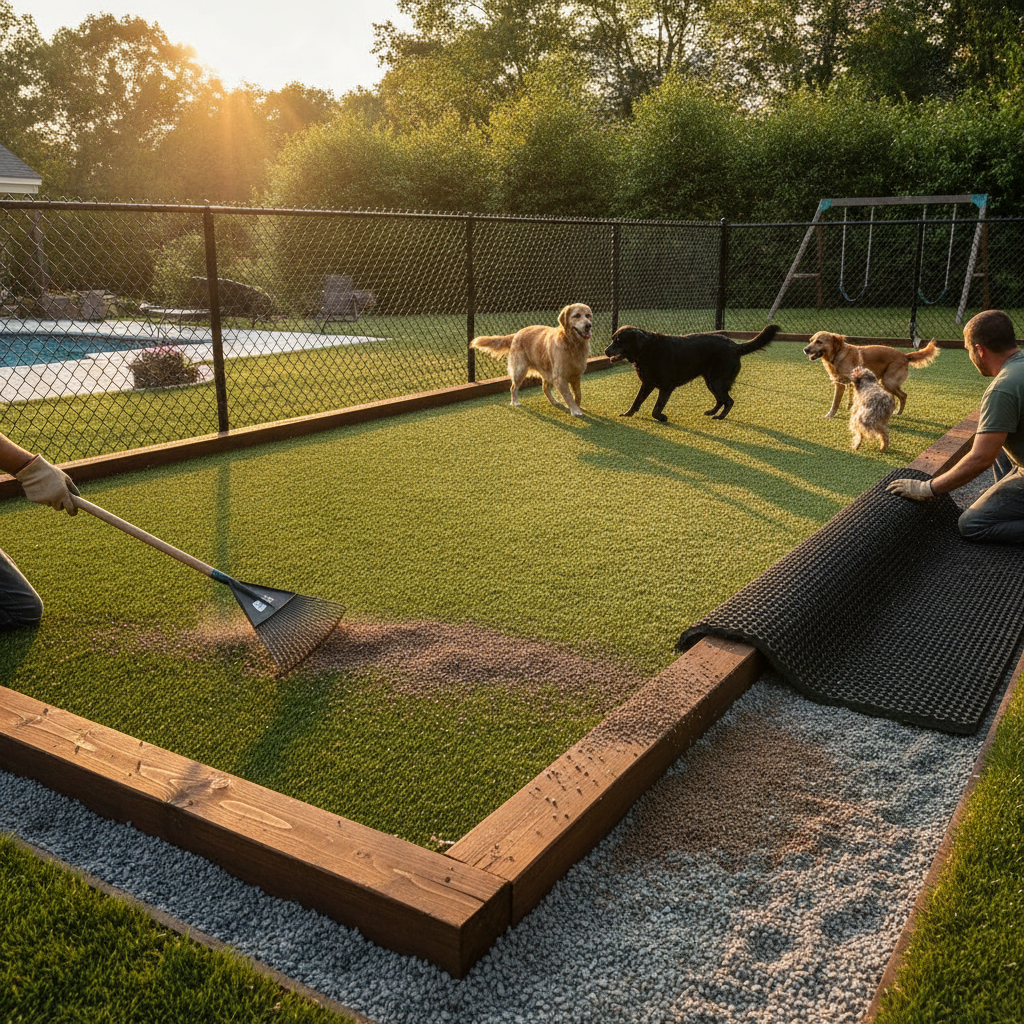
How Do You Install Artificial Turf Inside a Dog Run or Kennel Enclosure in Burke, VA? What Pet Owners Need to Know About Drainage, Hygiene, and Odor Control
If you have a dedicated dog run or kennel enclosure in your Burke, VA backyard, standard artificial turf installation just isn’t going to cut it. A dog run concentrates urine, waste, and moisture into a small, enclosed footprint — often daily, often in volume — which means the difference between a surface that stays clean and one that becomes a permanent hygiene problem comes down almost entirely to what’s built underneath the turf, not on top of it. Done right, an artificial turf dog run is one of the most practical upgrades a pet owner can make. Done wrong, it traps odor and bacteria in the base layer and costs you more to fix than it would have cost to do correctly the first time.
Why Dog Run Turf Is a Different Installation Category Entirely
Most backyard turf installations are designed to handle rain — which falls roughly evenly across a surface and drains away over a broad area. A dog run is different. You’re funneling concentrated liquid waste — often multiple times a day — into a confined zone, frequently without the dilution that open lawn space provides. In Fairfax County’s humid summers, that buildup accelerates bacterial growth and ammonia off-gassing faster than you’d expect, especially in an enclosed run where airflow is limited by fencing on multiple sides.
That’s why pet-specific turf installations built for dog runs and kennel enclosures require a layered engineering approach rather than a simple turf-over-gravel setup. At Grassify, the system we use for enclosed pet areas includes a 5-layer drainage architecture designed to handle over 400 inches per hour of liquid throughput — far more than any DMV rainstorm will throw at it, and built specifically so urine doesn’t pool, doesn’t saturate the base, and doesn’t create the sour-smell feedback loop that makes most dog runs unpleasant to be around within a year of install.
What a Properly Engineered Dog Run Turf System Actually Looks Like
Here’s what goes into a correctly built kennel or dog run turf installation in a Northern Virginia backyard:
- Excavation and slope grading: The existing soil is excavated down — typically 3 to 4 inches in an enclosed run — and the sub-base is graded to direct drainage away from fencing posts and toward a natural outlet or dry well. In Burke and Springfield, where clay-heavy soil is common, skipping this step means liquid sits and saturates rather than escaping. Poor sub-grade drainage is the number-one cause of long-term odor problems in dog runs.
- Crushed aggregate base: A compacted layer of crushed granite or decomposed granite is packed to create a firm, permeable base. This layer does two jobs — it gives the turf a stable, non-shifting foundation and it allows rapid liquid movement downward away from the turf fibers and backing.
- Permeable weed barrier: A geotextile fabric layer prevents organic material from migrating up into the base over time, which matters more in a kennel environment where you’re rinsing the surface regularly.
- Turf with perforated backing: The turf itself must have a perforated or flow-through backing — not a solid backing. This is non-negotiable for any pet application. Solid-backed turf will pool liquid on top of the backing layer and become a bacterial reservoir within months.
- Zeolite deodorizer infill layer: This is where the chemistry happens. Zeolite is a naturally occurring mineral that actively binds ammonia molecules — the primary source of that sharp urine smell — at the molecular level. It’s not a masking agent. It captures ammonia and neutralizes it. For dog runs, we use a zeolite-dominant infill system topped with a light antimicrobial infill layer. This combination is what enables the 90-day odor-free guarantee we stand behind on every pet turf installation.
You can explore the specifics of our pet-friendly turf installation service to see the full system breakdown and product options we recommend for high-use pet areas.
Sizing, Shape, and Access — What Matters for Enclosed Dog Run Spaces
Dog runs in Northern Virginia backyards tend to fall into a few common configurations: a long narrow run along a fence line, an L-shaped enclosure built into a corner of the yard, or a freestanding kennel panel setup that sits in the middle of a yard or on a patio. Each presents different installation challenges.
Narrow runs — anything under 5 feet wide — require careful attention to seam placement. If your run is 4 feet wide and your turf roll is wider than that, you’re cutting and seaming on-site, and seam quality in a high-moisture environment is what determines whether you get 15 years or 5 years out of the installation. Our crews use heat-bonded seaming tape and polyurethane adhesive rated for pet environments, not standard landscape adhesive that breaks down with repeated moisture exposure and freeze-thaw cycling in Fairfax County winters.
Freestanding kennel panel setups on concrete or existing hardscape have a different problem — drainage underneath. If your kennel sits on a concrete slab, you need a turf system designed to drain laterally to a drain point rather than relying on sub-surface percolation. This is a solvable installation, but it requires planning the drain outlet location before the turf goes down, not after.
Heat Management in Enclosed Runs During Virginia Summers
Burke, VA summers regularly push into the mid-90s, and an enclosed dog run — particularly one surrounded by a solid fence or kennel panels — can trap radiant heat from both the turf surface and the surrounding structure. Standard synthetic turf can reach surface temperatures 40–60°F above ambient air temperature on a sunny day, which matters a great deal when you’re asking your dog to use the space in July or August.
For dog runs with significant sun exposure, we recommend turf products with heat-reflective yarn technology or lighter-colored blades that reduce surface temperature accumulation. We also recommend building partial shade coverage — a shade sail or pergola panel — into the enclosure design where possible. This isn’t just about comfort; sustained high surface temperatures accelerate infill off-gassing and can shorten fiber lifespan in a high-UV environment. The right product selection upfront matters as much as the base engineering.
What Routine Maintenance Actually Looks Like
One of the biggest misconceptions about dog run turf is that it’s maintenance-free. It’s significantly lower maintenance than natural grass — no mud, no dead patches, no mowing — but it does need a simple weekly routine to perform the way it’s designed to:
- Rinse the surface with a garden hose after each use if possible, or at least weekly. This dilutes residual urine and moves it through the drainage layers before it concentrates.
- Remove solid waste immediately — don’t let it sit. Turf surfaces are easy to clean, but allowing waste to dry onto the fibers creates more work and can stain lighter-colored blades.
- Once a month, use an enzyme-based pet turf cleaner to treat the surface. Enzyme cleaners break down organic matter at the molecular level and work in combination with the zeolite infill layer to maintain odor neutralization over time.
- Fluff the turf blades with a stiff-bristle brush or power broom twice a year, particularly in high-traffic zones where dogs run repeated patterns. This keeps pile height consistent and prevents matting.
Frequently Asked Questions: Dog Run Turf in Burke and Fairfax County
How long does artificial turf last in a high-use dog run?
With proper base engineering and routine maintenance, a quality pet turf system in an enclosed dog run should last 12 to 15 years in a Northern Virginia climate. The limiting factors are fiber wear in heavy-traffic zones and infill degradation over time — both of which are addressable with periodic infill top-dressing. Grassify backs every installation with a lifetime warranty on seams, edges, and base construction.
Can I install dog run turf myself to save money?
You can purchase turf rolls and lay them on a DIY basis, but the base engineering — proper excavation depth, slope grading, compacted aggregate layer, and drain routing — is where most DIY installs fail in Fairfax County’s clay-heavy soil. Without correct drainage, the zeolite infill can’t do its job, and you’ll be dealing with odor within a season. The turf itself is a small part of the cost and complexity. The base is where the investment actually lives.
Does turf in a dog run require HOA approval in Burke?
It depends on your HOA’s governing documents and whether the dog run is visible from common areas or the street. Many HOAs in Burke Centre, Rolling Valley, and Signal Hill require architectural approval for any surface modification in the backyard, even enclosed areas. We walk every client through the approval process and provide documentation packages that satisfy most HOA architectural review requirements. See our Fairfax County service area page for more on navigating local HOA requirements.
What’s the typical cost range for dog run turf installation in Northern Virginia?
Pet turf installations — including the full 5-layer drainage system and zeolite infill — typically run $15 to $22 per square foot installed, depending on enclosure size, access conditions, and site prep complexity. Smaller enclosed runs sometimes cost more per square foot due to the precision cutting and seaming required in tight spaces. We provide detailed, itemized quotes at no charge — no estimates over the phone without seeing the site first.
Will the turf smell after a few months even with zeolite infill?
Not when the drainage system is built correctly. Odor is almost always a drainage problem before it’s an infill problem — if liquid is pooling in the base rather than draining through, zeolite alone can’t compensate. That’s why we back our pet turf installations with a 90-day odor-free guarantee: if the system is performing the way it’s engineered to perform, odor control isn’t a question. If you’re smelling ammonia from an existing turf dog run, it usually means the sub-base drainage failed, not that the turf itself is bad.
Ready to Build a Proper Dog Run in Your Burke or Northern Virginia Backyard?
A well-engineered dog run is one of the best investments you can make for your dog’s daily quality of life and your own sanity. No more muddy paws tracked through the house. No more dead grass patches. No more standing water and the smell that comes with it. Just a clean, durable, low-maintenance surface that holds up to a dog’s daily routine through Virginia summers, fall rains, and February freeze-thaw cycles alike.
Grassify installs pet turf systems across Burke, Springfield, Fairfax, and throughout Fairfax County — with licensed, background-checked crews and a lifetime installation warranty on every project. Contact us to schedule a free on-site consultation and get an accurate, itemized quote for your dog run or kennel enclosure.


