
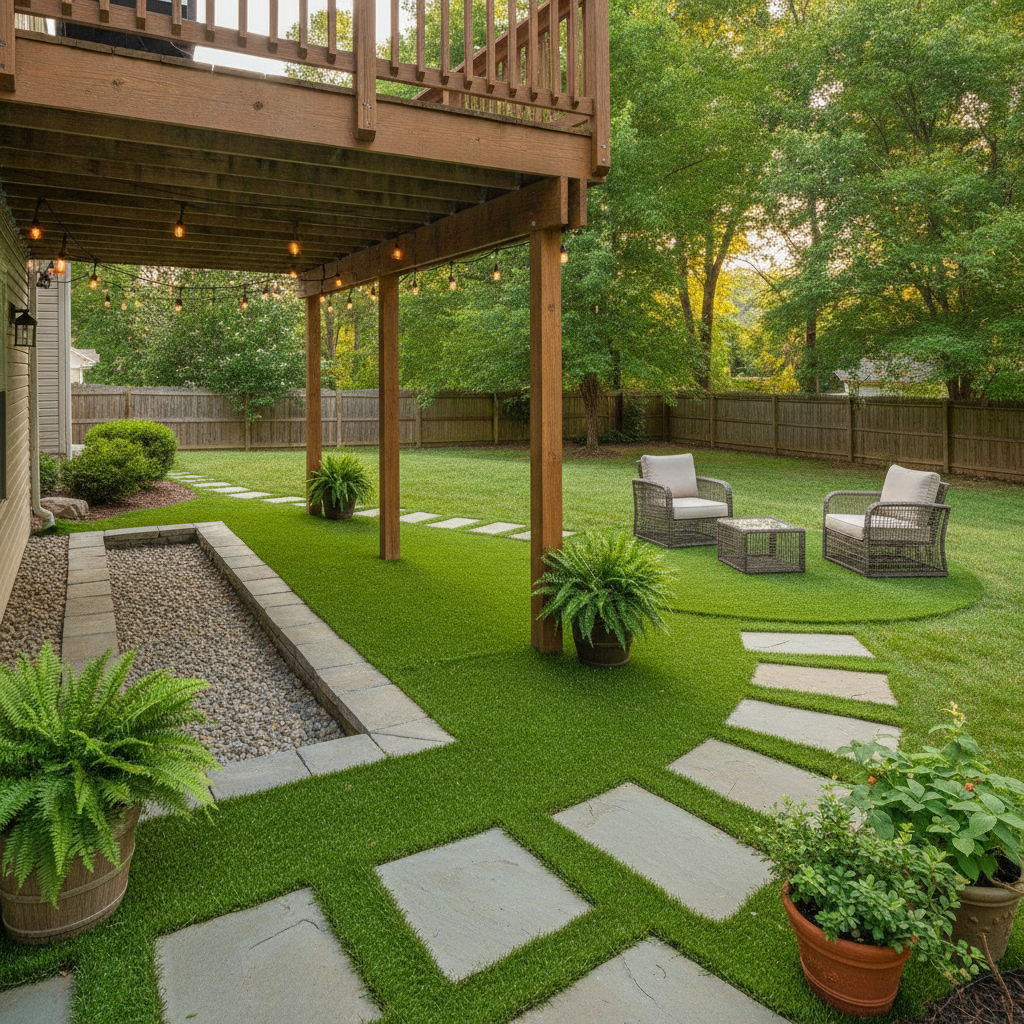
How Do You Install Artificial Turf Underneath a Deck or Elevated Structure in Burke, VA? What Homeowners Need to Know About Shade, Drainage, and Finishing
Yes, artificial turf can absolutely work under a deck — and in Burke, VA, it’s one of the most practical uses we see. That low-clearance zone beneath an elevated deck is usually a problem area: bare dirt that turns to mud after every spring rain, compacted clay that never drains properly, or a gravel patch that migrates into the rest of your yard. Artificial turf solves all of that, and when it’s installed correctly, the space actually becomes usable — a clean surface for storage, pets, kids, or just a visually finished yard. The key word is correctly. Under-deck installations have specific challenges around drainage, airflow, turf selection, and edge finishing that make them meaningfully different from an open backyard install. Here’s what you need to know before you start.
Why the Space Under a Deck Is Actually a Harder Install Than Open Lawn
Most homeowners assume the tricky part is just maneuvering materials into a tight space. That’s part of it — but the real engineering challenge is water. In Fairfax County, we average over 40 inches of rainfall per year, and a significant portion of that hits your deck surface and sheets off the edges directly into the zone below. If your deck doesn’t have a drainage system of its own, you’re funneling a large volume of water into a small footprint every time it rains.
Combine that with Northern Virginia’s heavy clay soil — which drains slowly under ideal conditions — and you have a space that’s constantly fighting waterlogging. That matters for turf because standing water underneath synthetic grass destroys the base over time, produces odor, and attracts mosquitoes. It also accelerates seam failure and backing degradation. Getting the base and perimeter drainage right before the turf goes down isn’t optional.
The other factor is shade. Under a deck, your turf sees dramatically less UV exposure. That sounds like a good thing for longevity — and it is — but it also means you need to think about airflow and moisture retention. Areas with poor airflow can stay damp longer after rain, which matters if you have pets using the space.
Base Prep: What Needs to Happen Before Any Turf Goes Down
Proper base preparation under a deck follows the same fundamental logic as any turf install, but with tighter constraints. Here’s what the process looks like on a typical Burke or Springfield home with an elevated wood or composite deck:
- Excavation: We typically remove 3–4 inches of existing soil. Under a deck, that often means working with shovels and wheelbarrows in low-clearance conditions — no skid steer, no power equipment.
- Grading: The sub-base is graded to direct water away from the house foundation and toward the open yard. A 1–2% slope is usually sufficient and doesn’t create a visible dip in the finished turf surface.
- Base material: A compacted layer of crushed aggregate (typically Class II or crushed granite) goes in at 3–4 inches of compacted depth. This is where most DIY and budget installs cut corners — using sand or decomposed granite alone, which shifts, compacts unevenly, and fails within a season or two under DMV freeze-thaw cycling.
- Weed barrier: A commercial-grade fabric goes over the compacted base before the turf is laid. Consumer-grade fabric from a hardware store breaks down within a few years and allows weed infiltration through seams.
If your deck doesn’t have gutters or a deck drainage system diverting water away from the perimeter, we’ll often recommend installing perforated drain pipe around the outer edge of the under-deck zone before turf goes in. That one addition can double the longevity of the base in high-rainfall seasons.
Choosing the Right Turf Product for a Shaded, Under-Deck Space
Not every turf product is a good match for an under-deck installation. You’re looking for a few specific characteristics:
- Lower pile height: In tight-clearance zones, a 30mm–38mm pile height tends to look more proportional and stays cleaner than a taller 50mm pile that flattens more easily in a confined space.
- Good drainage rate: Look for a backing with a drainage rate of at least 30–40 inches per hour per square yard under normal conditions. If pets are using the space, that number needs to be significantly higher — our pet turf systems are engineered to drain at 400+ inches per hour specifically to handle concentrated liquid volumes.
- UV stabilization still matters: Even in shade, UV stabilized fibers are worth specifying. Reflected UV from surrounding surfaces and partial sun exposure adds up over years.
If your dog spends time in the under-deck zone, that changes the product selection significantly. You’ll want a pet-friendly turf system with antimicrobial infill, zeolite deodorizer layers, and a drainage rate engineered specifically for pet use. The confined, lower-airflow conditions under a deck mean odors concentrate faster than they would in an open yard — so the drainage and infill system need to be doing more work, not less.
Tight-Access Installation: What to Expect on Job Day
Many decks in Burke Centre, Rolling Valley, and other Fairfax County neighborhoods were built close to the property line or have finished skirting on three sides with a single access panel. That affects how materials move in and out, how compaction equipment gets positioned, and how seams are planned.
An experienced local crew handles this differently than a general landscaper or a franchise installation team. They’ll plan the turf layout so seams fall in lower-visibility areas, cut the turf panels to work within the access constraints, and hand-compact the base in sections rather than trying to force a plate compactor into a 24-inch clearance zone. The edge finishing at the transition from under-deck to open yard is also a detail that separates a clean install from one that looks like an afterthought — a properly nailed bender board or aluminum edging profile holds the turf perimeter flat and prevents curling over freeze-thaw cycles.
Expect a typical under-deck turf install in a 200–400 square foot zone to run in the $18–$25 per square foot range, factoring in the extra labor involved in tight-access base prep and hand compaction. That range can shift depending on site conditions, existing drainage, and product selection. A site visit is the only way to give you an accurate number.
Frequently Asked Questions: Under-Deck Turf in Northern Virginia
Will artificial turf under a deck get moldy or smell over time?
It won’t mold if the base drains properly and there’s reasonable airflow at the perimeter. Synthetic fibers don’t support mold growth the way organic material does. Odor from pet use is the more common issue, which is why the infill and drainage system selection matters so much in confined spaces.
Can I install turf under a deck myself to save money?
The turf itself isn’t the hard part — it’s the base. Under-deck zones are exactly where DIY installs fail fastest because hand-compacting a stable aggregate base in tight clearance is physically demanding and technically specific. A poorly compacted base shifts in Northern Virginia’s freeze-thaw cycles and creates visible humps, edge lifting, and drainage failure within one or two winters. The cost to redo it is almost always more than it would have cost to do it right the first time.
Does turf under a deck need to be a different product than what’s in my open backyard?
Not necessarily different, but it should be specified for the conditions. Drainage rate, pile height, and infill type should all be evaluated with the shade and confined-space context in mind. We often use the same product family in both zones with minor specification adjustments. See our residential turf options for a sense of what’s available.
Will my HOA in Fairfax County require approval for turf under my deck?
Probably not, since under-deck zones typically aren’t visible from the street or neighboring properties. But HOA architectural guidelines vary — some communities in Fairfax County and Springfield require approval for any ground-surface modification in the rear yard. It’s worth checking your CC&Rs before the work starts, just so you’re not caught by a rules interpretation you didn’t anticipate.
How long does artificial turf under a deck last?
When the base is properly engineered and the product is correctly specified, 15–20 years is realistic. Reduced UV exposure in a shaded zone can actually extend fiber life compared to a full-sun installation. Grassify backs all installations with a lifetime warranty on seams, edges, and base integrity — so if something fails due to workmanship, it’s on us to fix it.
Ready to Turn That Under-Deck Problem Area Into a Finished Space?
That muddy, unusable zone under your deck doesn’t have to stay that way. Grassify has been solving exactly these kinds of backyard problems for homeowners across Burke, Springfield, Fairfax, and throughout Fairfax County — and we know what it takes to do it right in this climate. If you’re ready to get a real answer about what your specific space needs, reach out to schedule a free on-site consultation. We’ll come out, look at your drainage situation, clearance constraints, and yard goals, and give you a straight answer on what it’ll take and what it’ll cost.


