
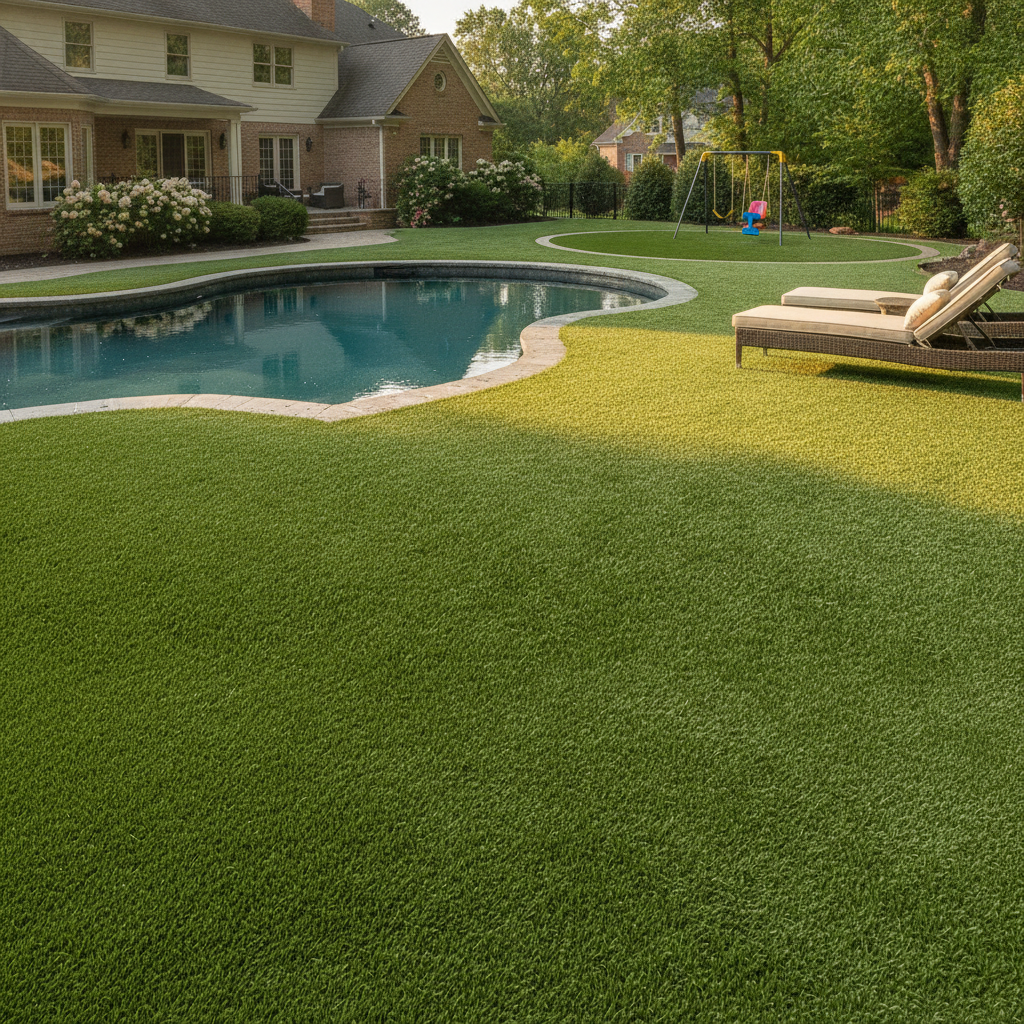
Can You Put Artificial Turf Around a Pool Deck in Bethesda, MD? Here’s What Pool Owners Need to Know
Yes — artificial turf is one of the best surfaces you can put around a pool, but only when the right product is installed the right way. Pool deck turf is a completely different category from the synthetic grass you’d install in a backyard lawn, and treating it like a standard turf job is one of the most common mistakes we see from general landscapers and out-of-state franchise installers working through the Montgomery County and Bethesda areas. If you’re weighing this upgrade for your home in Bethesda, Potomac, or Chevy Chase, here’s the honest breakdown of what makes pool deck turf work — and what makes it fail.
Why Standard Turf Products Don’t Belong Around Pools
Most residential turf products are engineered for lawns and pet areas. They’re built around foot traffic patterns, UV exposure, and moisture from rain or irrigation. A pool surround introduces an entirely different set of stressors that standard turf simply isn’t rated for:
- Constant chlorinated water contact. Splashing, dripping, and wet foot traffic carry chlorinated water into the turf’s backing and infill layer day after day throughout the swim season. Standard turf backings can degrade under that kind of chemical exposure over two to three seasons.
- Sustained heat from adjacent hardscape. Pool deck concrete and pavers absorb and radiate heat aggressively in the DMV’s humid summers. That heat transfers into surrounding turf. Without a heat-resistant fiber treatment, surface temperatures can climb uncomfortably high — a real problem for bare feet on a July afternoon in Bethesda.
- Slip-and-fall liability. Around water, surface texture matters. Turf installed poolside needs a specific pile orientation and drainage design that sheds water quickly rather than holding a wet surface layer that becomes slick underfoot.
- Drainage volume demands. A pool splash zone can dump hundreds of gallons across the surrounding surface during active use. The sub-base engineering for pool deck turf has to handle that volume efficiently — not just the light percolation that a typical lawn turf system is designed around.
The products and installation methods that solve these problems aren’t exotic — but they do require a turf installer who actually understands the pool environment and specs accordingly.
What Pool-Specific Turf Products Are Actually Built For
At Grassify, the product we use for pool deck and patio applications is purpose-built for exactly this environment. Our Plush Pad turf features a chlorine-resistant backing that holds up to repeated chemical water contact without breaking down, a lower pile height optimized for wet surface drainage, and a slip-resistant texture that gives bare feet real traction when the deck is wet.
The fiber itself is UV-stabilized to resist the intense sun exposure that pool areas receive — often more direct sun than a shaded lawn area — and the infill system is selected specifically for pool environments. We avoid crumb rubber infill in pool applications because of both heat absorption and the possibility of chemical interaction over time. Instead, we use a fine silica sand infill that keeps surface temperatures lower and won’t react to pool chemistry.
Heat resistance is worth calling out specifically for pool owners in the greater Bethesda area. Montgomery County gets legitimately hot summers, and pool decks compound that heat. Our pool turf products incorporate heat-diffusing fiber technology that measurably reduces surface temperature compared to standard fibers — not enough to make mid-afternoon July barefoot walking effortless, but meaningfully more comfortable than standard turf or unshaded concrete.
The Sub-Base Engineering That Most Installers Skip
Here’s where a lot of pool deck turf jobs go sideways — even jobs done by companies who do good lawn turf work. The sub-base prep for a pool surround is different, and cutting corners here creates problems that show up fast.
In Northern Virginia and the Maryland suburbs, our spring rainfall averages are significant, and the clay-heavy soil composition under most residential properties in areas like Bethesda and Rockville does not drain naturally at anything close to the rate a pool environment demands. A properly engineered pool deck turf installation requires:
- Full removal of existing sod or vegetation to a depth of 3–4 inches minimum
- A compacted aggregate base layer (typically decomposed granite or crushed stone) graded away from the pool coping at a consistent slope to direct water away from the water’s edge and toward designated drainage points
- A permeable weed barrier rated for chemical water exposure
- Turf seamed and secured specifically to manage the edge conditions along the coping, where water ingress is highest
The drainage rate target for a pool surround is higher than a pet turf system — we’re aiming for consistent performance well above 300 inches per hour at the turf layer, with the sub-base engineered to keep pace. If a contractor gives you a quote that doesn’t mention base depth, compaction, or slope grading, that’s a conversation worth pressing on before you sign anything.
What Pool Deck Turf Actually Costs in Bethesda and the Surrounding Area
Pool deck and patio turf typically runs $16–$25 per square foot installed, depending on the condition of the existing surface, whether concrete demolition or removal is involved, the complexity of the perimeter edge work around coping and adjacent hardscape, and the specific product selected. That’s a wider range than standard lawn turf because pool surrounds involve more variable site conditions.
For Bethesda and Potomac homeowners, it’s worth factoring in that many properties in these neighborhoods have existing natural stone or paver surrounds that require careful coordination at the seam lines. That edge detail work takes real skill to execute cleanly and is one area where installer experience shows up directly in the finished result.
You can also install turf over an existing concrete pool deck rather than removing it, which can bring costs down considerably depending on the concrete’s condition and drainage design. Our pool deck turf installation page covers the surface options in more detail if you want to get oriented before reaching out.
The Safety Question: Slip Resistance and Pool Surround Turf
One thing that almost none of the local competitor sites address directly is the slip-resistance question for pool deck turf — which is genuinely the first safety concern any pool owner should raise. Wet turf that retains surface moisture is a hazard. Properly installed pool surround turf should not.
The short answer: good pool deck turf drains fast enough that a wet surface layer doesn’t persist under normal conditions. The texture of the fiber and the drainage rate of the backing combine to pull water down and away rather than holding a slick film on the surface. This is why pile height and fiber structure matter — a longer, denser pile designed for lawn aesthetics actually performs worse in a wet pool surround than a lower-profile, more open pile specifically designed to drain. Choosing the wrong product for the wrong environment is where slip risk comes from, not from synthetic grass as a category.
We install pool deck turf with crews who are licensed, insured, and background-checked, and our installations come with a lifetime warranty on seams, edges, and base work. That warranty matters in a pool environment where the stress on seams and edges is genuinely higher than in a lawn application.
Frequently Asked Questions: Pool Deck Turf in Bethesda and Montgomery County
Does artificial turf around a pool get moldy or develop algae?
When the drainage is engineered correctly, standing water doesn’t persist in the turf layer, which is what creates mold and algae conditions. Properly installed pool deck turf with an adequate sub-base slope drains fast enough to prevent this. Using the wrong base or installing on a flat grade without engineered drainage is what causes moisture retention problems.
Can pool chemicals damage artificial turf over time?
Standard turf backings can degrade under repeated chlorinated water exposure. Pool-specific turf products use chlorine-resistant backing materials that are rated for this environment. This is one of the most important spec differences to confirm before purchasing or contracting any pool deck turf job.
Is turf slippery when wet around a pool?
Pool-specific turf with the right pile structure and drainage rate is not slippery when wet under normal conditions. The key is selecting a product designed for wet environments rather than adapting a standard lawn product. If an installer is quoting you the same product for your pool deck as your backyard lawn, that’s worth questioning.
Do I need HOA approval to install turf around my pool in Bethesda or Chevy Chase?
For single-family homes that are part of an HOA, any modification to outdoor hardscape or landscaping — including turf installation in a pool area — typically requires architectural review approval. Montgomery County HOAs vary in how strictly they govern synthetic turf. We help clients navigate the approval process and can provide product samples and spec documentation to support your submission.
How long does pool deck turf last in the DMV climate?
With proper installation and pool-grade materials, you should expect 12–18 years of functional life from pool deck turf in the Maryland and Northern Virginia climate. The combined stressors of chlorine exposure, summer heat, and the region’s freeze-thaw winter cycles are real, but products engineered for this environment handle them without significant degradation when the base prep is solid. Our installations carry a lifetime warranty on seams, edges, and base integrity.
Ready to Replace That Pool Surround? Let’s Talk.
If you’ve been thinking about replacing worn concrete, slippery pavers, or muddy grass around your pool in Bethesda, Potomac, Great Falls, or anywhere across the Montgomery County or Arlington area, Grassify is the team to call. We’re based in Burke, VA, and we’ve been doing this specifically in the DMV for over a decade — we know the soil conditions, the HOA landscape, and the product specs that actually hold up in this region’s climate.
Get a free on-site consultation and a no-pressure quote. Contact Grassify here and we’ll get out to your property, measure the area, assess the existing surface, and walk you through exactly what the right installation looks like for your specific setup — before you spend a dollar.


