
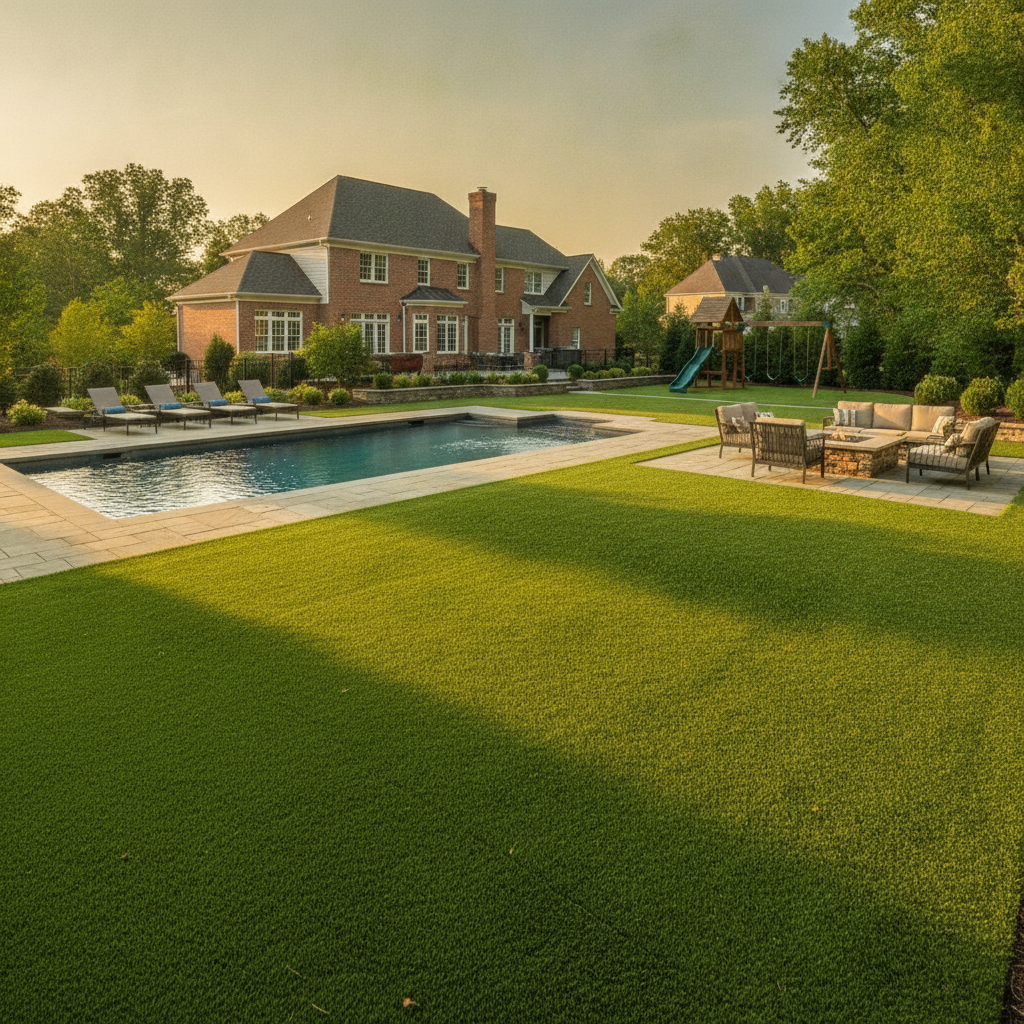
What Does Artificial Turf Installation Actually Cost in Fairfax County? A Realistic Price Breakdown
If you’ve been shopping for artificial turf in Fairfax County and gotten quotes ranging from $8 a square foot to $28 a square foot, you’re not imagining things — and nobody’s necessarily lying to you. Artificial turf pricing in Northern Virginia genuinely varies that much, and the difference usually comes down to what’s underneath the grass, not just the grass itself. Here’s an honest, detailed breakdown of what drives turf installation costs in this area, what’s reasonable to expect to pay by project type, and the questions you should ask before you sign anything.
Why Turf Pricing in Northern Virginia Is More Complicated Than It Looks
Most cost guides you’ll find online quote a flat national average — usually somewhere around $12–$18 per square foot — without accounting for the specific conditions that define this region. Fairfax County has heavy clay soil that drains poorly and expands significantly during the freeze-thaw cycles we get every winter. A reputable installer has to account for that in base preparation. The Beltway corridor also has a high concentration of townhomes with tight-access yards, older properties with uneven grades, and HOA-governed communities that may require specific product aesthetics or documentation before any installation can begin.
All of those factors affect labor, materials, and time — which is why a quote from a general landscaper or a national franchise that doesn’t account for them should raise a red flag, not a celebration.
The Real Cost Breakdown: What You’re Actually Paying For
When you break down an artificial turf installation quote, there are essentially five cost categories. Understanding each one helps you compare quotes accurately.
1. Base Preparation (Often the Biggest Variable)
This is the most commonly underbid line item in cheap quotes. A proper base in Northern Virginia typically involves removing existing sod and organic material, grading the subgrade for slope, and installing 3–4 inches of compacted crushed aggregate (usually Class II road base or decomposed granite). In areas with heavy clay — common across Burke, West Springfield, and Lake Braddock — you may also need a French drain or perimeter drainage channel to redirect water runoff. Skipping or shortcutting this step is the single biggest reason turf installations fail: you end up with puddles, soft spots, and seam separation within 2–3 years.
Base prep alone can run $3–$7 per square foot depending on site conditions, existing grade, and whether drainage infrastructure is required.
2. Turf Material
The grass itself varies widely in quality. Residential lawn turf with a 30mm–50mm pile height and UV-stabilized polyethylene fibers runs roughly $2.50–$6 per square foot at the material level, depending on face weight, fiber shape, and backing construction. Higher face weights (above 60 oz) and dual-layer drainage backings cost more but significantly outperform budget options over a 15–20 year lifespan. Grassify’s Lush Life turf is a good example of a residential-grade product engineered specifically for yards, pets, and kids — not just aesthetics.
3. Infill
Infill is the material brushed into the grass fibers to support blade orientation, add weight, and manage temperature and odor. Crumb rubber is the cheapest option but increasingly unpopular for yards with kids and pets. Silica sand is the standard baseline. For pet installations, a zeolite infill layer adds odor-control chemistry and is a non-negotiable part of a quality pet turf system. For putting greens, fine-grain sand is applied at specific rates to control ball roll speed. Infill typically adds $0.75–$2.50 per square foot depending on type and application rate.
4. Labor and Installation
Licensed, insured crews with real DMV-area experience cost more than day labor or general landscapers — and they should. Turf seaming is a craft skill. Seams done poorly are visible in months, especially in sunlight. Perimeter edges need to be anchored and finished to last through ground movement. In tight-access yards like those common in Burke Centre or townhome communities across Falls Church and Arlington, crews may need to hand-carry materials rather than use equipment, adding labor time. Labor typically runs $4–$8 per square foot for residential projects.
5. Project-Specific Add-Ons
Edging materials, weed barrier fabric, bender board borders, and drainage channel installation are often quoted separately or bundled quietly into base numbers. Always ask for a line-item breakdown.
Cost by Project Type: What to Realistically Budget
Here’s a realistic range for common project types in Fairfax County and the surrounding Northern Virginia area:
- Residential lawn (500–1,500 sq ft): $12–$20 per square foot fully installed. A 1,000 sq ft backyard in Burke or Fairfax typically runs $13,000–$19,000 with proper base prep and drainage.
- Pet turf with 5-layer drainage system: $15–$22 per square foot. The premium covers a high-flow drainage backing (400+ in/hr), zeolite deodorizer layer, and antimicrobial infill. See how Grassify approaches pet turf installation if you want to understand what that system actually involves.
- Pool deck or patio turf: $14–$22 per square foot, depending on whether you’re going over concrete or a compacted base, and whether perimeter drainage for splash zones needs to be engineered.
- Backyard putting green: $18–$28 per square foot. Sand-infill systems, hole cup installation, fringe turf, and precise grading for true ball roll all add cost — but the result is a usable practice surface, not a carpet nailed to the ground.
- Small townhome yard or courtyard (under 300 sq ft): $15–$25 per square foot. Smaller footprints don’t get cheaper per square foot — in fact, tight-access logistics and custom cuts often push the per-square-foot cost higher than larger open installs.
What Competitor Quotes Often Leave Out (And Why It Matters)
One thing that’s conspicuously missing from most competitor websites in this market is a transparent, itemized explanation of what’s actually included in a quote. You’ll see phrases like “full installation” or “turn-key service” without any detail about base depth, infill type, drainage engineering, or warranty terms on seams and edges.
That ambiguity is intentional — it makes apples-to-apples comparison nearly impossible. When you’re evaluating quotes in Fairfax County, ask every contractor these specific questions:
- How deep is the aggregate base, and what material are you using?
- Is perimeter or subsurface drainage included, or quoted separately?
- What infill type and application rate are you specifying?
- What is your warranty, and does it cover base movement, seam separation, and edge failure — or only the turf material?
- Are your crews licensed and insured in Virginia?
A contractor who can’t answer those questions clearly is likely outsourcing to unverified crews or cutting corners on base prep. In Great Falls, where many high-end properties have elaborate grading and drainage needs, that shortcut can cost you significantly more in remediation than you saved upfront.
HOA Considerations That Can Affect Your Project Cost
If you live in an HOA-governed neighborhood — and a large portion of Burke, Burke Centre, and the communities around Lake Braddock and West Springfield are — you’ll need to factor in the approval process before installation begins. Some HOAs require a specific turf color (blade color range, thatch color), maximum pile height, or a designated area restriction. Getting denied post-installation is expensive. A good installer helps you navigate that process upfront, including preparing product samples, specification sheets, and neighbor-notification documentation if required. That consultation time is part of the value you’re paying for — and it’s not something a general landscaper who dabbles in turf will offer.
Frequently Asked Questions: Turf Installation Costs in Fairfax County
Is artificial turf more expensive in Northern Virginia than in other parts of the country?
Labor costs in the DMV area run higher than the national average, and the clay-heavy soil common across Fairfax County typically requires more aggressive base prep than you’d need in a sandier region. So yes — you should expect to pay toward the higher end of national price ranges, and you should be skeptical of quotes that come in significantly below $12 per square foot for a complete residential install.
Does a larger yard cost less per square foot to install?
Generally, yes. Material waste and fixed mobilization costs get spread across more square footage on larger jobs, which typically lowers the per-square-foot price. Conversely, small yards — especially in townhome communities in Springfield, Falls Church, or Arlington — often cost more per square foot due to access challenges, custom cuts, and minimum project costs.
What’s not included in most turf quotes?
Watch for drainage infrastructure, edging materials, tree root removal, significant grading work, and HOA documentation support. These are often excluded from base quotes and added later. Always ask for a fully itemized scope of work before signing.
How long does a properly installed turf system last in this climate?
A correctly installed system — with proper base depth, quality turf fiber, and UV-stabilized backing — should last 15–20 years in Northern Virginia’s climate. Freeze-thaw cycles and humid summers are hard on cheap installations, but they don’t significantly stress a well-engineered one.
Does Grassify offer a warranty?
Yes. Grassify backs its installations with a lifetime warranty covering seams, edges, and base integrity — not just the turf material. That’s a meaningful distinction. Material warranties from manufacturers are common; installation warranties that cover the workmanship underneath are not.
Ready to Get an Honest Quote?
If you’re comparing turf quotes in Fairfax County and want someone to walk you through exactly what you’re getting — base depth, infill type, drainage plan, and warranty terms — Grassify is based right here in Burke, VA and has been installing turf across Northern Virginia, Washington, D.C., and Maryland for years. We’ll give you a real number, not a teaser rate that balloons once the crew shows up.
Request a free consultation here and we’ll come out, look at your site, and give you a fully itemized quote with no pressure and no surprises.


