
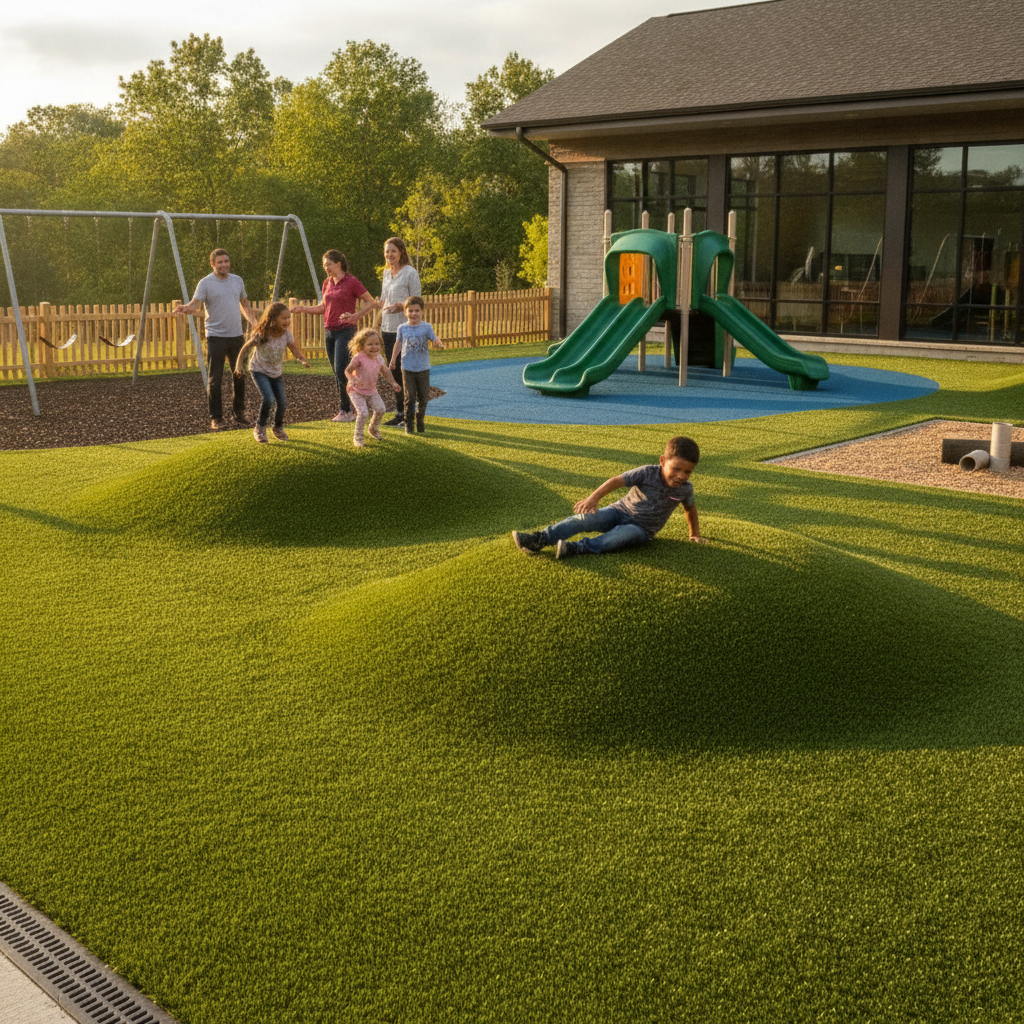
How Do You Install Artificial Turf on a Commercial Daycare or Preschool Playground in Rockville, MD? What Directors and Owners Need to Know
If you’re running a licensed daycare or preschool in Rockville, MD and you’re thinking about replacing wood chips, rubber mulch, or bare dirt with artificial turf, you’re asking exactly the right question — and the answer is more specific than most general turf installers will tell you. Playground surfacing for commercial childcare facilities isn’t a standard residential install. It requires certified shock-absorbing backing systems, ADA-accessible transitions, and drainage engineering that holds up under fifty kids per day across Montgomery County’s wet spring season. Get those details wrong, and you’re not just dealing with a call-back — you’re dealing with a licensing inspection.
Why Daycare Playground Turf Is a Different Animal Than a Backyard Lawn
Most homeowners looking at artificial turf are focused on aesthetics: how it looks, how it drains after a rainstorm, whether the dog is going to tear it up. For a commercial childcare facility, those factors still matter — but they’re secondary to safety certification. In Maryland, childcare facilities licensed through the Maryland State Department of Education must meet specific playground surfacing requirements tied to ASTM F1292 impact attenuation standards. If your surfacing doesn’t meet the critical fall height rating for the equipment installed in your play area, you’re out of compliance. Period.
That’s where CPSC (Consumer Product Safety Commission) guidelines and IPEMA (International Play Equipment Manufacturers Association) certification become non-negotiable. IPEMA-certified playground turf systems are third-party tested to confirm they meet ASTM impact standards for the specific fall heights claimed. When you’re evaluating turf proposals, you need to ask for the IPEMA certificate — not a brochure claim, not a spec sheet, the actual third-party certificate with the fall height rating listed.
At Grassify, our commercial playground turf installations use systems that are CPSC-compliant and IPEMA-certified, with critical fall height ratings matched to your specific equipment layout. That documentation travels with your project file and is available if a licensing inspector asks for it.
What the Base Prep Looks Like for a Preschool Playground in Rockville
Rockville and the broader Montgomery County area get heavy spring rainfall — often in concentrated bursts that overwhelm surfaces that weren’t engineered with drainage in mind. A daycare playground that puddles after rain isn’t just inconvenient; it shuts down outdoor time and creates liability exposure from slips and falls. Getting drainage right starts at the ground, not at the turf surface.
A proper base for a commercial playground installation typically includes:
- Excavation to 4–6 inches below finished grade, depending on the shock pad thickness required to achieve the certified fall height rating
- Compacted Class II road base graded to a 1–2% slope to direct water away from the play area and toward designated drainage points
- A certified shock-absorbing pad layer — this is what gets your system its IPEMA fall height rating; it’s not just foam, it’s an engineered pad with a tested G-max value
- High-drainage-rate turf backing — commercial playground turf needs to drain at 400+ inches per hour to prevent standing water between the fibers
What you’ll rarely hear from a general landscaper or residential-only turf company is that the shock pad and the turf surface have to be tested together as a system. The pad that achieves a 10-foot critical fall height rating with one turf product may perform differently with another. This is an area where using a certified commercial installer matters — not a crew that primarily does residential backyards and adds playground work as a side service.
ADA Accessibility: The Detail Most Contractors Skip
This is the gap that most competitor turf sites in the DMV area leave completely unaddressed. ADA Title III requires that commercial facilities — including licensed daycares — maintain accessible routes to and within play areas when they undergo surface improvements. That means your turf installation can’t create an abrupt edge or grade change that blocks wheelchair or mobility aid access to the play structure entry points.
In practice, this affects how perimeter borders are built, how transitions between turf and adjacent hard surfaces (like concrete sidewalks) are finished, and whether the system maintains a firm, stable surface across its entire area — not just at the entry point. The ADA Accessibility Guidelines for Play Areas (ADAAG) are specific, and a properly scoped commercial installation accounts for them in the design phase, not as an afterthought.
If you’re getting quotes from contractors who aren’t mentioning ADA transition details, ask them directly. The answer tells you a lot about how much commercial childcare work they’ve actually done.
Surface Temperature and Shading Considerations in the DMV Summer
Summers in Rockville, Silver Spring, and across the Maryland suburbs are genuinely hot. Artificial turf — like any dark surface — absorbs heat, and without the evaporative cooling that natural grass provides, surface temperatures can climb significantly above air temperature on sunny July afternoons. For a daycare playground, that’s a legitimate concern when young children are using the space barefoot or in sandals.
There are a few ways to address this. Heat-resistant fiber technology reduces surface temperature compared to standard polyethylene fibers. Strategic site planning — orienting the play area to maximize afternoon shade from existing trees or shade structures — makes a meaningful practical difference. And for facilities with covered or partially shaded play areas, turf performs significantly better thermally. When you’re getting site assessments, ask your installer to evaluate sun exposure and recommend products or layout adjustments accordingly.
What to Budget and What to Watch Out For in Contractor Proposals
Commercial daycare playground turf installations typically run in the range of $18–$28 per square foot installed, depending on the size of the area, the fall height rating required (which determines shock pad thickness and cost), ADA transition complexity, and whether new drainage infrastructure needs to be added. Larger footprints and simpler layouts trend toward the lower end. Small, complex spaces with multiple equipment zones, drainage tie-ins, and ADA border work trend higher.
Be cautious of proposals that come in well below that range for a commercial site. The most common cut corners are: skipping the IPEMA-certified shock pad in favor of a standard residential base, using non-certified turf products with unverified impact ratings, and treating ADA transitions as optional. Any one of those shortcuts can create real liability exposure for your facility.
Also confirm that your installer is licensed and insured for commercial work in Maryland — not just Virginia. Many DMV-area turf companies are licensed in Virginia but don’t carry the appropriate Maryland contractor credentials. For a facility in Rockville or elsewhere in Montgomery County, that matters.
Frequently Asked Questions
Does Maryland require IPEMA-certified surfacing for licensed daycare playgrounds?
Maryland childcare licensing regulations require that outdoor play areas meet safe surfacing standards under ASTM F1292 impact attenuation guidelines. IPEMA certification is the recognized third-party verification that a surfacing system meets those standards for a specific fall height. While the regulation references the standard rather than mandating IPEMA by name, an IPEMA certificate is the clearest documentation you can provide to a licensing inspector. It’s the standard any reputable commercial installer will work to.
How long does a daycare playground turf installation take?
For a typical preschool play area in the 2,000–5,000 square foot range, installation typically runs 3–5 business days once materials are on site. Site prep and excavation, base compaction, shock pad installation, turf laying, seaming, and perimeter finishing each have to cure or set properly. Rushing any stage compromises performance. Plan for a brief facility closure during installation — most daycares schedule it over a weekend plus a day or two of buffer.
Can artificial turf be installed around existing playground equipment without removing it?
Yes, in most cases. Experienced commercial installers work around existing post footings, swing set anchors, and equipment bases. The turf is cut and seamed precisely around each anchor point and finished with a clean perimeter border. What does sometimes change is the grade — if your current mulch or rubber surface sits higher than the surrounding grade, the base prep may need adjustment to achieve the right finished height relative to the equipment entry points.
How do you maintain artificial turf at a high-traffic childcare facility?
Daily use means regular maintenance matters. Weekly brushing to keep fibers upright, monthly inspection of seams and perimeter edges, and quarterly infill top-off as needed are the standard cadence for a commercial site. At a daycare, you’ll also want to address spills and tracked-in debris promptly — a leaf blower and rinse with a garden hose handles most of it. Antimicrobial infill options are available and worth considering in childcare environments. Our installation guide covers long-term maintenance basics in more detail.
What’s the lifespan of playground turf at a commercial facility?
A properly installed commercial playground system with a certified shock pad typically lasts 8–12 years in a high-traffic childcare environment. The shock pad itself may need evaluation sooner if the facility adds taller equipment that pushes the fall height requirement beyond the original certified rating. Grassify provides a lifetime warranty on seams, edges, and base workmanship — if something fails on our end of the installation, we come back and fix it.
Ready to Get a Real Assessment for Your Daycare Playground?
If you’re managing a licensed daycare, preschool, or early childhood center in Rockville, Bethesda, Silver Spring, or anywhere across the Washington D.C. metro area, Grassify will come out, walk your site, evaluate your equipment fall heights, and put together a proposal that meets Maryland compliance standards — not just a general estimate based on square footage. We’ve been doing this work across the DMV for over a decade, and we know what licensing inspectors look for and what playground directors actually need from a surfacing system. Contact us to schedule your free on-site consultation.


