
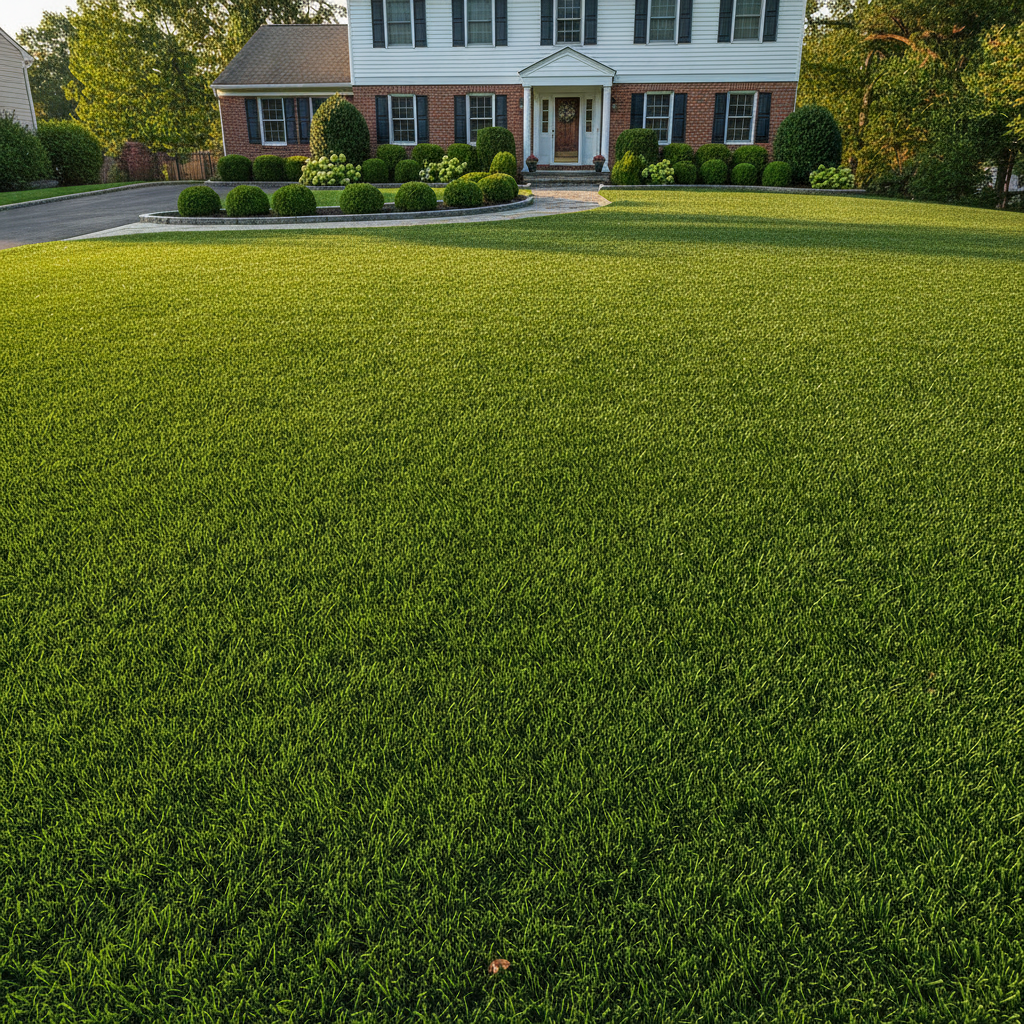
How Do You Install Artificial Turf in a Front Yard with No Irrigation System in Rockville, MD? If your front lawn has never had a sprinkler system and you’ve been limping through each summer with a hose, a patchy lawn, and a rising water bill, artificial turf is the most practical long-term answer. In Rockville and across Montgomery County, a surprising number of older homes — particularly colonials and split-levels built in the 1970s and 80s — were never set up with in-ground irrigation. Converting that struggling grass to synthetic turf doesn’t require retrofitting a sprinkler system first. In fact, that’s exactly the point: once the turf is down, you won’t need one.
But a front yard installation done right involves more than rolling out green carpet. Here’s what you actually need to know before you start calling installers.
Why Front Yards Without Irrigation Are Perfect Candidates for Artificial Turf
Natural grass in an un-irrigated front yard in Rockville faces a brutal cycle. Spring rains keep it green through May, but by July, when the DMV’s heat and humidity hit their peak, the lawn browns out fast. You hand-water when you remember, the grass turns crunchy in patches, and by August you’re looking at a front yard that’s half dirt and half stressed turf. Come fall, you overseed. Come spring, you do it again.
Artificial turf breaks that cycle entirely. Once installed, it stays green, dense, and uniform year-round — no irrigation, no reseeding, no fertilizer. For Montgomery County homeowners spending $30–$70 a month watering a front yard that still looks bad, the math on synthetic grass starts making a lot of sense within the first couple of years.
Beyond aesthetics, there’s a practical durability argument. UV-stabilized polyethylene fibers don’t bleach out, crack, or thin over time the way stressed natural grass does. A well-installed front yard turf system in Rockville — with proper base prep and quality fibers — should look sharp for 15 to 20 years without any meaningful effort on your part.
The Installation Process: What’s Different About Front Yards
Front yard turf installations have a few wrinkles that backyard jobs don’t. Access is usually easier — no narrow gate, no fence to work around — but visibility is higher, which means seam placement and edge finishing need to be precise. You’re also more likely to be dealing with walkways, tree lawn strips, utility covers, and curb transitions that require careful cutting and border work.
Site Prep and Excavation
Regardless of whether your yard ever had irrigation, the installation process starts the same way: remove the existing vegetation, excavate to the appropriate depth (typically 3 to 4 inches for a standard residential front lawn), and establish a compacted aggregate base. In Rockville, where Montgomery County soil tends to have moderate clay content, that excavation depth is important. Clay doesn’t drain — it holds water. If a crew skips proper excavation and installs turf directly over existing soil or a thin gravel layer, you’ll end up with puddles sitting under the turf after every rain.
A properly engineered base in this region uses a compacted crushed stone or decomposed granite layer that moves stormwater down and away from the surface at a controlled rate. For a standard residential front yard, you’re looking for drainage performance in the range of 30 to 50 inches per hour through the turf backing itself — more than enough to handle even a heavy mid-Atlantic downpour.
Turf Selection for Curb Appeal and Durability
Front yards are judged by neighbors, HOA architectural committees, and anyone walking by. That means pile height and color matter. For a realistic, polished look, most front yard installations in the Rockville and Bethesda area use turf products in the 35mm to 42mm pile height range — tall enough to look lush but not so tall it reads as artificial at a glance. Two- or three-tone blades with a natural thatch layer built in do a lot of the visual work here.
Because front yards face full sun exposure most of the day, UV-stabilized fibers aren’t optional — they’re a baseline requirement. Cheaper imported products without UV stabilization can yellow or lose color saturation within a few years. Quality products engineered for North American climates hold their color under sustained UV exposure without fading. You can explore Grassify’s Lush Life turf, which is specifically designed for residential lawns with the UV resistance and fiber density that Rockville’s sun exposure demands.
The HOA Question: What Rockville and Montgomery County Homeowners Need to Ask First
This is the piece that most installers — and frankly most competitor websites — completely gloss over, and it’s a real problem for homeowners who get excited about turf and skip this step.
If your home in Rockville sits within an HOA-governed community — and a large percentage of Montgomery County neighborhoods do — you almost certainly need architectural approval before any turf hits your front yard. HOAs in Maryland and Virginia vary widely on their rules. Some communities have approved synthetic grass for front yards with specific restrictions on pile height, color range, or the percentage of front yard that can be covered. Others prohibit it entirely in front-facing areas. A few have no policy at all and will evaluate your request on a case-by-case basis.
The worst outcome is installing a beautiful front yard and getting a cease-and-desist letter from your HOA two weeks later. The right installer will help you understand what documentation and product specs to submit with your architectural application — and won’t pressure you to skip that process to move faster.
If you’re not in an HOA, Montgomery County itself doesn’t currently require permits specifically for residential turf installation, but you should verify whether your municipality has any relevant stormwater or impervious surface rules that apply. A licensed local installer will know the current landscape and flag anything that needs attention before work starts.
What Competitors Aren’t Telling You: The Freeze-Thaw Factor
Here’s the angle that most turf company websites in this market completely miss — including the bigger regional players. Rockville sits squarely in a freeze-thaw climate zone. Winter temperatures oscillate above and below freezing regularly from December through February, and that cycling puts real stress on base layers, seams, and edges if the installation wasn’t done correctly the first time.
What happens when a base isn’t properly compacted or when drainage is inadequate? Water infiltrates the base, freezes, expands, and shifts. Over a few winters, that can create uneven surfaces, lifted edges, and separated seams — especially near walkway transitions and curb cuts where water naturally collects. This is particularly relevant for front yards, which have more hard-surface interfaces than backyards typically do.
A quality installation accounts for this by using the right aggregate base depth, proper compaction equipment (not just tamping by hand), and seam-bonding methods that hold under thermal expansion and contraction cycles. Ask any installer you’re evaluating how they prep for freeze-thaw stress in Montgomery County winters. If they look at you blankly, that tells you something important.
Grassify’s installations come with a lifetime warranty on seams, edges, and base — which only works as a promise if the underlying base is actually built to survive DMV winters. You can learn more about how we approach the installation process from excavation through finishing.
Cost Context for a Rockville Front Yard Project
For a typical Rockville front yard — somewhere between 400 and 1,000 square feet depending on the lot — you’re generally looking at installed costs in the range of $12 to $20 per square foot for a standard residential turf system. That range accounts for differences in excavation complexity, the turf product selected, and edge treatment requirements. More ornate border work — like curved transitions against a brick walkway or mulch beds — adds time and cost.
The offset is real and worth calculating: the average Northern Virginia or Montgomery County homeowner spends between $800 and $1,500 per year on lawn care, watering, fertilizer, and seasonal seeding. Artificial turf eliminates most of that overhead. Over a 15-year product lifespan, the economics tend to favor turf by a significant margin, especially on front yards where maintenance is more visible and non-negotiable.
FAQs: Front Yard Turf Installation in Rockville, MD
Do I need to remove my old grass before turf is installed?
Yes. Existing vegetation needs to be cleared and the area excavated to proper depth before base aggregate is laid. Installing turf over existing lawn — a shortcut some installers offer — creates drainage and stability problems that show up within a few years.
Will artificial turf in my front yard get too hot in the summer?
Synthetic turf does retain heat on sunny days, and surface temperatures can run 20–30°F above ambient air temps during peak summer hours. For front yards — which are generally walk-through rather than extended lounging areas — this is rarely a functional problem. If heat is a concern, we can discuss turf products with heat-mitigating fiber technology and recommend infill options that moderate surface temperatures.
How does artificial turf in a front yard handle heavy rain in Montgomery County?
Properly installed turf with an engineered aggregate base handles heavy rain better than compacted natural soil does. The crushed stone base and perforated backing allow water to drain rapidly — typically at 30 to 50+ inches per hour — which actually reduces surface runoff compared to a dense clay lawn. That said, drainage design needs to account for your specific grade and any hard-surface transitions.
Does Grassify help with HOA approval submissions for front yard turf?
Yes. We’ve worked with HOAs across Montgomery County, Fairfax County, and throughout the DMV. We can provide product specification sheets, color samples, and installation documentation your architectural committee typically requires for a complete application.
How long does a front yard turf installation take from start to finish?
Most standard front yard projects in the 400–800 square foot range are completed in one to two days once materials are on-site. Larger or more complex installations with extensive edging or grading work can run two to three days. Lead time from signed contract to installation start is typically two to four weeks depending on the season.
Ready to Stop Fighting Your Front Lawn?
If your Rockville front yard has been losing the battle against heat, clay soil, and a missing irrigation system, it’s time for a permanent fix. Grassify serves homeowners across Montgomery County, Fairfax County, and the broader DMV area with licensed, insured crews and installations backed by a lifetime warranty on seams, edges, and base prep.
You don’t need a sprinkler system. You don’t need to reseed every fall. You just need the right base, the right product, and an installer who knows what a Maryland winter can do to a poorly built turf job. Request your free consultation today and we’ll walk your property, answer your HOA questions, and put together a design that works for your specific yard — no pressure, no guesswork.


