
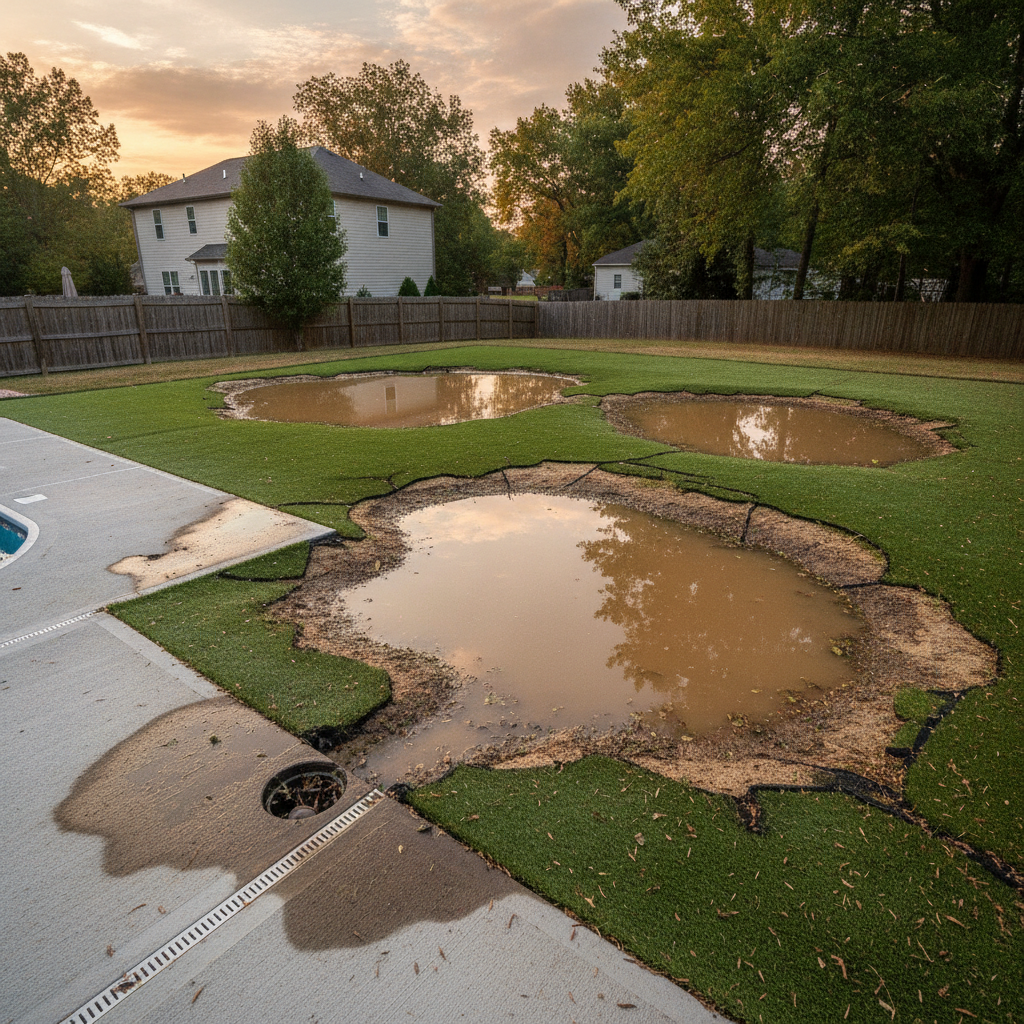
What Happens If You Install Artificial Turf Without Proper Drainage in Silver Spring, MD?
If you install artificial turf without proper drainage in Silver Spring, MD, you’re setting yourself up for standing water after every rainstorm, a base that slowly turns into a soggy, compacted mess, and a surface that smells like a locker room by midsummer. The turf itself might look fine for a season or two — but underneath, the system is quietly failing. And once the base goes, so does your investment.
This isn’t a scare tactic. It’s what happens when drainage engineering is treated as an afterthought — which, unfortunately, is more common than you’d think in the DMV market. A lot of installers will lay crushed aggregate and call it done. That’s not drainage design. That’s gravel with good intentions.
Why Drainage Is the Most Important Part of Any Artificial Turf Installation
When most people think about artificial turf, they focus on the surface — pile height, blade shape, how green it looks, how soft it feels underfoot. Those things matter. But the drainage system underneath is what determines whether your turf actually performs over a 10- to 15-year lifespan or falls apart in three.
Artificial turf is a permeable surface by design. The backing has perforations, and water is supposed to move through the grass blades, through the infill layer, and down through a compacted aggregate base that routes moisture away from the area. When any part of that system is poorly engineered — wrong aggregate depth, inadequate slope, low-permeability backing, no edge drain channels — water has nowhere to go.
What follows is predictable:
- Standing water pools on the surface after rain, creating a slippery, unusable surface and inviting mosquito breeding
- The aggregate base softens and shifts, causing the turf to ripple, bubble, or develop uneven spots
- Seams and edges lift as the base erodes unevenly — a direct result of freeze-thaw cycles putting stress on a foundation that was never properly compacted
- Organic debris and standing moisture create anaerobic conditions in the infill, which produces sulfur-like odors that no amount of rinsing will fix without pulling the turf up
In a region like Silver Spring and broader Montgomery County, Maryland — where spring rains are heavy, summers are humid, and the soil composition often includes clay-heavy subgrades that resist drainage — none of this is theoretical. It’s what happens when installers skip the engineering.
What a Properly Engineered Drainage System Actually Looks Like
A drainage system that holds up in the DMV isn’t complicated, but it does require discipline in execution. Here’s what a quality installation includes:
1. Subgrade Evaluation and Grading
Before any aggregate goes down, the existing soil needs to be assessed for drainage capacity and graded with intentional slope — typically a minimum of 1% grade toward a defined drainage outlet. In yards with clay-heavy subsoil (common in Silver Spring and across Montgomery County), this may require subgrade amendment or the installation of a French drain system to move water laterally before it reaches natural percolation layers.
2. Crushed Aggregate Base — The Right Depth, the Right Material
The standard is a compacted base of 3 to 4 inches of crushed aggregate — typically Class II road base or decomposed granite — that provides both structural support and a drainage medium. Rounded pea gravel is often substituted by budget installers because it’s cheap, but it lacks the angular interlocking properties that keep the base stable under foot traffic. Over time, rounded aggregate migrates and voids, leading to the rippling and soft spots mentioned above.
3. High-Permeability Backing on the Turf Itself
The turf backing matters as much as the base. Standard perforated turf backings drain at roughly 30 to 50 inches per hour — adequate for light residential use in a dry climate, but borderline insufficient for the DMV’s spring rain events. At Grassify, we spec products with drainage rates above 30 inches per hour at minimum, and for pet applications, our pet turf systems are engineered with five-layer drainage technology rated at over 400 inches per hour — because pet waste, heat, and humidity will expose any drainage weakness fast.
4. Perimeter Edge Drains Where Necessary
In tighter yards or installations that abut hardscape — patios, concrete borders, fence lines — water can’t exit through the perimeter the way it does on an open lawn. Perimeter channel drains or slotted pipe wrapped in filter fabric should be installed along any edge where runoff would otherwise pond. This detail gets skipped constantly by general landscapers who treat turf as just another mulch job.
The DMV Climate Makes Bad Drainage Worse — Fast
Silver Spring sits squarely in a mid-Atlantic climate that is genuinely hard on outdoor surfaces. You get 40-plus inches of annual rainfall, humid summers that keep surfaces wet long after rain has stopped, and winter freeze-thaw cycles that expand and contract any moisture trapped in a poorly drained base.
That last point is critical. When water infiltrates a base that drains slowly, it doesn’t just sit there — in winter, it freezes. Frozen water expands by about 9%, which means it pushes upward against your turf. If that happens repeatedly across dozens of freeze-thaw cycles over a winter — which is typical in Montgomery County and across the Beltway corridor — the base heaves, seams separate, and edges pull away from borders. By spring, you’re looking at a warranty conversation with an installer who may or may not pick up the phone.
This is why base preparation and drainage engineering deserve at least as much attention as the turf product itself. A $22-per-square-foot turf system installed on a poorly prepared base will fail before a $15-per-square-foot product on a well-engineered foundation.
What Competitors in This Market Often Get Wrong
Reviewing how drainage is discussed across the local turf market, there’s a consistent pattern: most companies mention that artificial turf drains well, but very few explain how drainage is actually engineered, what failure looks like, or what questions homeowners should be asking before signing a contract. You’ll find general claims about permeability but no detail on aggregate specification, subgrade assessment, or slope requirements.
That gap matters because it leaves homeowners without the knowledge to evaluate competing bids. If you don’t know that rounded aggregate is the wrong base material, you can’t catch it on a proposal. If you don’t know that a French drain may be required in clay-heavy soil, you won’t know to ask whether one is included.
Before you hire anyone for a turf installation in Silver Spring, Bethesda, Chevy Chase, or Rockville, ask these questions directly:
- What is the drainage rate specification of the turf backing you’re installing?
- What aggregate material are you using for the base, and at what compacted depth?
- Have you assessed the subgrade soil for drainage capacity, and do you plan any subgrade amendment?
- What is the designed grade slope, and where does the water outlet?
- If perimeter drainage is needed, is that included in this proposal?
A qualified installer answers these without hesitation. If you get vague reassurances instead of specifics, that’s the information you need.
You can also review our installation guide for a deeper breakdown of what quality base prep looks like from the ground up.
Frequently Asked Questions About Artificial Turf Drainage in Silver Spring and the DMV
How do I know if my yard in Silver Spring has poor natural drainage before installing turf?
After a moderate rainstorm, walk your yard 30 to 60 minutes later. If you see standing water in any area, or if the soil feels spongy and saturated, your subgrade has limited drainage capacity. This is common in Montgomery County due to clay-heavy soil. A good installer will assess this during site evaluation and factor it into the base design — potentially recommending subgrade amendment or a French drain system.
Can artificial turf make drainage problems worse in an existing yard?
Yes, if it’s installed incorrectly. An impermeable or low-permeability backing, a base with inadequate slope, or a perimeter with no outlet can actually concentrate water and make pooling worse than with natural grass. Properly installed turf with the right base and backing rate should move water faster than natural lawn, not slower.
Does pet turf need a different drainage system than regular residential turf?
Absolutely. Pet waste is liquid and organic, and it introduces a chemical and biological load that standard drainage systems aren’t designed for. Pet turf installations should include a five-layer drainage system with high flow-through capacity, a zeolite deodorizer layer to neutralize ammonia, and antimicrobial infill. Without these components, the odor problem becomes permanent — it doesn’t rinse away, it builds up in the base.
What’s the typical cost difference between a basic turf installation and one with proper drainage engineering in the DMV?
A basic turf installation in the $12 to $14 per square foot range often reflects minimal base prep — thin aggregate depth, no slope engineering, no perimeter drainage consideration. A properly engineered system with subgrade assessment, correct aggregate specification, and perimeter drainage where needed typically runs $16 to $22 per square foot depending on application and site conditions. The delta pays for itself many times over in avoided remediation costs.
How long does a properly installed turf system last in the Montgomery County climate?
With correct base preparation and drainage engineering, a quality turf system in the DMV should realistically last 15 to 20 years. The base — not the turf surface — is almost always the failure point in systems that fall short of that lifespan. Grassify backs our installations with a lifetime warranty on seams, edges, and base integrity.
Get a Drainage Assessment Before You Commit to Any Turf Installation
If you’re looking at artificial turf for a yard in Silver Spring, Bethesda, Chevy Chase, Rockville, or anywhere across Fairfax County on the Virginia side, drainage engineering isn’t optional — it’s the whole game. A turf surface is only as good as what’s underneath it, and in the DMV climate, that base will be tested every spring, every humid summer, and every freeze-thaw cycle in between.
At Grassify, every installation starts with a proper site assessment — not a quick walk-around before a hard sell. We evaluate your subgrade, design drainage slope into the base plan, spec the right aggregate depth and backing permeability for your application, and include perimeter drainage wherever the site demands it. Then we back all of it with a lifetime warranty on seams, edges, and base integrity.
If you’re ready to do turf right the first time, contact Grassify today for a free consultation. We’ll come out, evaluate your site, and give you a straight answer on what your installation actually needs — drainage and all.


