
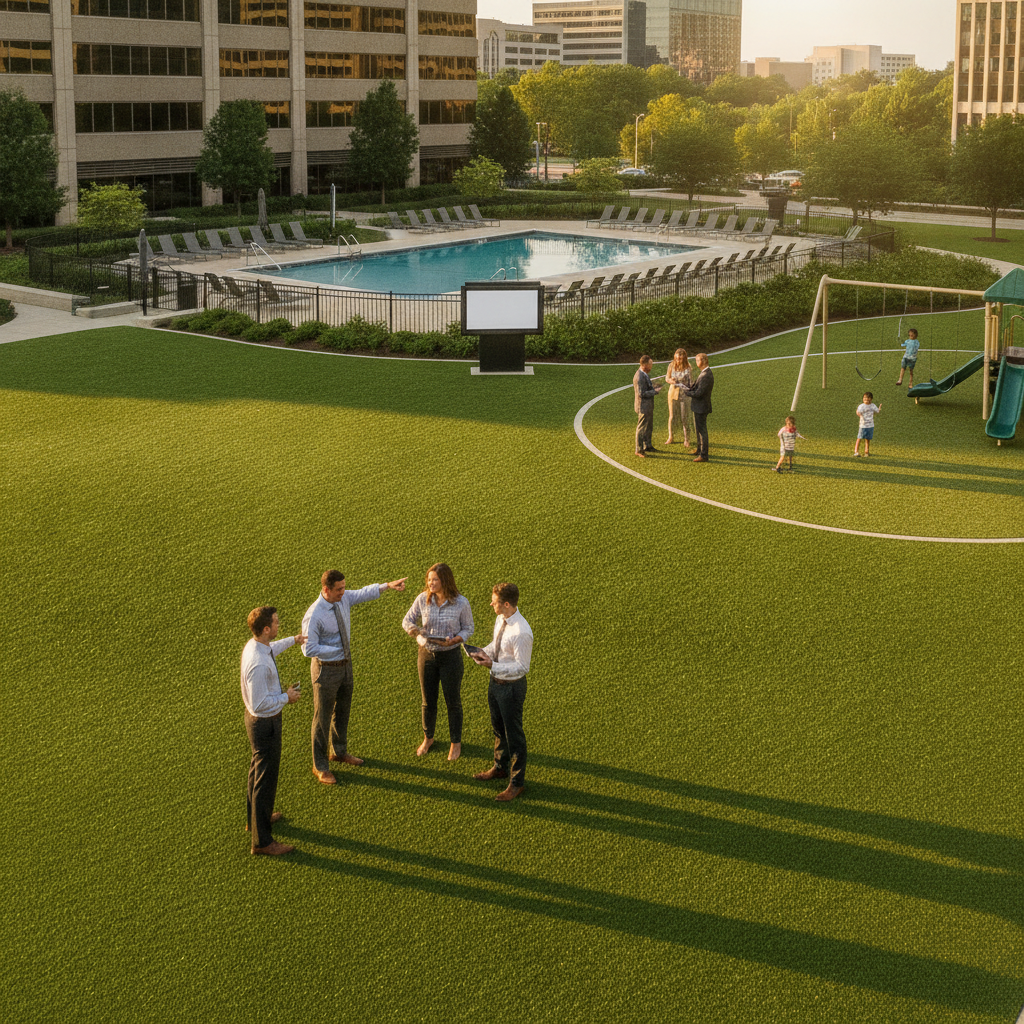
Does Commercial Artificial Turf in Chevy Chase, MD Actually Reduce Long-Term Facility Costs? What Property Managers Need to Know
Yes — when it’s installed correctly and specified for commercial use, artificial turf can meaningfully reduce long-term facility operating costs. But the answer comes with a real asterisk: the savings depend almost entirely on the quality of the installation, the turf product specified, and whether the contractor actually understands commercial applications. For property managers in Chevy Chase, MD and across the broader DMV corridor, this is where deals go wrong. You get quoted a low upfront price, the base prep gets cut short, and within two seasons you’re dealing with drainage failures, seam separations, and an angry board of directors. Let’s walk through what a legitimate commercial turf investment actually looks like — and how to tell the difference between a contractor who’s done this before and one who hasn’t.
Why Property Managers Are Looking at Artificial Turf Differently Now
Across Montgomery County, MD and down into Northern Virginia, commercial property managers are dealing with the same squeeze: landscaping contracts keep going up, water bills are climbing, and the labor needed to maintain a healthy natural lawn on high-traffic commercial grounds is increasingly hard to source reliably. Chevy Chase, in particular, has a concentration of upscale mixed-use properties, multi-family residential communities, and professional office campuses — all with exterior green space that gets heavy foot traffic and needs to look sharp year-round.
Natural turf under that kind of pressure doesn’t just look worn down — it becomes a liability. Muddy entry paths, uneven ground from irrigation failures, patchy dead zones after a dry August or a harsh February freeze-thaw cycle. All of that costs money to fix repeatedly. Artificial turf, done right, removes most of those recurring line items. But “done right” is doing a lot of work in that sentence.
The Real Numbers: Where Commercial Turf Saves Money
Here’s what actually changes on your operating budget when you switch a commercial property from natural grass to quality synthetic turf:
- Irrigation costs: Commercial irrigation on a 5,000–10,000 sq ft green space in the DMV can run $2,000–$6,000 annually depending on metered water rates and system complexity. Artificial turf eliminates virtually all of that — you only need occasional rinse-downs for debris.
- Lawn maintenance contracts: Weekly mowing, edging, fertilization, aeration, overseeding, and pest control on a commercial property adds up quickly. A mid-size commercial landscape contract in the Chevy Chase or Bethesda market can run $8,000–$18,000 per year. With synthetic turf, you replace that with periodic grooming — typically a few times a year — at a fraction of the cost.
- Repair and remediation: Turf damage from heavy use, disease, or drought on natural grass means re-sodding or overseeding — often $3–$8 per sq ft every few years. Synthetic turf eliminates those cycles entirely.
- Liability and appearance: This one’s harder to quantify, but uneven or damaged natural turf creates trip hazards and property appearance issues that affect tenant satisfaction and renewal rates in commercial settings.
At Grassify’s commercial installation pricing — which typically runs $14–$22 per sq ft depending on application, site complexity, and product selection — most commercial properties in the DMV corridor see full ROI within 4–7 years, often sooner when irrigation savings are significant. After that, you’re operating at a net cost reduction for the life of the turf, which on a properly installed commercial system is 15–20 years.
What “Commercial Grade” Actually Means (And Why It Matters Here)
This is the content gap that most local turf competitors gloss over: the difference between residential turf and genuine commercial-grade turf is not just marketing language. It’s a meaningful specification difference that affects performance, safety, and longevity — and it’s especially relevant if you’re managing a school, daycare, gym, or high-traffic property in the DMV.
Commercial turf products are built for higher foot traffic density, UV exposure over longer uninterrupted periods, and in some applications, regulatory compliance. For school and daycare playgrounds, that means CPSC and IPEMA-certified shock-absorbing backing with verified critical fall height ratings — not just a product that looks soft. For gym or indoor sports applications, it means indoor sports turf with the right pile density and infill for lateral movement and safety.
The base prep standards for commercial installations are also more demanding. In the Beltway corridor, you’re dealing with clay-heavy soils, freeze-thaw cycles every winter that stress any subsurface installation, and heavy spring rainfall that exposes drainage failures fast. A commercial base needs compacted crushed aggregate at proper depth — typically 3–4 inches for standard commercial and deeper for high-load areas — with drainage engineering that handles the volume your site actually receives, not just theoretical specs from a product sheet.
What Chevy Chase and DMV Property Managers Should Ask Before Signing a Contract
If you’re evaluating commercial turf contractors in the Maryland or Northern Virginia market, these are the questions that separate qualified installers from general landscapers who’ve added turf to their service list:
- What is the drainage rate of the product you’re specifying, and how does your base design support that rate on my site? You want a specific number (commercial systems should drain well above 30 in/hr; pet-focused commercial areas need 400+ in/hr systems) and a clear explanation of how the base is engineered to match it.
- Are your crews licensed, insured, and background-checked? For school, daycare, or multi-family residential applications, this is non-negotiable.
- What is the warranty coverage, and who backs it — you or the manufacturer? At Grassify, we back our installations with a lifetime warranty on seams, edges, and base work. If a seam lifts in year three, we fix it — no argument.
- What turf product are you proposing, and why is it appropriate for this traffic level and application? A contractor who can’t answer this specifically isn’t specifying commercial turf — they’re selling you whatever they buy in bulk.
- Have you installed commercial turf in this region before, and can you show me comparable completed projects? DMV-area climate factors — humidity, freeze-thaw, heavy spring rain — are specific enough that regional experience genuinely matters.
For commercial properties that include outdoor areas used by children, it’s also worth reviewing our commercial and playground turf services to understand what CPSC compliance actually requires at the installation level — not just the product level.
The HOA and Multi-Family Angle in Montgomery County and Northern Virginia
Many commercial properties in the Chevy Chase, Bethesda, and Silver Spring corridor are mixed-use or attached to HOA-governed residential communities. That adds a layer of complexity that purely residential installers often haven’t navigated before. You may need to satisfy both a property management board and a municipal or county review process — and in some cases, demonstrate compliance with local water conservation ordinances that actually favor synthetic turf installation.
In Fairfax County and across Montgomery County, HOA architectural committees have increasingly specific standards for how turf must look at the property boundary, what perimeter edging systems are acceptable, and whether visible drainage infrastructure needs to be concealed. These aren’t obstacles — they’re just details that need to be managed by a contractor who’s actually done it before in this region.
Frequently Asked Questions
How long does commercial artificial turf last in the DMV climate?
A properly installed commercial turf system in the Chevy Chase, Burke, or Arlington area should last 15–20 years under normal commercial traffic. The primary factors that reduce lifespan are inadequate base preparation, poor seam quality, and UV-degraded fiber from products not rated for full-sun exposure. All three are preventable with the right contractor and product specification from the start.
Do I need special permits to install commercial artificial turf in Maryland?
It depends on the municipality and the scope of work. Most commercial artificial turf installations in Montgomery County, MD and across the DMV don’t require building permits for surface-level replacement, but grading, drainage modification, or installations adjacent to stormwater infrastructure can trigger review requirements. A qualified installer should pull applicable permits and handle that process — if a contractor tells you no permits are ever needed for commercial work, that’s a red flag.
Can artificial turf handle heavy foot traffic from schools or daycares?
Yes — but only when the correct product and infill system are specified. Commercial playground turf requires CPSC and IPEMA-certified shock-absorbing backing with a verified critical fall height rating appropriate for your equipment heights. Standard residential or decorative turf products are not appropriate for these applications, regardless of how they look or how low the price is.
What’s the typical ROI timeline for commercial turf in the Chevy Chase or Bethesda area?
Most commercial properties in this market see full ROI within 4–7 years when you account for eliminated irrigation, reduced landscaping contracts, and avoided repair costs. Properties with higher water costs or large irrigated footprints often see ROI in 3–5 years. We’re happy to walk through a site-specific cost comparison during a free consultation.
Does commercial turf require any ongoing maintenance?
Yes, but it’s minimal compared to natural grass. Commercial installations benefit from periodic power brooming to keep infill distributed and fibers upright, occasional debris clearing, and rinse-downs in high-use or pet-adjacent areas. On a typical commercial property, this translates to a few scheduled service visits per year rather than weekly maintenance contracts.
Ready to Talk About Your Property?
If you’re managing a commercial property in Chevy Chase, Bethesda, Rockville, or anywhere across the DMV corridor and you want a straight answer on whether artificial turf makes financial sense for your specific situation, Grassify will give you that conversation without the sales pressure. We’ve been doing commercial and residential turf installation across Northern Virginia and Maryland for years, and we know what works here — because we’ve built it here, through real DMV winters and summers, on real DMV soil.
Request your free commercial turf consultation today. We’ll assess your site, walk through product options appropriate for your traffic and use case, and give you an honest cost-versus-savings comparison before you commit to anything.


