
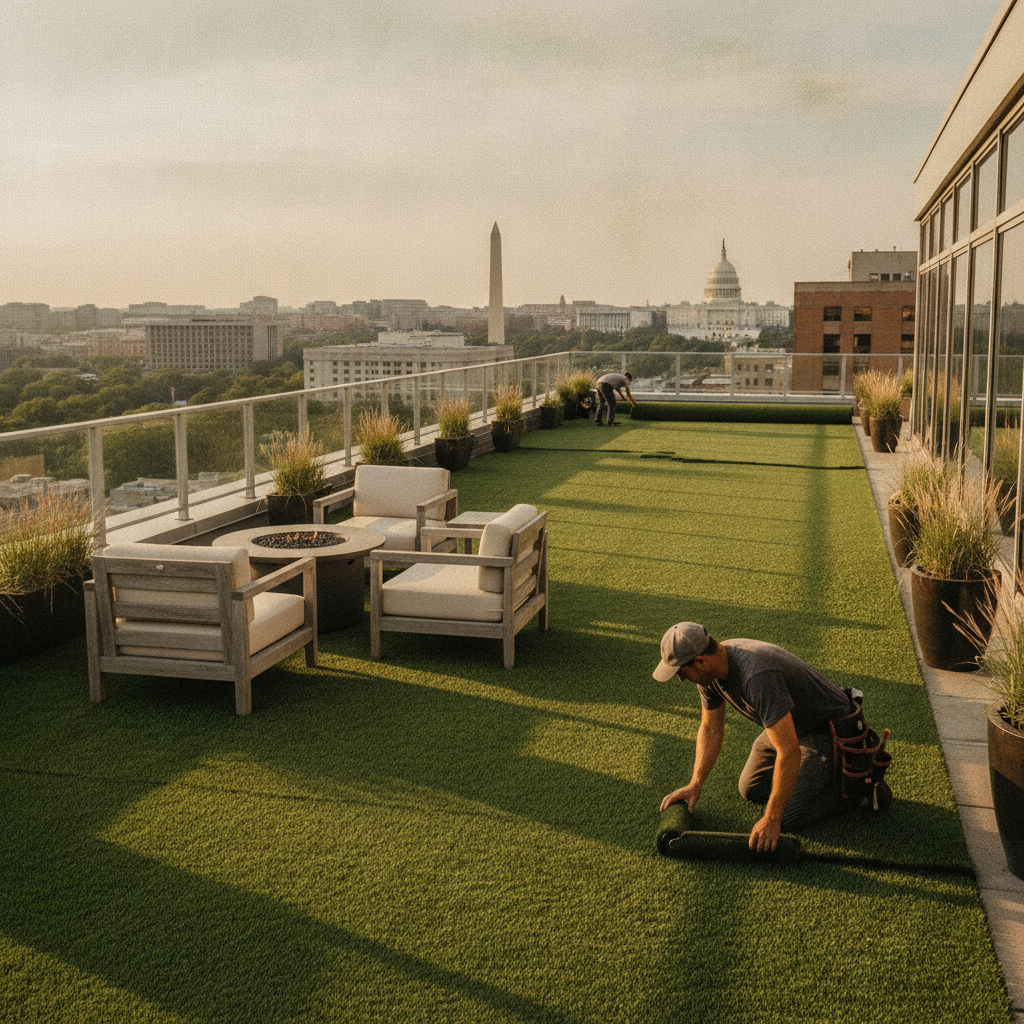
Can You Install Artificial Turf on a Rooftop or Balcony in Washington, D.C.? What Urban Property Owners Need to Know
Yes — you absolutely can install artificial turf on a rooftop terrace or balcony in Washington, D.C., and when it’s done right, it’s one of the most dramatic outdoor upgrades an urban property can get. But done wrong, it creates drainage headaches, structural risk, and the kind of condo board dispute nobody wants. The difference comes down to whether your installer actually understands rooftop and elevated surface installation — or whether they’re just rolling out residential lawn turf and hoping for the best.
We’ve done rooftop and balcony turf installations across the DMV, from high-rise terraces in D.C. to covered balconies in Arlington and Bethesda. Here’s an honest look at what these projects involve, what questions you need to ask, and what separates a proper installation from one that fails in the first rainy season.
Why Rooftop Turf Is Different From a Backyard Installation
Most homeowners assume turf is turf — that what works in a Burke, VA backyard translates directly to an urban rooftop. It doesn’t. Elevated surfaces like rooftops and balconies introduce a set of challenges that require a fundamentally different approach:
- Structural load. Artificial turf, infill, and a base layer add weight. A typical residential base uses 3–4 inches of compacted crushed aggregate, which is fine in the ground but completely impractical on a rooftop slab. On elevated surfaces, your installer needs to work within the building’s live load limits — usually 30–100 lbs per square foot depending on construction type — and choose a lightweight system accordingly.
- Drainage routing. On a standard lawn, water drains through the base and into the soil below. On a rooftop or balcony, you have nowhere for that water to go except through existing drains. If your installer doesn’t account for the building’s drainage outlets, you’ll get standing water under the turf within the first heavy spring rain — and D.C. gets plenty of those.
- Surface temperature. Rooftop surfaces get significantly hotter than ground-level installations because they’re exposed on all sides with no shade from adjacent structures. In a DMV summer, a south-facing rooftop with standard turf can reach surface temperatures well above 150°F. This is where heat-resistant, UV-stabilized fiber technology matters, not as a marketing term, but as a functional requirement.
- Wind and edge fastening. On a rooftop or open balcony, turf edges that aren’t properly anchored become a liability. Standard ground stapling doesn’t apply. Your installer needs a mechanical fastening system appropriate for the substrate — whether that’s pavers, concrete, or a composite deck surface — along with perimeter trim that holds under wind load.
What the Right Turf Product Looks Like for an Elevated Surface
Not every turf product is built for this application. For rooftop and patio installations, you want a turf with a permeable, chlorine-resistant backing, a slip-resistant texture (especially around any water features or in rain), and fibers that are UV-stabilized to handle full sun exposure year-round.
At Grassify, we typically recommend our Plush Pad product line for poolside, patio, and elevated surface applications. It’s engineered specifically for hard-surface installs — it lays flat without requiring a heavy aggregate base, the backing is designed to let water pass through to existing drains, and the fiber blend holds up against direct sun and reflected heat from surrounding concrete and glass.
Pile height for rooftop applications generally runs 30mm–38mm. You want enough density to feel substantial underfoot, but not so tall that the turf becomes unstable on a smooth concrete or paver substrate. Infill on elevated installs is typically kept minimal — a light sand layer for stability, enough to hold the fibers upright without adding unnecessary weight.
The Drainage Engineering Question Nobody Else Is Asking
This is the gap we see consistently when reviewing what local competitors have published about rooftop and balcony turf: almost none of them address drainage routing on elevated surfaces in any meaningful way. They’ll mention that artificial turf drains well — and it does, at 30 to 400+ inches per hour depending on the backing — but that only tells half the story.
The other half is: where does the water go after it passes through the turf? On a rooftop, it goes to whatever drainage outlets exist on that slab. If those drains are in the wrong location relative to your turf layout, or if the turf installation creates low spots that pool water, you end up with a saturated surface and potential damage to the building membrane below.
Before any rooftop turf project, a proper installer should walk the surface, identify all existing drain locations, and design the turf layout so that water is directed — not blocked — toward those outlets. In some cases, that means installing a thin drainage mat layer between the turf backing and the rooftop surface to create a channel for water movement even when the turf lays flat. This adds a small amount to the project cost but eliminates a problem that’s very expensive to fix after the fact.
Condo Boards, Building Management, and Getting Approval
If you own a condo or rent a unit with a private rooftop in Washington, D.C., Arlington, or Bethesda, you almost certainly need approval before modifying the outdoor surface — even if it’s deeded as your private space. Condo associations and building management companies have jurisdiction over anything that could affect the building structure, shared drainage systems, or the building’s exterior appearance.
The approval process typically requires:
- A written description of the installation including materials, weight specifications, and drainage plan
- Confirmation that the installation is removable and won’t damage the rooftop membrane
- Installer credentials — license, insurance, and often a certificate of general liability naming the building or HOA
- Sometimes a letter from a structural engineer confirming the load is within the building’s capacity
We’ve helped property owners in Alexandria and Chevy Chase navigate this process. Having your installer prepare a proper specification sheet — not just a sales quote — makes a significant difference in getting board approval on the first submission rather than going back and forth for months.
What Does Rooftop Turf Installation Actually Cost?
Rooftop and elevated surface projects typically run on the higher end of the turf installation cost range — generally $18–$25 per square foot — because of the additional logistics involved. Equipment can’t always reach upper floors easily, material staging takes more coordination, and the installation itself is more technically demanding than a standard lawn replacement.
That said, the return on investment is hard to argue with. A rooftop terrace that currently sits empty except for the occasional chair becomes a genuinely usable outdoor living space. For commercial properties — restaurants, boutique hotels, co-working spaces in D.C. — the revenue potential from a well-designed rooftop amenity easily justifies the installation cost. For residential condo owners, it’s a direct quality-of-life upgrade in a city where private outdoor space is genuinely rare.
If you’re also considering artificial turf for other areas of your property — a backyard lawn, a pet area, or a side yard — you can explore the full range of residential lawn turf options Grassify offers across Northern Virginia and the DMV.
FAQs: Rooftop and Balcony Turf in the DMV
Will artificial turf damage my rooftop membrane?
Not if it’s installed correctly. A proper rooftop turf installation uses a protective drainage mat layer between the turf and the membrane surface. This prevents any abrasion, allows water to move freely, and means the turf can be removed without leaving damage. Using mechanical fasteners that penetrate the membrane is a mistake — any reputable installer will avoid that approach.
How does rooftop turf handle D.C.’s heavy summer rains?
D.C. summers are humid and rainy, and a rooftop surface can receive a significant volume of water in a short storm event. The key is matching your turf’s drainage rate to the capacity of your existing roof drains. A good installer calculates this before the project starts. With a permeable backing and a proper drainage mat, water clears quickly and doesn’t pool under the turf.
Does rooftop turf get too hot to use in summer?
It can, on a south-facing surface with no shade. Heat-resistant turf products and light-colored infill both help reduce surface temperatures. Adding shade elements — a pergola, shade sail, or planters with tall grasses — is the most effective way to keep rooftop turf comfortable during peak summer heat.
Can I install turf on a small apartment balcony in Arlington or Bethesda?
Yes. Small balconies — even 60 to 80 square feet — are a popular application. The installation is straightforward on this scale, and even a minimal patch of green space changes the feel of an urban apartment entirely. The main considerations are edge anchoring to the balcony railing or perimeter and ensuring water drains off the edge or to an existing outlet, not into the unit below.
Do I need a structural engineer before installing turf on my rooftop?
For a lightweight turf system without a heavy aggregate base, most residential rooftops built in the last 30 years can accommodate the load without an engineering review. However, if your building or condo board requests one, or if you’re adding furniture and planters in addition to turf, a structural review is worth the investment. We can recommend what information to provide an engineer to make that process efficient.
Ready to Turn Your Rooftop Into Something You’ll Actually Use?
Rooftop and balcony turf is one of the most rewarding projects we do — and one of the most technically specific. If you’re in Washington, D.C., Arlington, Bethesda, Alexandria, or anywhere in the DMV corridor, Grassify’s team has the experience to design and install a rooftop surface that handles the region’s climate, meets your building’s requirements, and actually performs the way it should for years.
Request a free consultation and we’ll walk through your space, your building’s specifications, and the right product for your project — before you commit to anything.


