
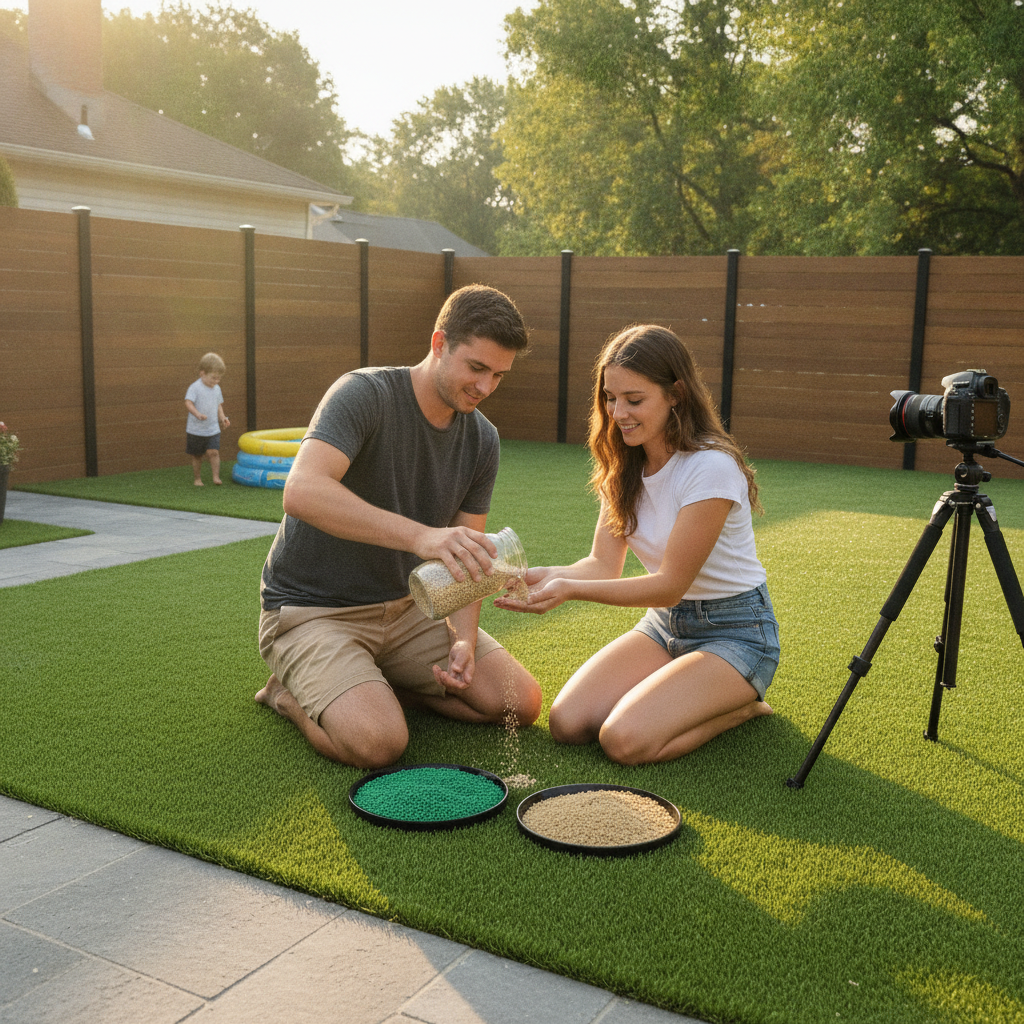
What Type of Artificial Turf Infill Is Best for a Backyard in Rockville, MD?
The short answer: it depends on how you use your yard. If you have dogs, you need a different infill than if you’re putting in a low-maintenance lawn for curb appeal. And if your kids play on it, there are health and safety considerations that should steer you away from one of the most commonly sold infill types on the market. For homeowners in Rockville, MD — where summers are hot and humid, spring rains are relentless, and backyards range from spacious lots in neighborhoods like Fallsmead to tighter setups closer to the Pike corridor — getting infill right is one of the most important decisions in the entire installation.
And yet, it’s almost never explained well. Most competitor websites in the DMV area either skip infill entirely or mention it in one vague sentence. That gap costs homeowners — because the wrong infill leads to poor drainage, matted fibers, persistent odor, and in some cases, real safety concerns for kids and pets.
Why Infill Matters More Than Most Installers Tell You
Infill is the granular material brushed into the base of your synthetic grass blades after installation. It serves several critical functions simultaneously: it weighs the turf down so it stays flat and stable, it keeps the grass blades standing upright instead of flattening over time, it regulates surface temperature, it affects how the surface drains, and — depending on the product — it controls odor and bacterial growth.
No infill is perfect for every situation, which is exactly why a one-size-fits-all approach from a general landscaper or an out-of-state franchise installer is a red flag. Someone who installs irrigation systems and natural sod six days a week isn’t going to recommend the right infill for your specific yard; they’re going to recommend whatever they stock.
The Most Common Infill Types — What They Are and Where They Belong
Silica Sand
Washed, rounded silica sand is the most widely used infill in residential applications, and for good reason. It’s inert, it doesn’t retain moisture, it drains well, and it’s affordable. For a standard residential lawn in Rockville or neighboring Bethesda — especially one that doesn’t see heavy pet traffic — silica sand is a solid baseline choice. It keeps blades upright, adds ballast weight, and doesn’t introduce any chemistry into your soil.
The caveat: silica sand alone doesn’t offer odor control, and in a hot Montgomery County summer, it can contribute to surface heat retention. For a purely aesthetic lawn, it works well. For pets or kids, you’ll want it combined with something else.
Crumb Rubber — And Why You Should Ask Hard Questions About It
Crumb rubber, made from recycled tire material, was the dominant infill in the turf industry for years — especially on sports fields. It’s resilient, it cushions impact well, and it’s cheap. It’s still widely sold, and plenty of installers in the DMV area use it without disclosing what it is.
Here’s the problem: crumb rubber contains polycyclic aromatic hydrocarbons (PAHs), heavy metals including zinc and lead, and volatile organic compounds. Several ongoing studies, including research commissioned by the EPA and California’s OEHHA, have flagged concerns — particularly for children who play on it regularly and may ingest particles. The science isn’t fully settled, but the direction of the research is clear enough that many school districts and parents across Montgomery County, MD have moved away from it entirely.
If you’re installing turf where children play, or where pets spend significant time, ask your installer explicitly: what infill are you using? If they can’t name it, that’s your answer.
Zeolite — The Right Choice for Pet Yards
Zeolite is a naturally occurring volcanic mineral with a highly porous, cage-like molecular structure that physically traps ammonium ions — which are the primary cause of urine odor in pet turf systems. It doesn’t just mask the smell; it captures the compound at a molecular level until rain or irrigation flushes it through the drainage system.
At Grassify, our pet-friendly turf installations use zeolite as a dedicated deodorizer layer within a five-layer drainage system engineered to move liquid at 400+ inches per hour. That’s not a coincidence — zeolite’s effectiveness depends on the liquid actually passing through quickly. If your drainage rate is sluggish (as it is in many budget installs), the zeolite becomes saturated and stops working. The drainage engineering and the infill type have to work together.
For Rockville homeowners with dogs, zeolite-blended infill over a properly graded crushed aggregate base is the standard we’d recommend — not because it’s more expensive, but because it’s the only combination that actually holds up through a full summer without requiring enzyme treatments every two weeks.
Organic and Coated Infill Options
Over the last several years, organic infills — including cork, coconut husk, and acrylic-coated sand — have gained traction as alternatives to crumb rubber, especially for playgrounds and child-heavy applications. These materials are non-toxic, they don’t off-gas, and some (particularly cork) have natural antimicrobial properties.
Coated sand infill, where individual silica grains are coated with an acrylic polymer, offers the weight and stability of standard silica with improved antimicrobial performance and slightly better temperature moderation. It costs more than plain silica, but for a yard in Silver Spring or Rockville that sees serious summer heat, it’s worth considering.
The trade-off with organic infills is longevity — cork breaks down faster than silica under heavy UV exposure and foot traffic, which means it may need to be replenished more frequently. Ask for realistic maintenance expectations upfront.
The Climate Factor: Why DMV Summers Change the Infill Math
Montgomery County, MD doesn’t have the extreme dry heat of Phoenix, but it has something arguably harder to manage: high humidity combined with summer temperatures regularly hitting the mid-90s. That combination accelerates bacterial growth in wet infill, concentrates odor faster in pet turf, and makes surface temperature a real comfort issue.
Standard dark infill absorbs radiant heat. In direct July sun, a black crumb rubber infill system can push surface temps well past 150°F. Lighter-colored silica sand and coated infills perform significantly better in that regard. If surface heat is a concern — and in most Rockville backyards it should be — the infill color and material type matter as much as any other spec.
Heavy spring rains, which are a consistent feature of life in this part of Maryland, also stress infill systems. If your base wasn’t properly graded and compacted before installation, infill will shift and pool water will find its way under the turf backing. That’s a base prep problem, but the wrong infill makes it worse. Our installation guide covers base prep in detail if you want to understand what proper grounding looks like before you hire anyone.
What to Ask Your Installer Before You Sign Anything
Most homeowners in Rockville, Bethesda, and Silver Spring get one or two bids, pick the lower number, and sign. That’s understandable, but it often means the infill spec never gets discussed. Before you commit, ask these questions directly:
- What infill are you using, and what is it made of? Get a brand name and a material spec sheet if possible.
- What drainage rate does your system achieve? Less than 30 inches per hour is inadequate for a pet yard. Demand specifics.
- How is the infill applied — by weight or by volume — and what depth are you targeting? Infill that’s underapplied leads to flat, matted turf within 12–18 months.
- Does your infill warranty cover performance degradation, or just the turf fiber itself? These are different things.
- Have you done installations in this specific neighborhood before? Yards near older tree canopy, clay-heavy soil, or on slopes require adjusted base prep and infill choices.
Frequently Asked Questions: Turf Infill in Rockville, MD and the DMV Area
Does artificial turf infill need to be replaced over time?
Yes, over time infill can compact, migrate toward drains, or degrade — especially organic infills like cork. Plan for an infill top-up every 5–8 years for silica systems, and inspect zeolite levels annually in pet yards. A professional installer should tell you this upfront.
Is crumb rubber infill banned anywhere near Rockville or in Maryland?
There is no statewide ban in Maryland as of this writing, but many school districts in Montgomery County have voluntarily moved away from crumb rubber on playgrounds in response to health research. For private residential use, it remains legal but increasingly uncommon among health-conscious buyers.
Can I use artificial turf without any infill?
Some turf products marketed as “infill-free” use a dense, pre-weighted backing that doesn’t require traditional infill. These can work well for low-traffic decorative applications, but for pet yards, playgrounds, or high-use backyards, they generally don’t perform as well over the long term. Ask your installer to show you real-world installs in comparable climates before going that route.
How does infill affect the feel of artificial turf underfoot?
Infill depth and material type significantly affect whether turf feels soft and natural or hard and plastic-like. Properly applied silica sand at the right depth keeps blades upright and gives a realistic softness. Under-infilled turf feels like walking on a tightly woven carpet over concrete — because it essentially is.
Does Grassify serve Rockville, MD and Montgomery County?
Yes. Grassify serves homeowners and commercial clients throughout the DMV, including Rockville, Bethesda, Silver Spring, and surrounding areas in Montgomery County. We handle everything from HOA documentation and base grading to infill selection and post-install inspection.
Ready to Get the Right Turf System for Your Backyard?
Infill isn’t a detail you should figure out after the crew shows up. It’s a core spec decision that affects how your turf performs for the next 15–20 years. If you’re in Rockville, Bethesda, Silver Spring, or anywhere across Montgomery County, MD — or if you’re on the Virginia side in Burke or Fairfax County — Grassify will walk you through exactly what infill system fits your yard, your pets, your kids, and your local soil conditions before a single square foot of turf is laid.
Request a free consultation here. We’ll come out, evaluate your space, and give you a straight answer — no upsell, no vague estimates, no fine print on infill type.


