
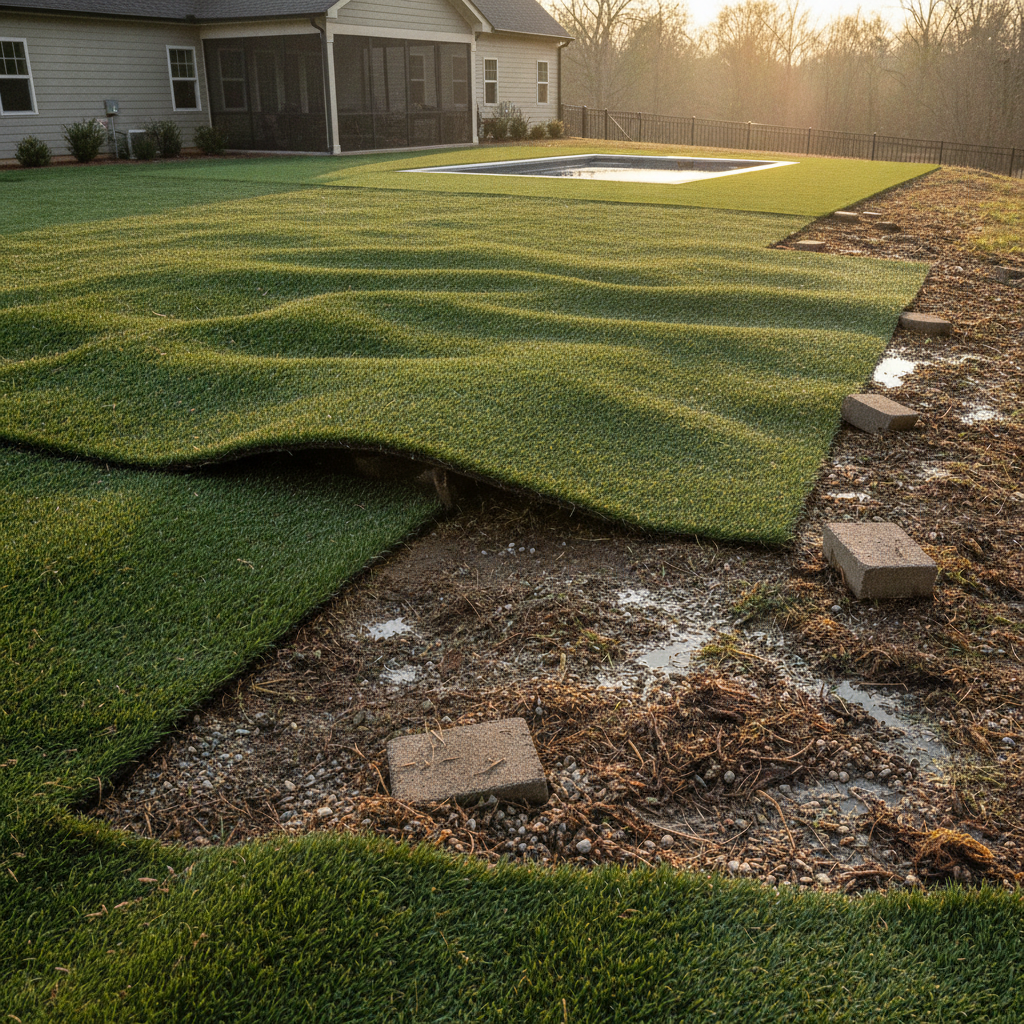
What Kind of Base Does Artificial Turf Actually Need in Waldorf, MD? A Ground-Up Guide for Property Owners
If you’re considering artificial turf for your home or property in Waldorf, MD, the most important thing to understand has nothing to do with the grass itself — it’s what goes underneath it. The base is the foundation your turf will live on for the next 15 to 20 years. Get it right, and you’ll have a flat, well-draining, odor-free surface that holds up through every Southern Maryland summer thunderstorm and January freeze. Get it wrong, and you’ll be dealing with pooling water, uneven settling, seam separation, and a whole lot of regret. This guide breaks down exactly what a proper artificial turf base requires, why it matters more than most installers want to admit, and what to ask before anyone picks up a shovel on your property.
Why Base Preparation Is the Step Most Installers Rush — and Why You Shouldn’t Let Them
Here’s the uncomfortable truth: base prep is the most labor-intensive, least visible part of any turf installation. Because homeowners can’t see it once the turf rolls out, it’s also the step that gets cut the most by installers trying to hit a low bid number. That’s especially common in this region, where a wave of out-of-state franchise turf companies have moved into the DMV market offering suspiciously low quotes that look great until the second or third heavy rain.
A proper base isn’t just gravel thrown down and packed loosely. It’s an engineered drainage system built to handle Southern Maryland’s rainfall patterns — and Waldorf gets a lot of rain. The area averages over 44 inches of precipitation per year, with intense spring downpours and humid summer storms that can dump two inches of water in under an hour. If your base can’t move that water out fast enough, it backs up under the turf, creates soft spots, and eventually starts to smell — especially if you have dogs.
What a Proper Artificial Turf Base Looks Like, Layer by Layer
A well-built base for residential turf in this region typically involves the following sequence. Every layer matters, and skipping or thinning any one of them will compromise the whole system.
Step 1: Excavation and Soil Removal
The existing soil, sod, and organic material need to come out — typically 3 to 4 inches deep for a standard residential lawn, and up to 6 inches for pet turf systems that require deeper drainage capacity. In Waldorf and surrounding Southern Maryland communities, the native soil tends toward clay-heavy composition, which holds moisture and resists drainage on its own. That clay has to be fully removed from the installation zone. If an installer tells you they can lay turf directly over your existing soil with just a light scalp — walk away.
Step 2: Weed Barrier Fabric
Once the soil is excavated, a commercial-grade weed barrier fabric goes down before any aggregate is added. This isn’t the thin landscaping fabric sold at hardware stores — it’s a permeable, UV-stable geotextile rated for long-term below-grade use. It prevents weed root intrusion upward into the base while still allowing water to pass through freely in the opposite direction.
Step 3: Crushed Aggregate Sub-Base
This is the backbone of the entire system. A 3- to 4-inch compacted layer of crushed decomposed granite or Class II road base aggregate gets packed in using a plate compactor. This material compacts tightly, drains quickly, and doesn’t shift under foot traffic the way pea gravel or sand-only bases do. The compaction step is critical — under-compacted base is the single biggest cause of turf surface settling and uneven appearance within the first year.
Drainage rate through this layer should be engineered to exceed 30 inches per hour, which gives the system meaningful headroom above what even heavy rainfall events deliver. For pet turf systems, Grassify builds a 5-layer drainage system with a zeolite deodorizer layer and antimicrobial infill that pushes drainage capacity to over 400 inches per hour — because liquid from pet use is far more concentrated and odor-intensive than rainwater alone.
Step 4: Fine Leveling Layer and Grade Management
After the main base is compacted, a thin top-dressing of fine crushed aggregate or leveling sand is applied and graded to create the correct slope for water runoff. This is where the installation crew’s experience shows. Grading is done by eye and laser level together, and getting it right requires someone who’s done it hundreds of times — not a general landscaper who occasionally lays turf as an add-on service.
In Southern Maryland and up through Prince William County and Stafford, we often encounter yards with slight natural grade problems — low spots that have collected water for years before turf was ever considered. Correcting those grade issues during base prep is the right time to address them. Doing it after the turf is laid is expensive and disruptive.
Step 5: Turf Installation and Infill Application
Only after all of the above is complete does the turf itself get rolled out, seamed, anchored at the edges, and infilled. For residential lawns, silica sand or a sand-and-crumb-rubber blend is typically used as infill to support fiber upright position and add ballast. For putting green installations, a pure silica sand infill is used to achieve the consistent ball roll that makes practice meaningful. The infill rate, pile height (typically 30mm to 50mm for residential lawns), and fiber density all affect how the finished surface looks and performs.
You can explore Grassify’s full installation guide for a deeper look at how each phase is documented and quality-checked on every project we complete.
The Freeze-Thaw Factor: Why Base Quality Matters Even More in This Region
Waldorf, Fredericksburg, and the broader DMV corridor experience genuine freeze-thaw cycles every winter — not the deep freezes of the Upper Midwest, but enough repeated cycling between above- and below-freezing temperatures to stress any poorly built base. Water trapped in under-compacted aggregate expands when it freezes, which causes heaving, surface unevenness, and seam stress over multiple winters. A properly compacted, well-draining base eliminates that standing water before it has a chance to freeze, which is why base prep isn’t just a summer concern.
Installers who come down from out of state and aren’t familiar with Fairfax County or Southern Maryland’s freeze-thaw patterns sometimes skip the depth of compaction needed to handle this. After 12-plus years of installations across the DMV — from Burke and Springfield up through Waldorf and down to Stafford — we can tell you that the bases that hold up through five or six winters are the ones built with compaction rates and drainage rates that don’t cut corners.
What Competitors Aren’t Telling You About Base Specs
After reviewing the content on several competing turf installer websites serving the DMV market, one thing is strikingly absent: any real technical explanation of base construction. Most sites describe artificial turf installation as a straightforward process — remove old grass, add base, install turf — without disclosing what type of aggregate is used, what depth is required, what drainage rate the system achieves, or how compaction is verified. That vagueness isn’t accidental. It gives installers room to adjust their base specs downward when they need to hit a lower bid number.
When you’re getting quotes for turf installation in Waldorf or anywhere else in Southern Maryland, ask every installer to specify in writing: the aggregate type, the compaction depth, the drainage rate, and whether the final grade will be laser-verified before turf is laid. Any installer unwilling to answer those questions specifically is probably not building the base your investment deserves.
Frequently Asked Questions: Turf Base Prep in Southern Maryland
How deep does the base need to be for a standard residential lawn?
For most residential applications in this region, a 3- to 4-inch compacted crushed aggregate base is the minimum. Yards with poor native drainage, significant clay content, or pet use often warrant 4 to 6 inches. We assess each site individually before quoting.
Can turf be installed directly over concrete or an existing patio?
Yes — on concrete or pavers, you skip the aggregate base entirely and use a turf-specific foam or drainage pad underlayment instead. The approach differs significantly from ground-level installation and requires different products. Drainage holes or gaps in the concrete surface matter too.
What’s the difference between decomposed granite and pea gravel as a base?
Decomposed granite compacts into a dense, stable surface that resists shifting under foot traffic. Pea gravel does not compact — it migrates under pressure, creating soft spots and uneven areas over time. For turf installation, pea gravel is not an appropriate primary base material.
How long does base preparation take on a typical residential project?
For a standard 500- to 1,000-square-foot residential yard, base prep typically takes one full day before turf installation begins the following day. Larger projects, significant grade corrections, or tight-access yards may add time. We schedule base prep and turf installation on separate days to allow proper compaction and inspection.
Does the base warranty cover settling or unevenness after installation?
Grassify backs every installation with a lifetime warranty on seams, edges, and base performance. If the base settles unevenly or drainage fails due to our workmanship, we come back and fix it. That warranty is worth asking about with any installer — because the base is the one thing you’ll never see but will absolutely feel if it’s built wrong.
Ready to Talk About What’s Going Under Your Turf?
Most conversations about artificial turf start with the grass. Ours starts with the ground. If you’re in Waldorf, Stafford, Fredericksburg, or anywhere else in the Southern Maryland and Northern Virginia corridor and you want a straight answer about what your specific property actually needs beneath the surface, reach out to the Grassify team. We’ll walk your yard, assess your soil, drainage patterns, and grade — and give you a clear picture of what the right base looks like before we ever talk about which turf product goes on top of it.
Request your free on-site consultation today and let’s start from the ground up — literally.


