
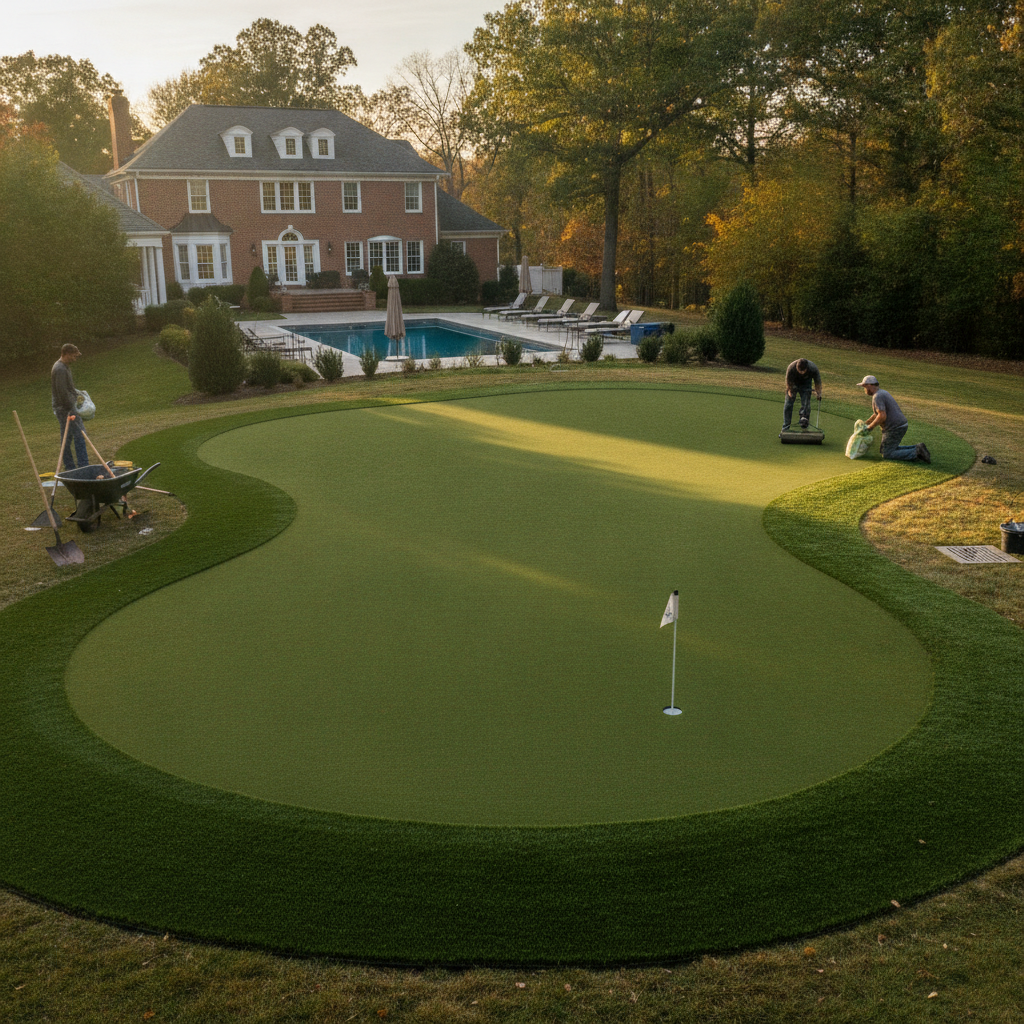
How Do You Build a Backyard Putting Green in Great Falls, VA? What Golfers Need to Know Before They Start
Yes — you can absolutely build a backyard putting green in Great Falls, VA, and when it’s done right, it genuinely improves your short game. But the phrase “done right” is doing a lot of heavy lifting in that sentence. A proper synthetic putting green isn’t just a patch of short turf with a hole cut in it. It’s an engineered surface: shaped subgrade, compacted aggregate base, purpose-built turf with specific fiber architecture, calibrated sand infill, and drainage that handles our Northern Virginia rainfall without turning soft or lifting at the seams. Get those elements right and you’ll have a green that rolls true for 15 or 20 years. Skip corners and you’ll be looking at a bumpy, puddling mess inside two seasons.
Great Falls is one of the better neighborhoods in Fairfax County for this kind of project. Lots are large, clay-heavy soil is common, and there’s real outdoor living space to work with. But that clay subsoil is also exactly why base engineering matters so much out here — and why a lot of the generic putting green kits sold online fall flat almost immediately.
What Makes a Synthetic Putting Green Actually Putt Well?
Most homeowners shopping for a backyard green focus on the turf product itself, which makes sense. But experienced installers will tell you the turf is almost secondary to what goes underneath it. Here’s the honest breakdown of what determines ball roll and surface consistency:
The Base Is Everything
A proper putting green base starts with excavation — typically 4 to 6 inches deep, depending on your existing soil conditions. In Great Falls and across much of Fairfax County, you’re often dealing with Virginia red clay, which compacts well but drains poorly on its own. That clay needs to come out and be replaced with a crushed aggregate base (usually a decomposed granite and crushed stone mix) that’s graded to your green’s contours, then mechanically compacted in lifts.
This is where the shape of your green gets built. Any undulations, slopes, or false edges are sculpted into the base — not into the turf. If you try to create contours by manipulating the turf layer itself, the ball roll will be inconsistent and the surface will shift over time as the material settles. Real contouring happens at the base level, before the turf ever goes down.
The Right Turf for Putting — Not Just Any Short Grass
Putting green turf is a completely different product category from residential lawn turf. You’re looking at pile heights in the 10mm to 15mm range (compare that to 30mm–50mm for a lawn surface), with a very tight, dense fiber structure that mimics the feel of a bentgrass green. The backing needs to be semi-permeable — firm enough to support consistent ball roll, but not so rigid that it creates dead spots.
At Grassify, we use Pro Putt for our putting green installations — a purpose-engineered surface with a true-roll fiber system and a sand-infill-compatible backing that holds its firmness through freeze-thaw cycles. That last part matters a lot in the DMV. A green that plays beautifully in September needs to come back in March without lifting seams or surface irregularities.
Sand Infill and Stimp Speed
Sand infill is what gives a synthetic putting green its speed and firmness — what golfers call stimp rating. A properly infilled green typically plays at 9 to 11 on the stimpmeter, which is comparable to a well-maintained public course green. The infill is broadcast evenly across the surface after installation and worked into the fiber using a power broom. Too little infill and the surface plays slow and soft. Too much and you start getting irregular bounce.
This calibration is something a lot of DIY installations and low-cost contractors get wrong. It’s not just dumping a bag of silica sand on the turf — it requires knowing the specific product’s infill rate by square foot and brushing it in with equipment that most homeowners don’t have.
What a Backyard Putting Green Project Actually Looks Like From Start to Finish
If you’re planning a custom green in Great Falls, McLean, or the Potomac, Maryland area across the river, here’s what a realistic installation timeline and process looks like:
- Site assessment and design: A good installer walks your yard, evaluates grade and drainage, identifies any utility or irrigation conflicts, and helps you design a shape that works with your space. Most residential greens run between 200 and 800 square feet, though we’ve done much larger for clients with more land.
- Permitting: Most Fairfax County jurisdictions don’t require a permit for a backyard putting green, but if you’re adding a retaining wall, drainage structure, or anything over a certain grade change, that can change. Always worth a quick check.
- Excavation and base prep: Two to three days depending on size. This includes excavating existing soil, installing drainage if needed, laying and grading the aggregate base, and compacting in lifts.
- Turf installation: One to two days. Turf is cut and seamed on-site, edges are secured with bender board or concrete edging, and cups and flags are installed.
- Infill and finishing: Infill is applied and worked in, the surface is brushed out, and the green is inspected for consistency.
- Total timeline: Most residential greens take four to six days from excavation to first putt, weather permitting.
The Gap Most Competitors Don’t Talk About: Fringe Turf and How It Affects the Full Experience
Here’s something you’ll notice if you browse most local turf websites: they show you pictures of a putting cup and a flag, but they rarely explain how the surrounding fringe turf integrates with the green — or why it matters for how the green actually plays and looks.
A fringe border (typically 12 to 24 inches wide around the perimeter of the green) serves two purposes. Aesthetically, it provides a visual transition from the ultra-short putting surface to your surrounding yard. Functionally, it gives you a chipping and bump-and-run zone that makes the green far more versatile for short-game practice.
Fringe turf runs at a slightly longer pile height than the green surface — usually 20mm to 25mm — with a softer feel underfoot. The seam between green and fringe needs to be done precisely; a poorly executed seam will create a lip that deflects putts and looks sloppy. We secure seams with a combination of adhesive and galvanized nails into the aggregate base, then finish with a tuck that makes the transition nearly invisible.
For homeowners in Great Falls or Bethesda who are investing in a premium outdoor space, this detail is the difference between a green that looks custom-built and one that looks like an afterthought.
Cost Context: What Should You Expect to Budget?
Backyard putting greens typically run between $15 and $25 per square foot installed, depending on the complexity of contouring, access to the yard, number of cups, and whether you’re adding fringe turf or surrounding lawn turf at the same time. A 400-square-foot green with two cups, a fringe border, and moderate contouring is a realistic midpoint project for most Great Falls properties. For a full picture of what drives turf pricing in the area, our putting greens service page breaks this down further.
Don’t anchor on the cheapest bid. In our experience across Fairfax County and the broader DMV, the lowest-priced putting green installations consistently cut corners on base depth or infill calibration — two things you can’t fix without tearing the whole surface up.
Frequently Asked Questions: Backyard Putting Greens in Northern Virginia
How long does a synthetic putting green last?
A properly installed green with quality turf and a well-compacted base should give you 15 to 20 years of consistent performance. Grassify backs our installations with a lifetime warranty on seams, edges, and base integrity — so if something fails on our end, we come back and fix it at no cost.
Will a putting green hold up through Northern Virginia winters?
Yes, if the base is engineered correctly. The freeze-thaw cycles in Fairfax County and the surrounding area can stress a poorly prepared base — you’ll see lifting seams and surface rippling on cheap installs come spring. Our base compaction process is specifically designed for mid-Atlantic freeze-thaw conditions.
Can I add a putting green alongside my existing lawn turf?
Absolutely. We commonly install a combination of lawn-height turf for general use and a putting surface in a dedicated corner or zone. The two surfaces seam together cleanly and the difference in pile height creates a natural visual boundary. Check out our residential lawn turf page to see how full-yard designs come together.
Do I need HOA approval for a putting green in Great Falls?
Great Falls is largely unincorporated Fairfax County with many HOA-governed communities. Whether you need approval depends on your specific HOA’s CC&Rs. Many associations treat a backyard putting green as a landscaping modification that requires written approval before installation. We help homeowners prepare documentation packages — including product specs, drainage plans, and visual mockups — to smooth that process.
How many cups should a backyard putting green have?
Most homeowners choose two to four cups, which gives you enough variety to practice different line and distance combinations without overcomplicating a smaller space. For greens under 300 square feet, two cups is usually plenty. Larger greens with more complex contouring can support four or more cup positions meaningfully.
Ready to Build Your Backyard Green?
If you’re in Great Falls, McLean, Potomac, Bethesda, or anywhere across Fairfax County or Montgomery County, Grassify designs and installs custom backyard putting greens built to actually perform — not just look good in a photo. We’ll walk your yard, talk through your short game goals, and put together a design that works with your space and your budget.
Reach out through our contact page to schedule a free on-site consultation. No pressure, no obligation — just a real conversation about what a custom green on your property would take.


