
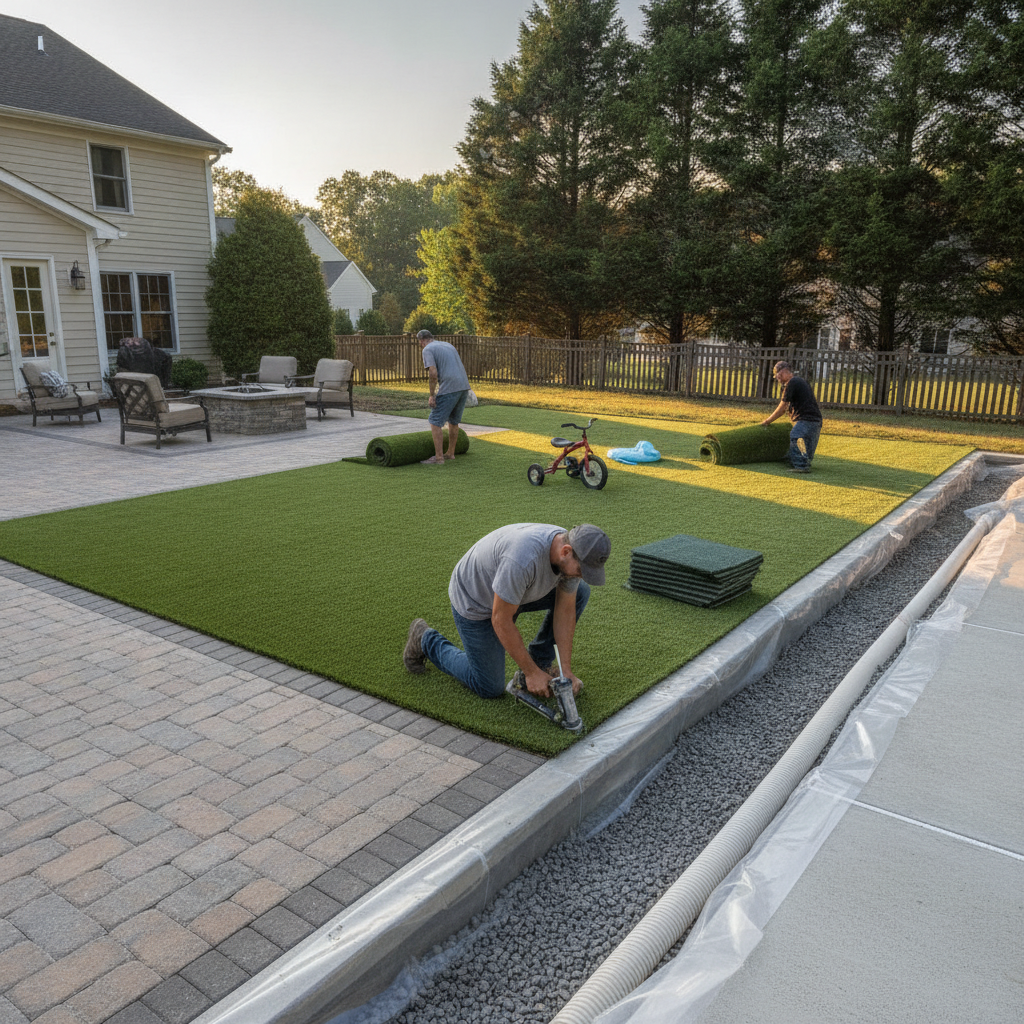
How Do You Install Artificial Turf on a Concrete or Paver Patio in Burke, VA? What Homeowners Need to Know
Yes, you can install artificial turf directly over concrete or existing pavers — and in Burke, VA, it’s one of the more common requests we get, especially from homeowners with aging backyard patios they want to soften without tearing everything out. But “can you” and “should you do it yourself with a big-box kit” are two very different questions. The installation method, drainage planning, and adhesive selection all need to be matched to your specific surface, or you’ll end up with bubbling seams, pooling water, and a turf installation that fails in two seasons instead of lasting fifteen years.
Why Homeowners in Burke and Fairfax County Are Choosing Turf Over Hard Surfaces
A lot of homes in Burke Centre, Rolling Valley, and the surrounding Fairfax County neighborhoods were built with concrete patios or large paver fields in the backyard. These surfaces age — they crack, stain, fade, and get slippery. Replacing them entirely can cost significantly more than installing turf on top, and the results rarely look as inviting.
Artificial turf over an existing hard surface gives you a surface that’s softer underfoot, cooler-looking than bare concrete, and far more usable year-round. For families with kids or pets who want a low-maintenance outdoor space without the mud and maintenance of natural grass, it’s genuinely practical. For pool surround areas, it also introduces a slip-resistant, drainage-friendly alternative to concrete that doesn’t blister your feet in July.
What makes this installation category tricky is that concrete and pavers don’t behave like soil. You can’t dig into them, compact a new base layer, or redirect water flow the same way you can in a standard lawn installation. Every drainage and adhesion decision has to account for what’s already there.
The Drainage Problem Nobody Talks About — and Why It Matters in Northern Virginia
If you search for how to install turf on concrete, most guides will tell you to glue the turf down and call it a day. That works fine in Arizona. In Northern Virginia, it’s a recipe for trouble.
The DMV area averages 40-plus inches of rain per year, with heavy spring downpours that can dump two or three inches in a few hours. Fairfax County’s freeze-thaw winter cycles add another layer of stress — water that doesn’t drain properly can get trapped under turf on concrete, freeze, expand, and start lifting seams or separating adhesive bonds by February.
Before any turf goes down on a concrete or paver surface, we assess the existing slope and drainage paths. Concrete patios that drain correctly — meaning they pitch away from the structure at roughly a quarter-inch per foot — can support turf installation without major modification. Patios that are relatively flat, crowned toward the house, or have settled unevenly need drainage corrections first, which sometimes means grinding the concrete surface to improve flow or installing perimeter French drains before we ever unroll a piece of turf.
On paver surfaces, drainage is usually better because water can move between joints — but only if those joints haven’t been sealed. Sealed pavers essentially become concrete for drainage purposes and need to be evaluated the same way.
Adhesion Methods: What Actually Holds Turf to a Hard Surface
There are three main approaches to securing artificial turf to concrete or pavers, and which one is right for your project depends on the surface condition and the intended use.
- Full perimeter adhesive bond with interior seam tape: This is the standard method for most patio applications. A two-component polyurethane adhesive is applied along all edges and seams, while the field of the turf floats freely across the surface interior. This allows the backing to breathe and minimizes adhesive failure from surface expansion and contraction during temperature swings.
- Full-field adhesive bonding: Used for high-traffic commercial applications or areas subject to strong wind uplift. This method completely bonds the turf to the surface and requires a completely clean, level, and sealed substrate. It’s more permanent and generally more expensive.
- Mechanical fastening into pavers or perimeter concrete: In some cases, especially around pool decks and for installations against vertical edges, we use concrete anchors or tapcon screws into a concrete border to mechanically fix edges before adhesive sealing. This is particularly useful where pool chemicals or frequent water exposure might degrade adhesive over time.
DIY kits from home improvement stores almost universally use double-sided carpet tape or low-grade contact cement. Neither holds reliably against Northern Virginia’s summer heat — surface temperatures on concrete can reach 130–150°F on a July afternoon — and both tend to fail within a season or two. A professional installation uses industrial-grade, UV-resistant adhesives rated for outdoor use in high-temperature environments.
What Turf Products Work Best Over Hard Surfaces
Not all artificial turf is designed for hard-surface applications. Products meant for in-ground lawn installations typically have thicker, heavier backing systems designed to anchor into a crushed stone base — these can feel stiff and uncomfortable when laid flat on concrete without a pad layer underneath.
For patio and deck applications, look for turf with a more flexible, open-weave backing that allows water to move freely through the pile and drain at the edges. Pile heights in the 30mm–38mm range tend to work best on hard surfaces — tall enough to feel soft and natural, but not so heavy that the turf develops wave patterns when it can’t be anchored from below.
If comfort underfoot is a priority — particularly for pool deck areas or spaces where kids or pets will spend a lot of time — a foam shock pad or perforated rubber pad installed between the turf and the concrete adds cushion and brings the surface temperature down noticeably on hot summer afternoons. Pool deck turf installations almost always benefit from a pad layer, especially here in the DMV where July heat can make unshaded hardscape surfaces genuinely uncomfortable.
What the Installation Process Actually Looks Like
A professional concrete or paver turf installation in a typical Burke or Springfield backyard follows a predictable sequence:
- Surface inspection and prep: The concrete or paver field is cleaned, inspected for cracks or low spots, and evaluated for drainage slope. Cracks larger than a quarter inch are patched before proceeding. Any oil stains or sealers that would prevent adhesive bonding are addressed.
- Drainage assessment and corrections: If the surface drains poorly, we address that now — before turf goes down. This may involve surface grinding, perimeter drain installation, or simply confirming that existing drainage paths are clear.
- Turf layout and cutting: Rolls are laid out to minimize seam placement in high-visibility areas. For patio applications, seams are typically placed along the longest straight edge or tucked against a wall or border.
- Adhesive application and bonding: Perimeter and seam adhesive is applied, edges are weighted or clamped during cure time (typically 24–48 hours), and any mechanical fasteners are installed.
- Infill application: Depending on the application, silica sand or a blended infill is brushed into the pile to stabilize fiber direction and add weight. For pet-friendly patio areas, a zeolite deodorizer layer is incorporated into the infill.
- Edge finishing: All perimeter edges are trimmed cleanly and sealed. Bender board or aluminum edging is installed where the turf meets a vertical surface.
For most standard patio projects in Fairfax County — say, a 400–600 square foot concrete patio — installation typically runs one to two days depending on surface prep requirements. Cost ranges for hard-surface turf applications generally fall between $14 and $22 per square foot installed, reflecting the adhesive and surface prep labor that a standard lawn installation doesn’t require. You can explore options for your specific backyard through Grassify’s residential turf services.
A Word on HOA-Governed Neighborhoods
Many homeowners in Falls Church, Alexandria, and across Fairfax County live under HOA rules that govern exterior improvements. Turf installed on a back patio that’s not visible from the street typically flies under the radar, but if your patio is visible from common areas, a community walkway, or a neighbor’s fence line, it may still require architectural review board approval. We’ve helped dozens of homeowners in HOA-governed communities prepare the documentation — material samples, drainage plan summaries, pile height specs — that makes approval straightforward. Don’t skip this step and assume you’re fine because it’s “just the patio.”
Frequently Asked Questions
Can artificial turf be glued directly to concrete without any base layer?
Yes, in most cases turf can be adhesive-bonded directly to concrete without a base layer — provided the concrete is clean, structurally sound, and drains properly. For comfort-focused applications like pool decks or play areas, a perforated foam or rubber pad between the turf and concrete improves feel and reduces surface heat.
Will the adhesive damage my concrete if I ever want to remove the turf?
Most polyurethane turf adhesives will leave a residue on concrete that requires grinding or chemical removal to fully clean. If preserving the original concrete surface matters to you, discuss this with your installer before bonding — mechanical perimeter fastening combined with a floating field installation is a more reversible option for some applications.
What happens to turf on concrete during a Northern Virginia winter?
Properly installed turf on a well-drained concrete surface handles freeze-thaw cycles reliably. The risk comes from water trapped under poorly drained turf — that water expands when it freezes and can start lifting seams or breaking adhesive bonds over multiple freeze-thaw cycles. Correct drainage assessment before installation eliminates most of this risk.
Can I install turf over cracked or uneven pavers without replacing them first?
Minor cracking and small surface variation can usually be addressed with patching compound before turf is installed. Significant unevenness — lips between pavers greater than about 3/8 inch, major settled areas, or widespread paver failure — needs to be corrected first. Turf will not hide severe surface irregularities; it will conform to them and potentially create a tripping hazard.
How hot does turf get on a concrete patio in summer compared to bare concrete?
Standard synthetic turf on concrete can reach similar or slightly higher surface temperatures than bare concrete in direct sun — both can exceed 120°F on a hot July afternoon in the DMV. Heat-resistant turf products with reflective fibers and cooling infill options can reduce surface temperatures by 20–30°F compared to standard turf. A foam pad layer also provides some insulation between the hot concrete and the turf surface above.
Ready to Turn That Old Patio Into Something You Actually Use?
If you’ve got a concrete slab or tired paver field that’s just sitting there, turf is one of the most cost-effective ways to transform it into an outdoor space your family will actually spend time in. Done right — with proper drainage assessment, quality adhesives, and the right product for your application — it’s a low-maintenance surface that holds up to Northern Virginia’s weather for well over a decade.
Grassify installs turf over hard surfaces across Burke, Springfield, Alexandria, Falls Church, Arlington, and surrounding Fairfax County communities. Every installation comes with a lifetime warranty on seams, edges, and base work — and we handle the full project from surface inspection through final infill brushing. Contact Grassify today to schedule your free consultation and get a straightforward assessment of what your patio project actually requires.


