
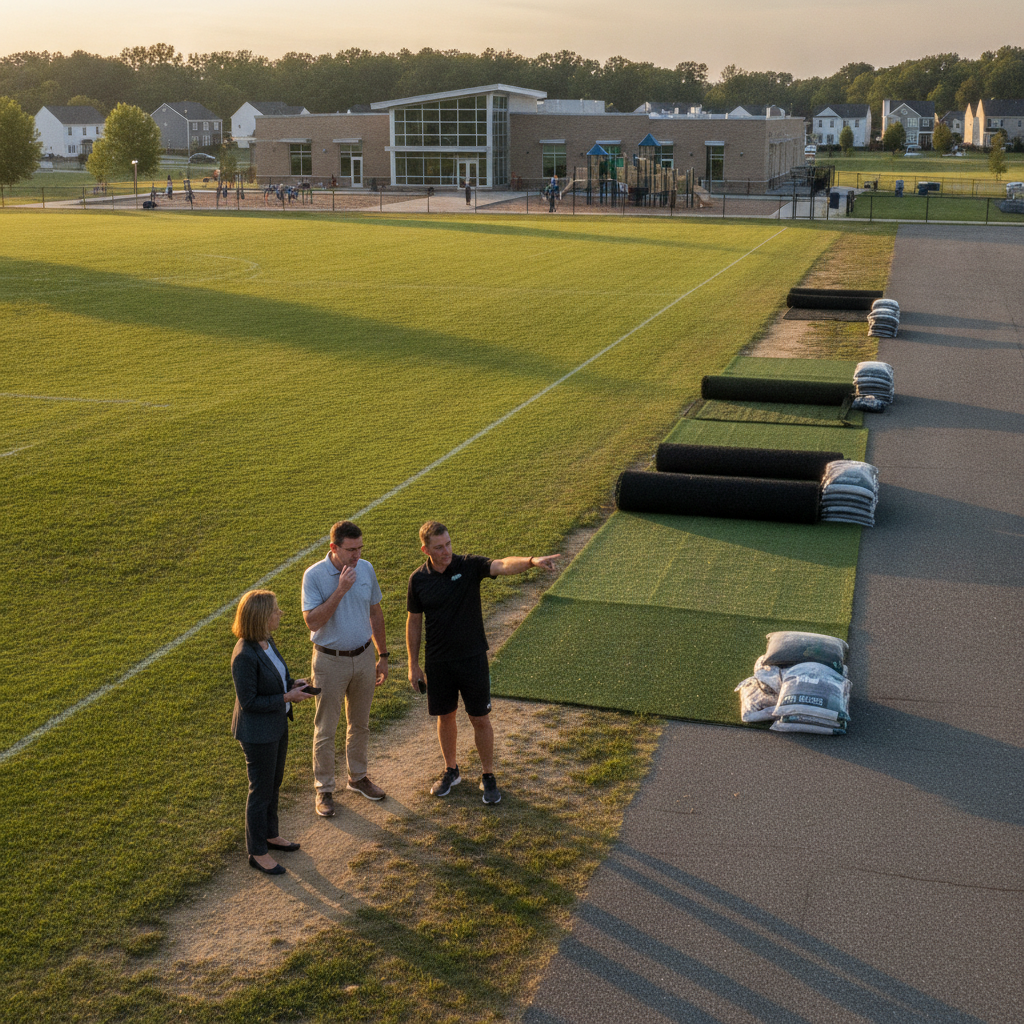
How Do You Convert a Natural Grass Sports Field to Artificial Turf in Springfield, VA? What Schools and Recreation Centers Need to Know
Converting a natural grass athletic field to artificial turf in Springfield, VA is a significant investment — but for schools, recreation centers, and parks programs in Fairfax County, it’s often one of the most operationally sound decisions a facility can make. The short answer to how you do it: you excavate the existing surface, engineer a compacted aggregate base with a precisely graded drainage plane, install a shock-absorbing pad layer where required, and then lay a sport-specific synthetic grass system built for the traffic load your field actually sees. But the details between those steps are where the project either succeeds long-term or becomes an expensive problem. This guide walks you through the full conversion process so you can make an informed decision and ask the right questions before you sign anything.
Why Natural Grass Fields in Northern Virginia Are Difficult to Maintain
If you manage or oversee an athletic field in Springfield, West Springfield, or anywhere in the Fairfax County corridor, you already know what natural grass does when soccer cleats hit it after three straight days of spring rain: it turns to mud, the turf tears out in high-traffic zones, and your maintenance crew spends more time reseeding and aerating than anyone would like. Northern Virginia’s climate — heavy spring precipitation, humid summers, and freeze-thaw cycles from November through March — is genuinely hard on natural grass fields. The soil compacts, drainage slows, and by mid-season, your highest-traffic zones look like a construction site.
That’s not a maintenance failure. It’s just the reality of what natural turf does under heavy use in this region’s weather conditions. Artificial turf doesn’t solve every problem, but it does eliminate most of the weather-dependent ones — and in a climate like ours, that matters a lot for scheduling, safety, and budget.
The Field Conversion Process: Step by Step
Step 1: Site Assessment and Grading Survey
Before a single shovel goes in the ground, a qualified installer needs to assess your existing field geometry, soil composition, and current drainage infrastructure. On many Fairfax County school and recreation sites, the existing field has either no engineered drainage at all or drain tile that’s been in the ground for thirty years and is partially collapsed. You need to know what you’re working with before you design a base system.
A proper grading survey establishes the slope tolerances for the new field. Most athletic turf installations are graded at 0.5% to 1.0% cross-slope, which is enough to shed water without creating an uneven playing surface. On sites with elevation challenges — and there are several in the Springfield and Burke area — that grading work takes real engineering, not just eyeballing it.
Step 2: Excavation and Base Preparation
The existing natural grass, sod layer, and organic soil layer come out first — typically to a depth of 4 to 6 inches depending on the application and what’s underneath. What replaces it is a compacted crushed aggregate base, usually a 4-inch layer of 3/4-inch crushed stone topped with a finer aggregate layer. This base serves two functions: it provides structural stability under foot traffic and cleats, and it acts as the primary drainage medium.
This is the step where shortcuts cause the most long-term damage. If the base isn’t properly compacted and graded, the turf surface will develop low spots, edge heaving, and seam failures — often within the first two to three winters due to our region’s freeze-thaw cycles. A base that wasn’t built right in September will show you exactly how wrong it was by February.
Step 3: Drainage Engineering
Athletic fields in Springfield and across Northern Virginia need drainage infrastructure that goes beyond what you’d install for a residential backyard. For a full field conversion, that typically means a perforated pipe drainage network installed beneath the aggregate base, sloped to a perimeter catch basin or existing stormwater system. The turf surface itself needs to drain at a rate that keeps the field playable within hours of heavy rainfall — not days.
The DMV’s spring rainfall patterns are not gentle. We regularly see 3 to 5 inch rainfall events between March and May. If your field drainage isn’t engineered to handle that, you’re either canceling games or putting athletes on a waterlogged surface. Neither is acceptable for a school or rec program.
Step 4: Selecting the Right Turf System for Athletic Use
Not all artificial turf performs the same way on an athletic field. Residential turf products optimized for aesthetics — lush pile heights in the 40mm to 50mm range — are not appropriate for high-intensity sport use. Athletic field systems are typically specified at 40mm to 50mm pile height as well, but the fiber weight, thatch layer, and infill system are engineered very differently.
For school and recreation fields, you’re looking at a crumb rubber, organic infill, or sand-rubber blend infill system to provide the right surface hardness for player safety. Outdoor sports turf designed for multi-use athletic applications needs to meet specific G-max (surface hardness) values — generally below 200 on the Gmax scale — to protect players from impact injuries during falls. For fields that also serve as playgrounds or where younger children will be present, CPSC-compliant shock absorption ratings may apply.
Step 5: Seaming, Line Marking, and Edge Finishing
Large field installations require seaming multiple rolls of turf together, and seam quality on an athletic field is not something to be casual about. Seams that fail under lateral cleat pressure or heavy use create trip hazards and turf bunching — safety liabilities you don’t want on a school property. Proper seaming uses industrial seam tape and adhesive systems rated for the traffic load, with seam orientations planned to minimize visibility and stress concentration.
Line markings on athletic fields are either yarn-infused at the manufacturing stage (preferred for high-traffic applications) or painted post-installation. Yarn-infused lines last the life of the field. Painted lines require reapplication. If you’re bidding out a field conversion, ask specifically which method is being quoted — the difference in long-term cost is meaningful.
What Competitor Installers Often Don’t Tell You About Field Conversions
Here’s a gap worth addressing directly: most turf installer websites in the Northern Virginia market talk about residential lawns and pet turf at length, but athletic field conversions get minimal coverage. What gets missed most often in the sales process for commercial field projects is the permitting and Fairfax County approval process. Depending on the size of your field and whether stormwater infrastructure is being modified, you may need a land disturbance permit, an erosion and sediment control plan, and coordination with Fairfax County’s Department of Public Works and Environmental Services.
An installer who doesn’t mention this upfront is either not doing full field conversions regularly, or is leaving you to figure it out yourself. Make sure whoever you hire has direct experience navigating Fairfax County’s permitting process for commercial turf projects — not just residential installs in Burke or Springfield neighborhoods.
If your project is at a school or daycare in the Fairfax County Public Schools system, there are additional procurement and approval steps. Playground turf on school grounds must meet CPSC and IPEMA certification standards for critical fall height — and documentation proving compliance needs to be part of your project file, not just a verbal assurance from a salesperson.
Cost and Timeline Expectations for a Field Conversion
Full athletic field conversions are priced differently than residential installs. Where a backyard lawn installation typically runs $12 to $25 per square foot depending on the application and site complexity, large athletic field projects often see lower per-square-foot pricing due to scale — but the total project cost is substantially higher because of the excavation depth, drainage infrastructure, and field-grade turf system requirements. A realistic planning budget for a full conversion at a school or recreation center in the Springfield or Fairfax County area should account for site prep, drainage engineering, turf material, infill, line markings, and permitting as separate line items.
Timeline from contract to playable surface is typically 6 to 12 weeks for a full field, depending on site conditions, weather windows, and permitting. Plan your conversion around your off-season — don’t start excavation two weeks before preseason practice.
Frequently Asked Questions
Does Fairfax County require permits to convert a school athletic field to artificial turf?
In most cases, yes — particularly if the project involves grading, drainage modifications, or land disturbance above certain thresholds. Your installer should be familiar with Fairfax County’s permitting requirements and should include permit coordination in their project scope, not leave it to you to figure out independently.
How long does an athletic field turf system last in the Northern Virginia climate?
A properly installed field-grade turf system in Northern Virginia typically performs well for 8 to 12 years under regular athletic use. The base and drainage infrastructure, if built correctly, can last significantly longer. Our region’s freeze-thaw cycles and spring rain load are the primary stressors — both are manageable with proper base engineering.
What infill is best for a multi-sport athletic field used by kids?
For school and recreation fields where child safety is a priority, organic infill options (such as cork or coated sand systems) are increasingly preferred over crumb rubber because they run cooler in summer and eliminate concerns about rubber particulate exposure. Sand-based infill systems are another option for fields prioritizing surface firmness and ball response. The right choice depends on your sport mix, maintenance capacity, and budget.
Can an existing field with poor drainage be converted without replacing the entire base?
Rarely, and we’d be skeptical of any installer who says yes without a thorough site assessment first. If the existing drainage infrastructure is failing, laying turf on top of it just transfers the problem to a more expensive surface. In most cases, proper drainage engineering means going back to the subgrade and rebuilding from there.
Do artificial turf athletic fields get too hot for use in summer in Virginia?
Standard turf surfaces can run 20 to 50 degrees warmer than the air temperature on sunny summer afternoons — that’s a real consideration for any Northern Virginia field used for daytime practice or games in July and August. Heat-mitigating infill systems and cooling irrigation solutions exist and should be discussed as part of your product selection, especially for fields in Springfield, Burke, or anywhere in Fairfax County where summer heat and humidity combine.
Ready to Talk About Your Field Conversion?
Whether you’re managing a school athletic program in West Springfield, overseeing a recreation center in Burke, or planning a parks department upgrade anywhere in Fairfax County, Grassify has the commercial field experience to take your project from site assessment through final inspection. We’re a licensed, insured, background-checked crew based right here in Burke — not a franchise dispatched from out of state. Contact us today to schedule a free consultation and get a realistic scope assessment for your field conversion project.


