
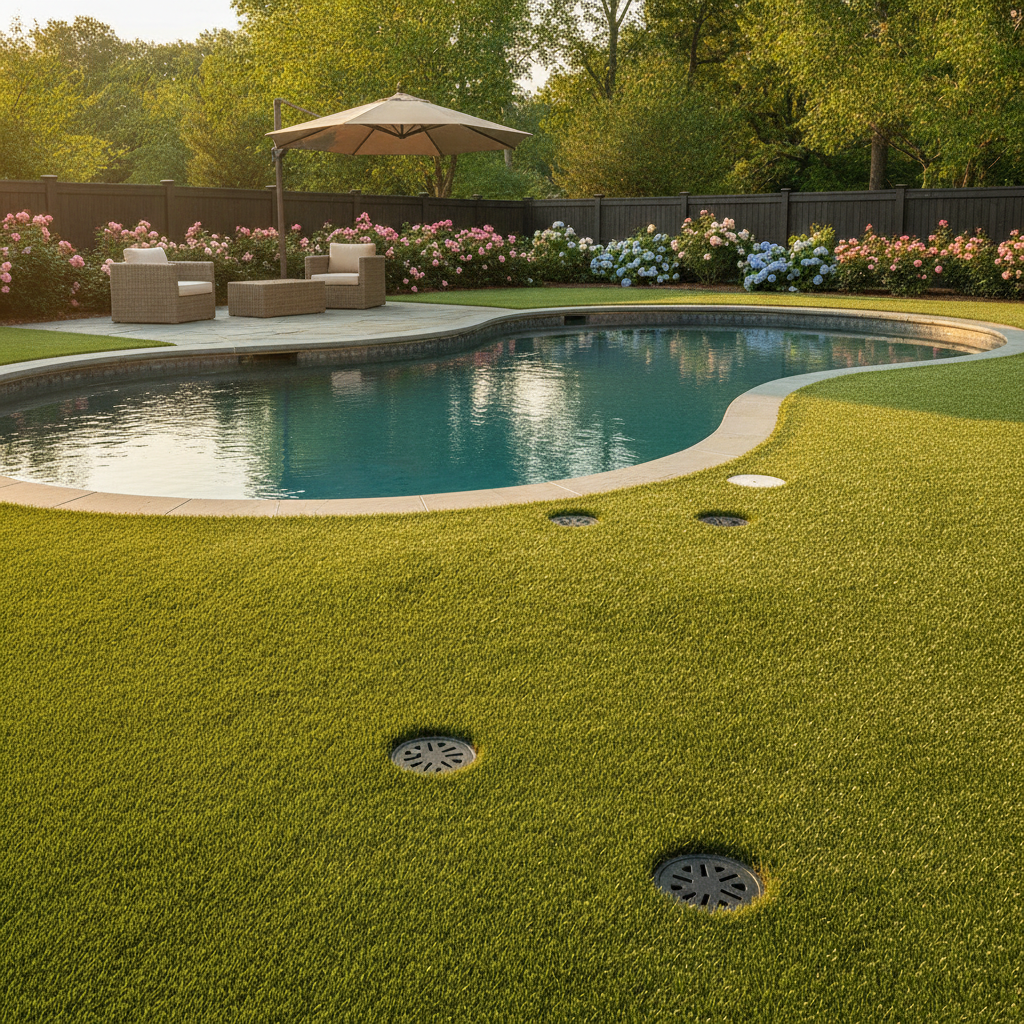
How Do You Install Artificial Turf on a Pool Deck or Patio in Potomac, MD? What Homeowners Need to Know
Yes — artificial turf is one of the best upgrades you can make to a pool deck or patio in Potomac, MD, but only if the product and the installation are actually built for that environment. Standard residential turf designed for a backyard lawn will not hold up around a pool. The wrong product will trap chlorinated water, get dangerously slick when wet, and radiate heat that makes the surface borderline unusable on a July afternoon in Montgomery County. Done right, with a turf product specifically engineered for poolside conditions, the result is a surface that looks great, drains fast, stays cooler than concrete or pavers, and never needs mowing, edging, or reseeding after a hard rain.
Here’s what you actually need to understand before calling anyone for a quote.
Why Pool Deck Turf Is a Completely Different Product Than Lawn Turf
This is the detail that most homeowners don’t realize — and one that a number of local competitors gloss over entirely on their websites. Pool deck turf has to solve problems that a lawn turf product simply was not designed to address.
The three core requirements for any turf installed in a splash zone or pool surround are:
- Chlorine-resistant backing: Pool water, whether from a traditional chlorine system, a saltwater setup, or a UV/ozone hybrid, will degrade a standard turf backing over time. Pool-rated turf uses a UV-stabilized, chemical-resistant backing material that holds up to years of splash exposure without cracking, delaminating, or releasing infill.
- Slip-resistant fiber texture: This is non-negotiable. Wet turf can be just as dangerous as wet tile if the product is not engineered for it. The right pool deck turf uses a lower, denser pile — typically in the 25mm–35mm range — with a textured, matte-finish fiber that maintains grip when wet rather than becoming a slip hazard.
- High-flow drainage engineering: Water moves fast around a pool. People walk, towels drip, kids cannonball in constantly. Your turf system needs a perforated drainage backing or a drainage layer underneath that can handle the volume without puddling. Inadequate drainage is also a mold and mildew risk in humid DMV summers.
At Grassify, our pool deck turf solutions are designed specifically around these requirements. We do not install the same product around a pool that we install in a backyard — and any installer who does is cutting a corner that will cost you later.
The Heat Problem: What No One Tells You About Turf Around a Pool in Maryland
Potomac and the surrounding Montgomery County area gets genuinely hot from June through September. Surface temperatures on dark paving, concrete, and even standard synthetic grass can climb well above 150°F on a sunny afternoon. Around a pool, where people are barefoot, that is a real problem.
The best pool deck turf products use lighter-colored fibers and heat-dissipating technology baked into the fiber construction itself — not just a light-colored infill on top. Some products also incorporate a cooling infill layer that retains moisture slightly to lower surface temp through evaporative cooling. It is not a perfect solution, but it makes a meaningful difference between turf you can walk on barefoot at 2pm and turf you cannot.
When you are comparing quotes, ask specifically about surface temperature performance. Ask whether the product has been tested in hot-sun conditions and what the installer recommends for your specific orientation — a south-facing pool deck with no shade overhead is a different problem than a pool area that gets afternoon shade from mature trees, which are common on larger Potomac and Bethesda properties.
Base Prep Around Pools: It’s Not the Same as a Lawn Installation
Installing turf over an existing concrete pool deck is a different process than a ground-level installation over soil. Both are common in Potomac and across the Beltway corridor, and each requires a specific approach.
Over existing concrete or pavers: The surface needs to be inspected for cracks, uneven sections, and existing drainage performance. Turf is typically adhered with a commercial-grade outdoor adhesive, with seams taped or heat-bonded. A foam or pad layer may be added underneath for comfort and slight cushioning, though for pool decks specifically this needs to be a non-compressible, waterproof foam — not the kind of pad used under indoor carpet.
Over a natural ground area adjacent to the pool: This requires a proper compacted gravel base — typically 3–4 inches of crushed aggregate — to establish drainage and prevent settling. In the DMV area, freeze-thaw cycles from December through February will heave an improperly prepared base, causing turf to ripple and seams to open. Getting the base right is not a place to cut corners, especially on an investment-level Potomac property.
If you are converting a grass or mulch area immediately adjacent to your pool to turf, expect the project to include excavation, base installation, compaction, and edging work before a single roll of turf goes down. That is the right way to do it, and the timeline reflects it — a typical pool area project in Montgomery County runs 2–4 days from prep to final trim, depending on square footage and complexity.
What Pool Deck Turf Actually Costs in the Potomac and Montgomery County Area
Poolside turf is generally priced at the higher end of the residential turf range — typically $18–$25 per square foot installed — because the product itself costs more and the installation involves more prep and precision work than a straightforward lawn replacement. The heat-resistant, chlorine-rated, slip-resistant products simply carry a higher material cost than standard landscape turf.
On a typical 500–800 square foot pool surround in Potomac or Chevy Chase, that puts the all-in project budget in the $9,000–$20,000 range depending on site conditions, existing surface, and product selection. It’s a meaningful investment, but when you are comparing it against the ongoing cost of pavers, natural stone, or concrete resurfacing — plus the cost of resealing, pressure washing, and weed management every year — the math usually comes out clearly in turf’s favor over a 10-year horizon.
Our Plush Pad product line is specifically designed for poolside, patio, and deck applications if you want a starting point for product research: learn more about Plush Pad here.
HOA Considerations for Pool Deck Turf in Potomac and Surrounding Communities
Many Potomac-area neighborhoods — particularly communities in the Rockville, Chevy Chase, and Bethesda corridors — are HOA-governed, and that can affect what you can install and where. Pool deck and patio turf is generally less restricted than front-yard turf because it is not visible from the street, but you should still check your CC&Rs before committing to a project. Some HOAs have rules about materials in shared or adjacent outdoor spaces, particularly in townhome or cluster-style communities.
If your pool area is visible from a shared community space, your HOA may require you to submit a request showing the product color, pile height, and installation plan. Grassify has navigated dozens of these approvals in Fairfax County and Montgomery County and can provide product samples, spec sheets, and documentation to support your HOA submission.
Frequently Asked Questions: Pool Deck Turf in Potomac, MD and the DMV Area
Will pool chemicals damage artificial turf over time?
Standard artificial turf backings can degrade with prolonged chlorine or saltwater exposure. Pool-rated turf uses a UV-stabilized, chemical-resistant backing that is specifically tested for this environment. Always confirm that the product you are purchasing is pool-rated — not just “outdoor” rated.
Is artificial turf slippery when wet around a pool?
A properly specified pool deck turf product is not slippery when wet. The key is pile height and fiber texture — lower pile heights in the 25mm–35mm range with a textured, matte fiber maintain traction. Avoid high-pile, silky-finish products in splash zones. Those are designed for lawn aesthetics, not wet-foot safety.
How does artificial turf drain around a pool compared to concrete?
Quality pool deck turf with a perforated backing drains at rates of 30–50 inches per hour or more, which means water moves through faster than most rainfall events or splash volumes can produce. Concrete, by contrast, pools and requires slope engineering. Turf drainage is more forgiving on uneven sites and eliminates the puddle zones that form on aging pool decks.
Can artificial turf go directly over my existing concrete pool deck?
Yes, in most cases. The concrete needs to be inspected for structural integrity, major cracks, and drainage performance. Minor surface imperfections can be addressed with patching compound before turf goes down. If the concrete has significant heaving or drainage problems, those need to be corrected first — otherwise they will show through the turf surface.
How long does pool deck turf last?
A properly installed pool deck turf product, using a pool-rated backing and maintained correctly, should last 15–20 years. UV-stabilized fibers resist fading for the life of the product. Grassify backs all seams, edges, and base work with a lifetime installation warranty — so if something shifts or opens up, we come back and fix it.
Ready to Replace Your Pool Deck Surface in Potomac or the Montgomery County Area?
If you are tired of pressure-washing algae off concrete, pulling weeds out of paver gaps, or watching your natural grass around the pool turn to mud every time it rains, artificial turf is worth a serious look. The right product, properly installed, makes your pool area genuinely usable — for kids, pets, and guests — without the maintenance burden.
Grassify serves Potomac, Bethesda, Chevy Chase, Rockville, and communities across Montgomery County MD, as well as our home base in Burke, VA and all of Fairfax County. We are licensed, insured, and background-checked — and every project includes a free on-site consultation before we quote you a number.
Contact Grassify today to schedule your free consultation. We will walk your pool area, assess your existing surface, and give you an honest recommendation — no pressure, no upsell, just a straight answer about what your project actually needs.


