
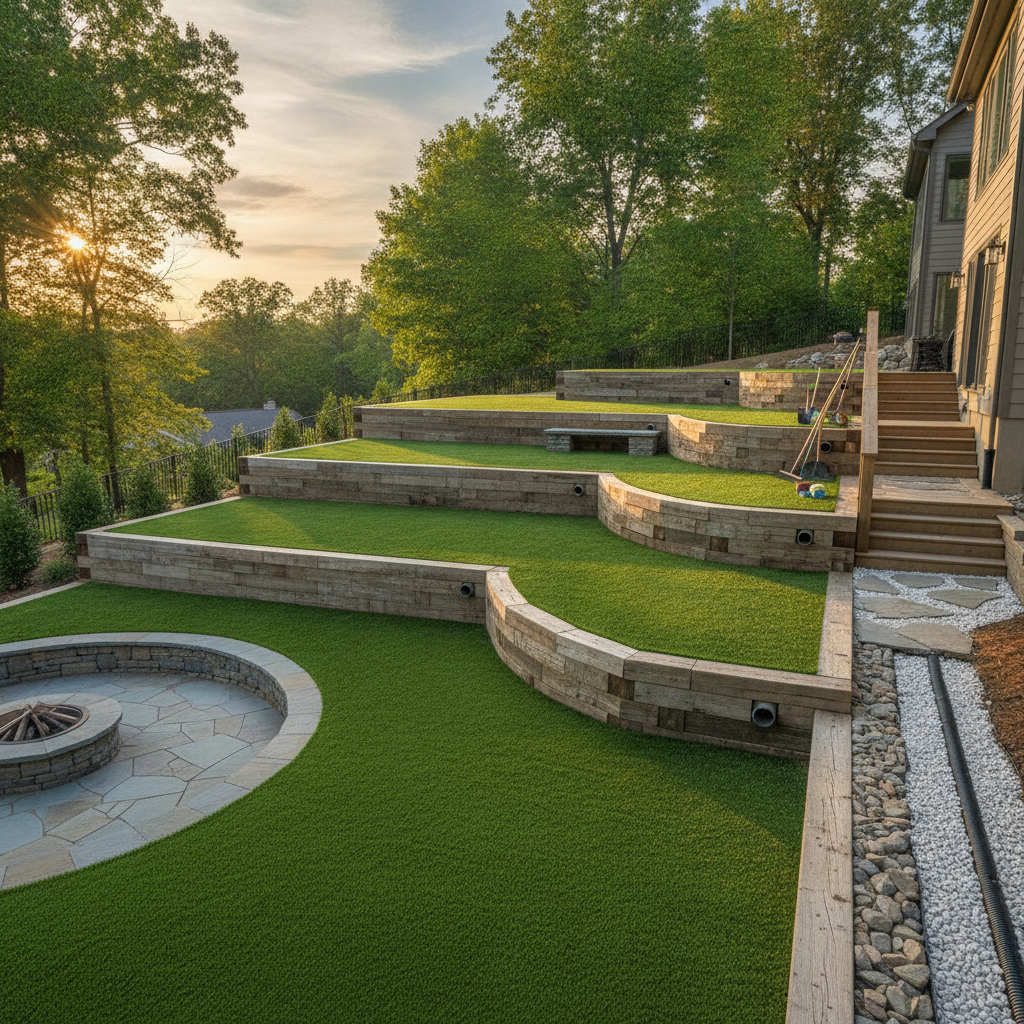
How Do You Install Artificial Turf Around a Retaining Wall or Tiered Landscape in Fairfax, VA? What Homeowners Need to Know About Sloped Yard Design
Yes, you absolutely can install artificial turf around retaining walls and across tiered landscapes — but it’s one of the more technically demanding residential turf jobs out there, and it’s rarely done right on the first attempt by crews without specific experience in grade transitions. In Fairfax, VA and across Fairfax County, tiered backyards are extremely common. The rolling terrain, legacy landscaping decisions, and older timber or block retaining walls that define so many homes in this corridor create a unique set of installation challenges that go well beyond rolling out grass on a flat lawn. Here’s what you actually need to know before any work begins.
Why Tiered Yards in Fairfax County Require More Than Standard Turf Installation
Most of Fairfax County’s older neighborhoods — including areas around Fair Oaks, Burke, and the Kings Park corridor into Springfield — were graded decades ago using techniques that created dramatic grade changes from one backyard level to the next. Many of these lots were then reinforced with pressure-treated timber walls, railroad ties, or CMU block walls that are now anywhere from 15 to 40 years old. That matters for turf installation in a few specific ways.
First, an aging retaining wall is not a stable anchor point. If your timber wall has any lean, rot, or soil pressure behind it, a turf installation that uses the wall as an edge anchor is going to show movement and separation within a year or two — sometimes sooner after a wet DMV winter. Before turf ever goes down, the structural integrity of the wall needs to be evaluated. This is a step that many general landscapers and out-of-state franchise installers skip entirely because it falls outside their scope of work and adds project time. A local crew that understands Northern Virginia terrain won’t cut that corner.
Second, tiered landscapes create multiple drainage planes. Water doesn’t just fall straight down into the base — it moves laterally across each level before it hits a grade change, and if those transitions aren’t engineered correctly, you end up with water pooling at the base of each wall, saturating the aggregate base, and eventually lifting the turf or causing the base to settle unevenly. In a region that averages over 40 inches of rain annually, with heavy spring downpour events that can drop two or three inches in a single afternoon, that’s not a theoretical problem. It’s something we see repaired regularly on jobs that weren’t designed with real drainage in mind.
The Gap That Most Competitor Sites Don’t Address: Seaming Across Grade Transitions
Here’s what very few local turf websites — and none of the competitor sites we’ve reviewed — actually explain clearly: seaming artificial turf across a grade change is fundamentally different from seaming on a flat plane.
On a flat surface, seams are aligned parallel to the primary viewing angle, glued on a seaming tape with the proper adhesive, and held under light tension until the adhesive cures. The load on that seam is predictable and manageable. On a tiered landscape, the turf has to transition over or around a wall cap, potentially fold down a vertical or near-vertical face, and then continue across the next flat section. The tension on that transition point is constant and directional — it’s always pulling away from the seam. If the seam isn’t engineered for that tension load and anchored correctly at both the top and the bottom of the transition, it will open. Usually within the first freeze-thaw cycle.
Proper technique involves mechanical fastening — not just adhesive — at all grade transition seams, with anchor boards or bender board systems installed in the base at the top of each drop. The turf is then wrapped and secured independently at each level before the visible face is finished. This takes more time and material than a standard flat-surface installation, and it’s reflected in the cost — but it’s also the reason a professionally installed tiered turf system can carry a lifetime warranty on seams and edges where a DIY attempt or low-bid job cannot.
Base Prep on Sloped Terrain: What Fairfax Homeowners Need to Know
On flat or gently sloped residential lawns, standard base prep typically involves excavating 3–4 inches of native soil, adding a weed barrier, compacting a crushed aggregate base layer, and finishing with a fine-crushed top layer before the turf goes down. That process changes significantly when you’re working across multiple tiers.
- Each level is treated as its own drainage zone. The aggregate base on each tier needs to be independently graded away from the wall face — typically a 1–2% slope toward an interior drain or the natural grade away from the structure.
- The wall face itself needs protection. Where turf wraps over or around a wall cap, a rubber or foam edge trim is typically installed to prevent the turf backing from abrading against hard masonry corners over time. Without this, the backing degrades and the turf edge begins to fray within a few seasons.
- Soil compaction is especially critical on slopes. Loose or poorly compacted soil on a sloped tier will settle after the first few rainfall events, creating surface undulations that are visible through the turf and can’t be fixed without pulling the entire installation up and re-doing the base.
If your yard in Fairfax has clay-heavy native soil — and much of Fairfax County does — the excavation depth may need to increase to 4–6 inches to get below the clay layer, which holds water and doesn’t compact reliably. This is especially true in neighborhoods like Great Falls and Falls Church where clay-heavy red soil is prevalent close to the surface.
HOA Considerations for Tiered Yard Turf in Fairfax County
Many communities in Fairfax County are HOA-governed, and architectural review requirements for artificial turf vary significantly from one association to the next. For tiered yard installations, there’s an additional layer of complexity: if your retaining wall is considered a structural element of the community’s shared infrastructure, or if any part of your project involves grading changes that affect drainage toward neighboring properties, you may need HOA approval before work begins — not just for the turf itself, but for any base modification that changes the site’s drainage pattern.
This is worth verifying before you schedule installation. A reputable local installer will help you understand what approvals are likely required and what documentation to prepare for your HOA’s architectural committee. Some communities also have specific pile height restrictions or color requirements for synthetic turf that must be followed. Our residential lawn turf installations include HOA documentation support as a standard part of the project process — because in Fairfax County, navigating that step correctly upfront saves everyone time.
What a Tiered Turf Installation Costs and How Long It Takes
Tiered and retaining wall turf projects in Fairfax typically run between $15 and $25 per square foot, depending on the complexity of the grade transitions, the number of tier levels, the condition of existing walls, and the access logistics on your property. Projects with straightforward two-level layouts and good vehicle access are on the lower end. Projects with three or more tiers, aging walls that need remediation, or tight backyard access — common in townhome communities in Springfield and similar corridors — are on the higher end.
Timeline is usually 1–3 days for most residential tiered projects, though wall remediation work before installation begins can extend that. Expect a site visit and base prep assessment before any firm quote is offered. Any contractor who quotes a tiered landscape job remotely, based on square footage alone, is not accounting for the variables that drive cost on this type of project.
For projects with active pets, our pet-friendly turf installations include a 5-layer drainage system rated at over 400 inches per hour — a spec that’s especially important on tiered yards where drainage needs to move efficiently across multiple grade levels without saturating the base at the transition points.
Frequently Asked Questions
Can I install artificial turf directly against a timber retaining wall?
Yes, but the wall needs to be structurally sound first. Timber walls older than 15–20 years should be inspected before turf is anchored to them. If the wall has lean, rot, or hydrostatic pressure issues, those need to be corrected before installation begins. We always assess wall condition during the initial site visit.
Will turf on a slope hold up through DMV winters?
It will if the base is engineered correctly and seams at grade transitions are mechanically anchored — not just glued. Freeze-thaw cycles put stress on any seam that relies solely on adhesive at a tension point. Properly anchored seams on tiered installations carry the same lifetime warranty as flat installations.
Do I need a permit to install turf on a tiered yard in Fairfax County?
Typically no permit is required for turf installation itself, but if the project involves structural changes to a retaining wall or significant regrading that affects drainage toward neighboring properties, Fairfax County may require a grading or erosion control permit. HOA approval is a separate process and is often required regardless of county permitting.
How does drainage work on a two- or three-level tiered yard?
Each tier is graded independently with its own drainage path — typically sloped 1–2% away from the wall face toward the yard’s natural drainage outlet or a French drain system installed at the base of each tier. The goal is to prevent water from accumulating at any transition point, which would saturate the base and cause settling or turf lifting over time.
Can turf be installed on the face of a retaining wall, not just the flat areas?
Yes, in some designs turf is wrapped over the wall cap and down the vertical face for a finished, seamless look. This is a specialty application that requires a flexible-backed turf product and specific mechanical fastening techniques on the wall face. It works well aesthetically and durably when done correctly, but it’s not a standard installation and should only be attempted by crews with direct experience on this application.
Ready to Turn Your Tiered Backyard Into Something You’ll Actually Use?
Tiered and retaining wall turf projects are some of the most dramatic backyard transformations we do at Grassify — a yard that’s been unusable or high-maintenance for years because of its grade becomes a clean, functional outdoor space that doesn’t require mowing, watering, or seasonal replanting. We’ve done these installations across Fairfax, Burke, Springfield, Great Falls, and Falls Church, and we know the terrain, the soil conditions, and the HOA requirements that apply in this part of Northern Virginia.
If you’re ready to get a real answer on what your tiered yard project would actually involve — base prep, drainage, wall assessment, cost, and timeline — reach out to Grassify for a free on-site consultation. We’ll come out, evaluate the site, and give you a straight assessment before you commit to anything.


