
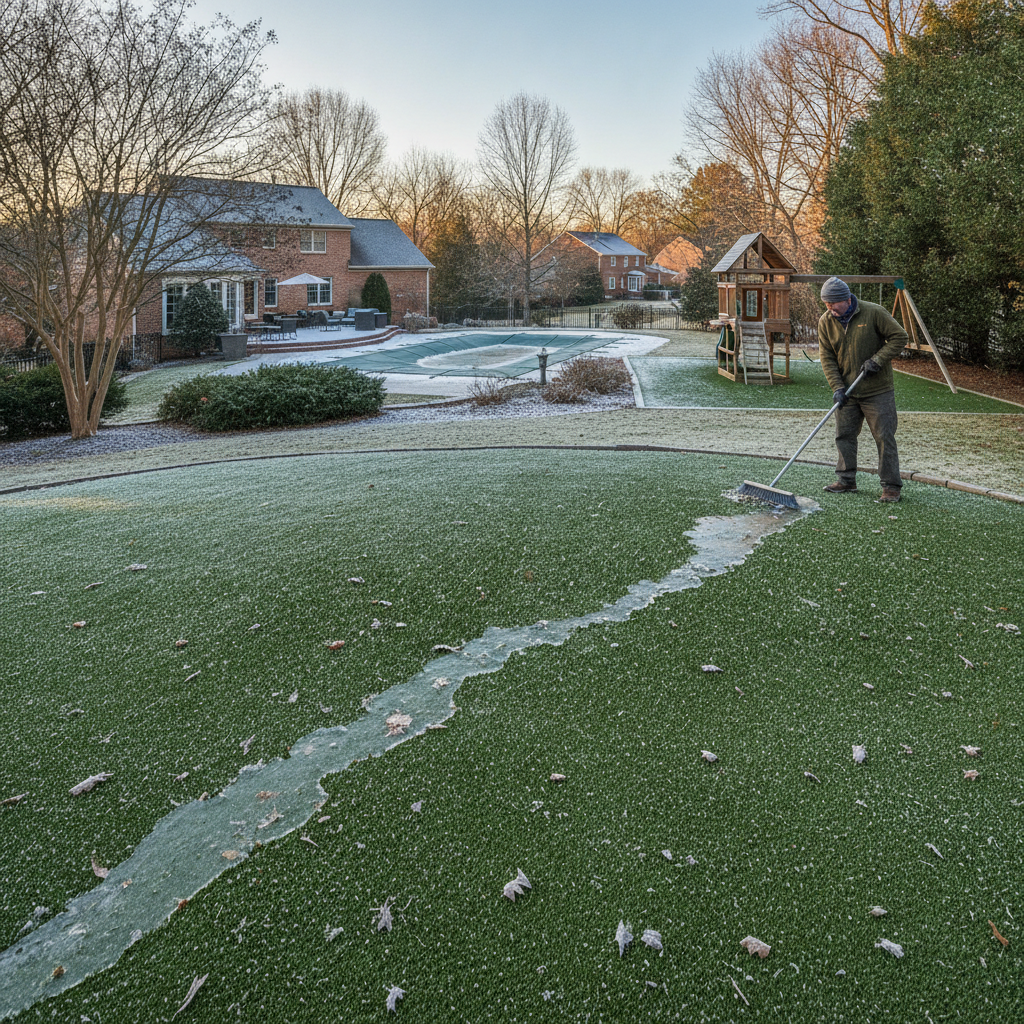
How Do You Maintain Artificial Turf Through a DMV Winter in Burke, VA? What Homeowners Need to Know About Cold-Weather Care
Yes, your artificial turf will be just fine this winter — but only if it was installed correctly in the first place, and only if you know the handful of things that actually matter when temperatures dip in Burke, VA. The DMV doesn’t get brutal Great Plains winters, but what we do get is arguably harder on synthetic grass: repeated freeze-thaw cycles, heavy wet snow, the occasional ice storm, and spring rains that test drainage capacity all at once. Most turf companies around Fairfax County won’t walk you through any of this after the install truck pulls away. Here’s what you actually need to know.
Why DMV Winters Are Harder on Artificial Turf Than People Expect
Northern Virginia winters aren’t defined by consistent cold — they’re defined by swings. You might have a 55-degree Tuesday followed by 22 degrees overnight on Wednesday, with a half-inch of ice by Thursday morning. That freeze-thaw cycle is the real stress test for a synthetic grass installation, and it’s the angle that almost no competitor in this market explains in any useful detail.
When water seeps into an improperly compacted base and then freezes, it expands. If your base layer — typically a compacted aggregate of crushed stone — wasn’t engineered with adequate drainage, that freeze-expansion cycle can cause subtle heaving, which over time leads to uneven turf surfaces, stressed seams, and edge lifting. Around neighborhoods like Burke Centre, Rolling Valley, and Signal Hill, where older yards often have heavy clay content underneath, this is an especially real risk when the base work is done cheaply or by a general landscaper who doesn’t specialize in turf.
A properly built base — 4 inches of crushed aggregate compacted to grade, with a weed barrier and benderboard perimeter — handles freeze-thaw cycles without issue. This is why base prep isn’t just an installation step; it’s the foundation of a turf system that performs well for 15 to 20 years, including every January in between.
What You Can (and Can’t) Do When Snow and Ice Arrive
This is the question homeowners ask most and find the least useful answers to online. Here’s the straightforward version:
Light snow: Leave it alone. Artificial turf handles light snowfall without any intervention. The snow will melt and drain through the turf’s perforations just like rainwater. In most cases in the Burke and Springfield area, that’s exactly what happens within a day or two.
Heavy snow accumulation: You can remove it with a plastic shovel or a soft-bristled push broom. Avoid metal-edged shovels — they can snag turf fibers or damage seams, particularly at the edges. Never use a metal snow blower attachment directly on the turf surface for the same reason.
Ice: This is where most homeowners make mistakes. Do not use rock salt or sodium chloride-based ice melt products on your artificial turf. Salt can degrade the backing material over time and affect infill chemistry, particularly if you have a zeolite deodorizer layer in a pet turf installation. The safe alternatives are calcium magnesium acetate (CMA) or sand for traction. CMA is widely available at hardware stores in the Fairfax County area and won’t damage your turf or harm pets once it’s tracked inside.
What about artificial turf on a pool deck or patio in Alexandria or Great Falls? Same rules apply, with one addition: if you have drainage channels integrated into the pool deck design, check them after heavy ice events to make sure they’re clear before the next thaw. Blocked drainage during a melt cycle can cause brief pooling, though it won’t damage the turf if the blockage is cleared promptly.
The One Maintenance Task Most Homeowners Skip All Winter
Fiber brushing. During winter, foot traffic is lighter and the turf looks fine — so most people don’t think about it. But in the DMV, we get heavy leaf fall from October through December, and those wet leaves mat down on turf fibers and trap moisture against the backing if they’re not cleared. Over a full winter season, that sustained moisture contact can contribute to mold or mildew in the thatch layer, especially in shaded yards in Falls Church or heavily wooded lots in Arlington.
A simple pass with a stiff-bristled broom or a power broom every few weeks through winter keeps fibers upright and clears organic debris before it becomes a problem. It takes about 15 minutes for a typical backyard. This is especially important for pet turf installations where the drainage layer is working harder year-round — keeping the surface clear of debris ensures the drainage system functions at full capacity when spring rains hit in March and April.
What a Properly Installed Turf System Should Handle Without Any Help From You
It’s worth being clear about what good turf just handles on its own:
- Freeze-thaw cycling — a correctly compacted base drains before freezing, eliminating heave risk
- Wet snow melt — turf with 400+ in/hr drainage capacity clears meltwater faster than most natural lawns
- UV exposure — quality UV-stabilized polyethylene fibers don’t degrade from low-angle winter sunlight
- Seam integrity — properly glued and nailed seams don’t separate under ground movement caused by light freeze-thaw cycles
- Color retention — turf won’t fade, yellow, or change color from cold temperatures alone
If your turf isn’t doing these things reliably, the problem almost always traces back to either low-quality materials or an installation that cut corners on base depth and seam adhesion. This is exactly why the out-of-state franchise installers who periodically market to Northern Virginia homeowners are worth scrutinizing carefully — their crews are often in and out of a region quickly, and the company may not be reachable when a seam lifts the following February.
You can review Grassify’s full installation guide to understand what a properly built system looks like from base prep through final brushing.
Preparing Your Turf for Spring Before the Rainy Season Hits
The transition out of winter is actually when proactive homeowners get the most value from a simple maintenance routine. Before the heavy spring rains that reliably soak Fairfax County in March and April, do a quick walk-through of your turf:
- Check perimeter edges and benderboard for any frost heave movement — look for sections that have lifted slightly or separated from adjacent hardscaping
- Inspect seams visually, especially in high-traffic areas, for any separation at the glue joint
- Clear any debris that accumulated in drainage zones or along fence lines over winter
- Do a thorough brushing to restore fiber pile before spring growth creates a contrast with any natural grass border areas
Catching a minor edge separation or seam issue in February costs almost nothing to fix. Left unaddressed through a wet spring, that same issue can become a full seam re-glue or edge replacement by June.
Frequently Asked Questions: Artificial Turf Winter Care in the DMV
Can I use a leaf blower on my artificial turf in the fall and winter?
Yes, absolutely. A leaf blower is one of the most effective and turf-safe tools for clearing organic debris. Use it on a low setting so you don’t displace infill, especially near edges where infill density tends to be lower.
Will my turf feel different or stiffer in cold temperatures?
It may feel slightly firmer underfoot when temperatures drop below freezing, particularly if the infill has compacted slightly over time. This is temporary and resolves as temperatures climb. Quality polyethylene fibers remain flexible down to well below the temperatures Burke, VA typically sees.
Is it safe for my dogs to use the turf during winter?
Yes. Cold temperatures don’t affect pet turf drainage performance, and turf is actually easier to rinse clean in cool weather since cooler temperatures slow bacterial activity. Just avoid applying road salt or standard ice melt anywhere near the surface.
How do I know if my base was installed correctly before winter hits?
After a heavy rain, check whether water pools on the turf surface for more than a few minutes. Properly installed turf with a well-graded aggregate base drains almost immediately. If you’re seeing standing water for 30 minutes or more after rain stops, the base grading or drainage channel design may need evaluation.
Does Grassify offer any post-installation inspection service going into winter?
Yes. We offer seasonal check-ins for existing customers across Fairfax County, Springfield, and surrounding areas. If your turf was installed by another company and you’re concerned about its condition before winter, we’re happy to do an honest assessment. No pressure, no upsell — just a straight answer about what you’re working with.
Get Ready for Winter the Right Way
Artificial turf is genuinely low-maintenance — but low-maintenance isn’t the same as no-maintenance, especially in a DMV climate that tests every part of an installation from October through March. If your turf was installed correctly, winter should be close to a non-event. If it wasn’t, winter is usually when you find out.
At Grassify, we back every residential installation with a lifetime warranty on seams, edges, and base integrity. If something moves in winter, we fix it. That’s the kind of accountability that matters when a Northern Virginia February decides to remind you what freeze-thaw actually feels like.
If you have questions about your existing turf, want a pre-winter inspection, or are thinking about installing before the ground freezes, contact Grassify for a free consultation. We’re based right here in Burke, VA and we know exactly what your yard is going to face this season.


