
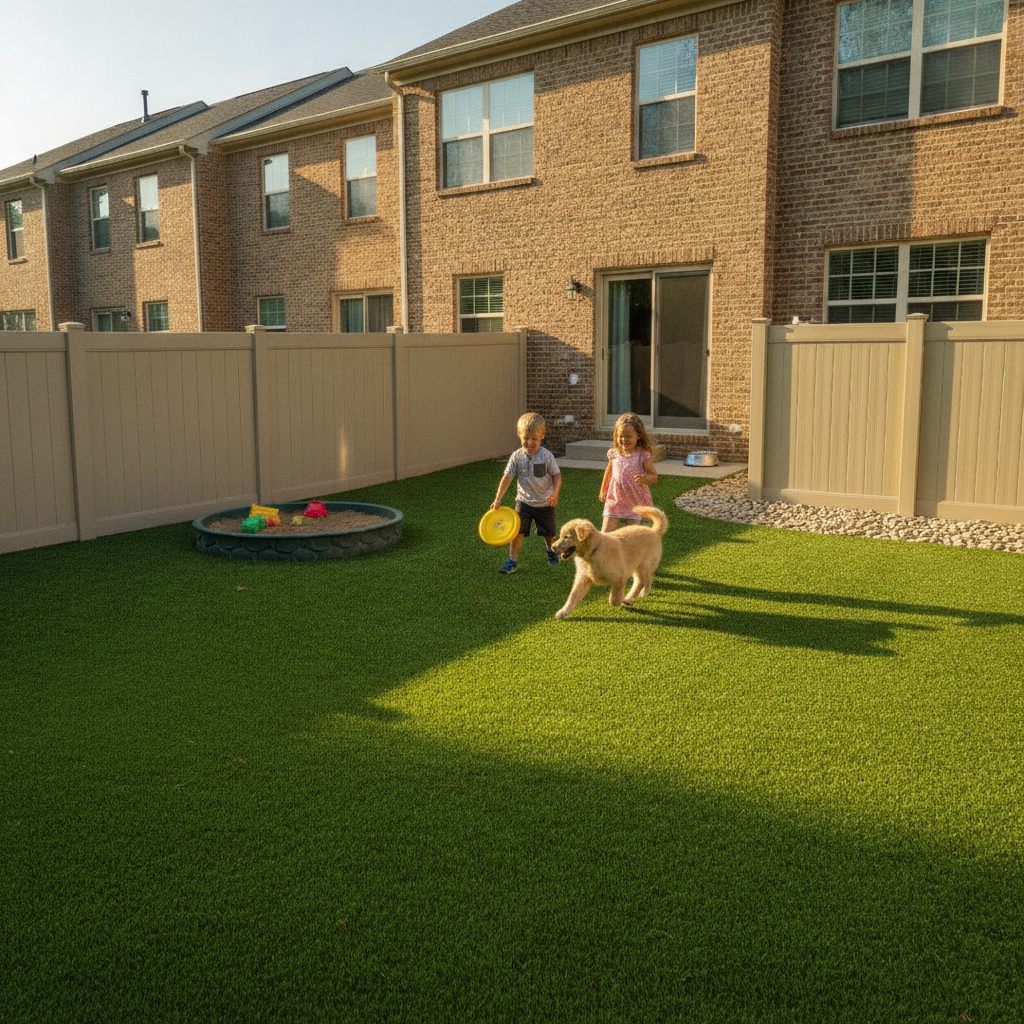
How Do You Choose Artificial Turf for a Pet-Friendly Townhome in Burke, VA When You Have Both Dogs and Young Children?
If you’ve got a dog and a toddler sharing a small townhome backyard in Burke, VA, you already know the problem: natural grass doesn’t stand a chance. Between the digging, the potty spots, the muddy paw prints tracked through your back door, and the kids rolling around in whatever the dog just left behind, it turns into a maintenance nightmare by mid-spring. Artificial turf solves most of that — but only if you choose the right product for a dual-use yard. A system built purely for pet drainage won’t necessarily meet child safety standards, and a turf designed for aesthetics alone won’t hold up to daily dog traffic. Here’s what you actually need to know before you buy.
Why Dual-Use Turf Is a Different Category Entirely
Most turf companies either optimize for pets or for aesthetics. Very few walk you through what happens when both a 60-pound Lab and a three-year-old are using the same 400 square feet of backyard every single day. That gap in guidance is something we see consistently across the Northern Virginia market — and it’s exactly the kind of situation Grassify installs for regularly in Burke, Springfield, and West Springfield.
When you’re designing for pets and children simultaneously, you’re managing three competing requirements:
- Drainage performance — fast enough to handle pet waste and heavy DMV spring rain without pooling
- Surface safety — soft enough and shock-absorbing enough that a falling toddler doesn’t get hurt
- Odor and hygiene control — a system that neutralizes bacteria and ammonia, not just masks it temporarily
Getting all three right at once requires intentional product selection, the right infill combination, and a base that’s engineered for both use cases — not just the cheapest option that fits the square footage.
The Drainage System Comes First — and It Has to Be Built Right
In a pet-heavy yard, drainage isn’t optional. Urine that doesn’t drain fully through the turf backing starts to break down in the infill layer, producing ammonia odor that gets worse in heat and humidity. Burke summers are hot and sticky, and a poorly drained pet turf will smell by July even if it looked great in April.
The system Grassify installs for pet-and-kid yards uses a five-layer drainage approach: a compacted crushed stone base, a permeable weed barrier, a drainage mat or flow-through backing on the turf itself, a zeolite deodorizer infill layer, and a top infill of antimicrobial silica sand. The zeolite layer is key — it’s a naturally occurring mineral that chemically binds ammonia molecules rather than relying on fragrance additives or temporary enzyme sprays. We back this system with a 90-day odor-free guarantee.
The drainage rate matters too. For a yard with one or more dogs, you want a system capable of draining at 400 or more inches per hour. That spec also matters during the heavy spring rains common across Fairfax County — a low-drainage system that handles pet waste but ponds during a May downpour isn’t doing its job.
If you want to dig deeper into how pet turf installation works from the ground up, we’ve covered the full process for Burke-area yards in detail.
Child Safety Standards Are Non-Negotiable — Even in a Backyard
Here’s the part most turf companies skip over when they’re selling you pet turf: the turf backing and infill depth also determine how safe a surface is for a child who falls on it. This is especially relevant if you have younger kids — ages one through five — who are going to be crawling, tumbling, and landing on that surface regularly.
CPSC (Consumer Product Safety Commission) guidelines and IPEMA certification standards define what’s called a Critical Fall Height rating — essentially how far a child can fall onto a surface before the risk of serious head injury becomes unacceptable. For a purely decorative or pet turf product installed on a compacted base, that number can be low enough to matter.
For dual-use yards where kids will be active, we recommend specifying a turf product and infill depth that hits at least a 3-foot Critical Fall Height rating — the standard applied to playground equipment under 4 feet tall. This doesn’t mean your backyard needs to look like a school playground. It means the base compaction, infill depth, and turf pile height are all calibrated to absorb impact, not just look green.
A 40mm to 50mm pile height turf with a polyethylene fiber (softer than nylon, more durable than basic polypropylene) hits the right balance — comfortable underfoot for kids, durable enough for dog traffic, and forgiving enough for falls.
HOA Approval in Burke Centre and Surrounding Communities
If your townhome sits inside an HOA — and in Burke Centre, Rolling Valley, or Signal Hill, there’s a reasonable chance it does — you’ll need architectural approval before installation begins. This is a step a lot of general landscapers skip over, and it can create real problems post-installation if your turf doesn’t meet the HOA’s specifications for pile height, color, or perimeter edging treatment.
Grassify handles the HOA documentation process as part of the project. We’ll put together the product specs, color swatches, and installation diagrams your architectural review committee needs — most Fairfax County HOAs want to see that the turf blade color matches the natural grass standard for the community and that edging is finished with a material that won’t damage adjacent landscaping or hardscape.
The other HOA consideration for small townhome yards: access. Many rear yards in Burke and Springfield are only reachable through a gate or fence opening. We work with tight-access lots regularly and size equipment accordingly — it doesn’t require demolishing a fence section or hauling base material across your neighbors’ yard.
The Right Infill for a Pet-and-Kid Yard: What to Actually Specify
Infill selection is where a lot of dual-use installations go wrong. Crumb rubber infill — common in sports fields and some pet turf applications — is not the right choice for a backyard where young children are playing daily. The surface temperature issue alone is significant: crumb rubber can get extremely hot in direct sun during a Northern Virginia summer, far hotter than the turf fiber itself. It’s also not antimicrobial, and there are ongoing studies about particulate exposure that make it a poor choice for a space where kids are rolling around.
For a pet-and-child yard, the right infill combination is typically:
- Bottom layer: Zeolite — 1 to 1.5 lbs per square foot for odor and ammonia control
- Top layer: Antimicrobial silica sand — rounded, coated to inhibit bacterial growth, stays cooler than rubber
This combination is what we use in Lush Life installations designed for lawn, pet, and family use — it’s formulated specifically for yards that see heavy daily use from both animals and children.
What Competitors Often Miss on This Specific Topic
When you look at how other local turf companies in the DMV handle this topic, most treat pet turf and kid-safe turf as completely separate categories. You’ll find pet turf pages focused entirely on drainage and odor, and you’ll find playground turf pages focused on fall ratings and certifications — but very little guidance on what to do when both requirements apply to the same 350-square-foot backyard in a Fairfax County townhome community.
That gap matters because it means homeowners are often sold a pure pet turf system that doesn’t address child safety, or a decorative turf that doesn’t have the drainage engineering to handle dog waste long-term. Neither works well for a family with both. The answer is a custom-specified dual-use system — not an off-the-shelf package.
Cost and Timeline Context
For a dual-use pet-and-child townhome installation in the Burke area, budget planning should account for the full engineered system — not just the turf roll price. A properly built dual-use yard with the five-layer drainage system, appropriate infill, and clean edging typically falls in the $15 to $22 per square foot range depending on access complexity, existing surface removal, and total square footage. Smaller yards don’t always cost less per square foot — tight access and intricate edging around existing landscaping can add time and labor.
Most townhome backyard installations take one to two days from base prep through infill and edging. HOA approval timelines vary — some committees turn around requests in a week, others take up to 30 days. We’ll tell you upfront what to expect based on your specific community.
Frequently Asked Questions
Is artificial turf safe for toddlers who might put things in their mouths?
Yes — when installed with the right infill. Antimicrobial silica sand infill is non-toxic and doesn’t off-gas harmful compounds. The turf fiber itself is UV-stabilized polyethylene, the same material used in food-safe packaging. We don’t use crumb rubber in any yard where young children are primary users.
How do I keep the turf clean with both a dog and young kids using it every day?
Solid waste should be removed promptly and the area rinsed with water — the same routine you’d follow on natural grass. Urine drains through the five-layer system without pooling or soaking into the base. For hygiene, a diluted enzyme cleaner rinse once every few weeks is enough to maintain the surface. No mowing, no fertilizing, no mud.
Will the turf get too hot in summer for kids to play on barefoot?
All synthetic turf surfaces are warmer than natural grass in direct sun — that’s a real consideration in Northern Virginia summers. The surface temperature varies significantly based on infill type and pile height. Silica sand infill runs cooler than crumb rubber. Lighter-colored turf blades reflect more heat than darker ones. We can walk you through heat-mitigation options during your consultation, including turf products with heat-reflective fiber technology.
Does my HOA in Burke Centre need to approve the turf before installation?
Most HOAs in Burke, Springfield, and Fairfax County require architectural review committee approval before any significant yard modification. The process usually involves submitting product specs, color samples, and an installation diagram. Grassify handles that documentation as part of the project — we’ve submitted HOA approval packages for communities throughout Fairfax County and know what most committees want to see.
How long does the turf last with heavy daily use from both a dog and kids?
A properly installed dual-use system with quality turf fiber should hold up for 15 to 20 years under normal residential use. The seams, edges, and base carry a lifetime installation warranty through Grassify. The turf fiber itself typically carries a manufacturer warranty of 10 to 15 years against UV degradation and fiber breakdown.
Ready to Build a Backyard That Works for Your Whole Family?
If you’re in Burke, Springfield, West Springfield, or anywhere else in Fairfax County and you’re trying to figure out how to make one small backyard work for both your dog and your kids — we’ve done this exact installation dozens of times. There’s no single off-the-shelf answer, but there is a right answer for your specific yard, your HOA, and your family. Contact Grassify today to schedule a free consultation and we’ll walk you through the product options, drainage engineering, and HOA documentation process from the start.


