
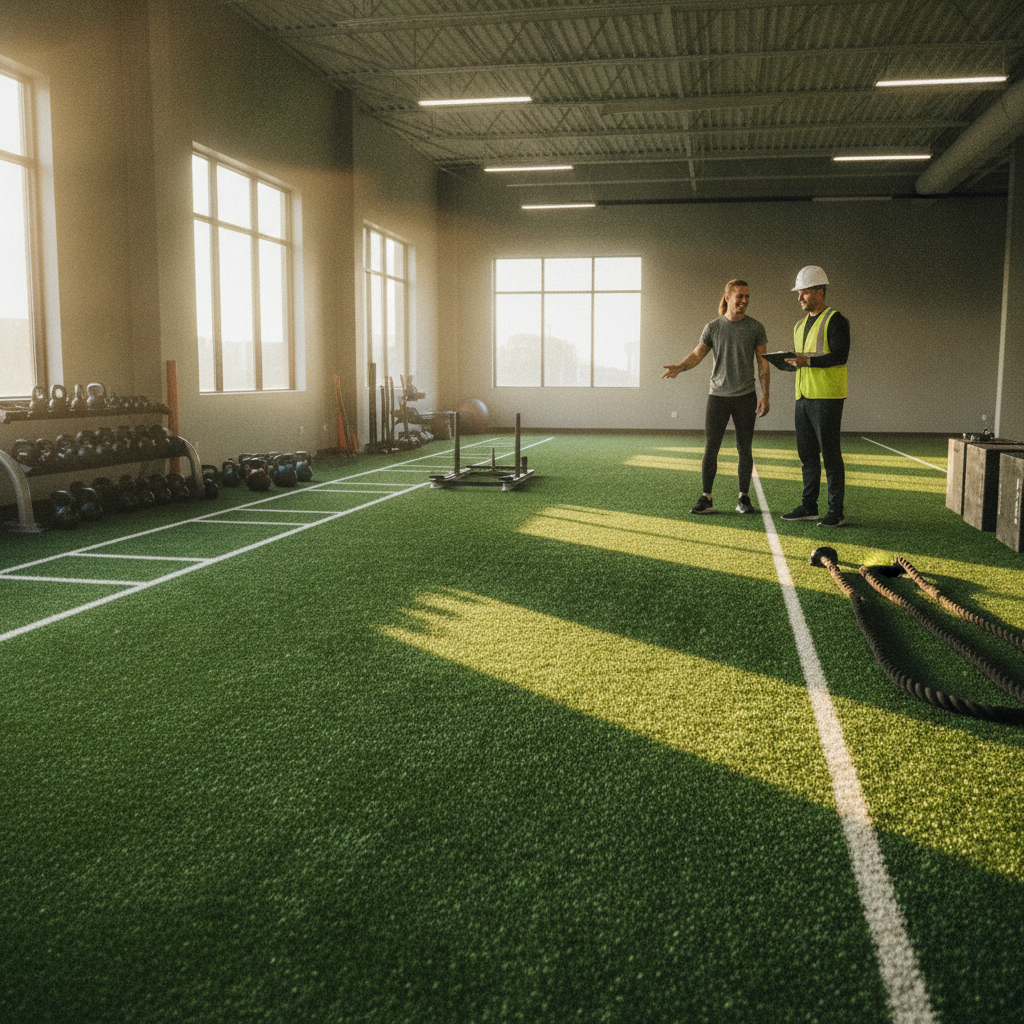
What Does Artificial Turf Installation Actually Look Like for a Commercial Gym in Falls Church, VA?
If you own or manage a gym in Falls Church, VA, you already know that your flooring is doing serious work every single day — sleds being dragged, tires being flipped, athletes sprinting, and clients doing bear crawls at 6 a.m. Artificial turf has become the gold standard for functional fitness areas, but most gym owners have no idea what the actual installation process involves before the crew shows up. And that gap in knowledge costs people. They hire the wrong installer, they get the wrong product, and six months later the seams are lifting and the pile is matted flat. This guide walks you through what a professional commercial gym turf installation actually looks like — step by step — so you can evaluate bids intelligently and know exactly what you’re paying for.
Why Gym Turf Is Not the Same as Lawn Turf (And Why That Distinction Matters in Northern Virginia)
This is the first thing most general landscapers and out-of-state turf franchises get wrong. Commercial gym turf and residential lawn turf are engineered for completely different load profiles. Lawn turf is designed to handle foot traffic and UV exposure. Gym turf is designed to handle lateral shear forces, sled drag weight, repeated point-load impacts from kettlebells, and the kind of daily abuse that would destroy a residential product in a year.
In the DMV area, you have an additional layer of complexity. Northern Virginia’s humidity and temperature swings — brutal summers followed by freeze-thaw winter cycles — put stress on any material. A product that performs fine in a climate-controlled gym in Phoenix may behave differently in a facility that has seasonal humidity exposure through loading dock doors or high-traffic entryways. Turf backing, adhesive selection, and seaming technique all need to account for this.
The right gym turf product typically runs between 40mm and 50mm in pile height for functional fitness applications — tall enough to provide cushion during floor-based movements, short enough to maintain sled drag resistance without bunching. Density matters as much as height. A low-density turf at 50mm will mat and flatten under heavy use within months. You want a face weight above 70 oz per square yard for commercial durability, with a primary backing that resists delamination under repeated impact.
Step One: Subfloor Assessment — The Part No One Talks About
This is the step that separates professional installers from the guys who just roll out turf and call it a day. Before a single square foot of turf goes down, the subfloor has to be evaluated and prepared correctly.
In most commercial gyms in Falls Church, Arlington, and the broader Fairfax area, you’re working over concrete — either a poured slab or a tilt-up panel floor. Concrete subfloors require a moisture vapor assessment before installation. If moisture vapor emission from the slab exceeds acceptable thresholds (typically above 3 lbs per 1,000 sq ft per 24 hours using the calcium chloride test), adhesive bond failure becomes a real risk. This is not a hypothetical concern in the mid-Atlantic region — our soil moisture conditions and seasonal humidity make vapor transmission a legitimate issue in older commercial spaces.
A qualified installer will also check for flatness tolerance. ASTM standards call for a floor flatness of no more than 3/16 inch deviation over a 10-foot span for direct-glue turf applications. High spots and low spots that exceed that tolerance will cause turf to lift, seams to gap, and edges to peel — especially under sled drag loads. Grinding high spots and filling low spots with a Portland cement-based leveling compound is standard prep work, not optional.
Step Two: Layout Planning and Seam Engineering
Gym turf typically comes in 15-foot wide rolls. For most commercial fitness spaces in the Falls Church and Fairfax corridor — which often run 2,000 to 6,000 square feet of turf coverage — you’ll have multiple seams. Where those seams land matters enormously.
Seams should never run perpendicular to high-traffic drag directions. If your sled track runs north-south, seams need to run parallel to that axis — not across it. A seam under a sled track that runs against the grain of traffic will open within weeks under repeated load. Professional layout planning accounts for pile direction, seam placement relative to traffic patterns, and the direction of natural lighting to minimize visible seam appearance.
Seaming itself is done with a combination of seaming tape and commercial-grade urethane adhesive, with a minimum 6-inch bonded seam width on either side of the joint. Heat-activated seaming tape is appropriate for some applications, but in a high-shear commercial environment, a glued seam outperforms it every time. At Grassify, our seams and edges carry a lifetime installation warranty — because we engineer them to last, not just to look good on day one.
Step Three: Infill Selection for Fitness Applications
Infill is the material broadcast into the turf pile after installation. In a gym environment, your infill choices are different from outdoor applications, and this is an area where a lot of installers make costly assumptions.
Crumb rubber infill — common in outdoor sports fields — is generally not appropriate for indoor commercial gym use. Off-gassing concerns in enclosed spaces and cleaning difficulty make it a poor choice for fitness facilities. The better options for indoor gym turf are:
- Sand infill: Affordable, non-toxic, and easy to maintain. Best for lighter-duty fitness applications. Does not provide significant shock absorption on its own.
- Thermoplastic elastomer (TPE) infill: A cleaner, odor-free alternative to crumb rubber with better resilience under repeated impact. Appropriate for high-traffic commercial applications.
- Coated sand / silica blend: Offers good weight distribution and turf blade support without the off-gassing concerns of rubber products.
Infill rate is applied in lbs per square foot based on the turf product specification. Under-infilling causes blades to lie flat and reduces the turf’s ability to recover after impact. Over-infilling makes the surface feel hard and reduces traction. Getting this right requires following the manufacturer’s specified infill chart — not guessing.
Step Four: Edge Finishing, Perimeter Anchoring, and Equipment Compatibility
Edges that aren’t properly secured are how gym turf fails. In a high-traffic fitness environment, even a slightly lifted edge becomes a trip hazard — a liability issue that no gym owner in the DMV area wants to deal with. Professional edge finishing uses a combination of perimeter gluing, aluminum or galvanized steel binder bars, and — where needed — transition strips rated for the specific flooring types on either side of the turf.
If your gym has weight racks, cable machines, or other equipment anchored to the floor, those anchor points need to be mapped before turf goes down. A good installer will cut and reinforce around anchor bolt locations so your equipment installation doesn’t compromise the turf border or backing integrity. Our indoor sports turf installations are planned around your equipment layout from the start — not retrofitted after the fact.
What the Competitor Sites Are Missing: A Real Process Breakdown
If you’ve done any research on local turf installers in the Falls Church or Northern Virginia area, you’ve probably noticed that most competitor websites talk about gym turf in the same three sentences: it looks great, it’s durable, and it’s easy to clean. What they don’t tell you is anything about moisture vapor testing, seam engineering relative to traffic patterns, or the specific infill requirements for enclosed commercial spaces. That gap in content reflects a gap in installation knowledge. When you’re evaluating bids for a commercial gym installation, the installer who can’t explain their seaming technique or their subfloor prep protocol is the one you need to walk away from — regardless of price.
For gym owners in Falls Church, Burke, Fairfax, and the surrounding area, Grassify’s gym turf services are built around the kind of technical installation detail that actually keeps a commercial floor performing for years. We’re not rolling out lawn turf and calling it a fitness floor.
What Does Commercial Gym Turf Installation Cost and How Long Does It Take?
For a standard commercial gym turf installation in Northern Virginia, expect a project range of roughly $12 to $22 per square foot installed, depending on subfloor condition, product selection, infill type, and edge complexity. A 3,000 sq ft functional fitness floor will typically run 2 to 4 days from subfloor prep through final infill broadcast and cleanup — longer if significant floor leveling is needed. The quote you receive should clearly itemize subfloor prep, adhesive, seaming, infill, and edge finishing as separate line items. If it’s a single lump number with no breakdown, ask for the detail before you sign anything.
Frequently Asked Questions: Gym Turf Installation in Falls Church and Northern Virginia
Do I need to remove my existing rubber flooring before gym turf goes over it?
Usually, yes. Installing turf over rubber flooring creates a composite system that isn’t engineered for the load, and it raises your finished floor height in ways that can create tripping transitions. In most cases, rubber flooring should be removed and the concrete subfloor assessed before turf installation begins. Your installer should make this call after physically walking the space.
How do I clean and maintain gym turf after installation?
Indoor gym turf is significantly easier to maintain than outdoor turf. Regular grooming with a stiff-bristle broom or power brush keeps pile upright and distributes infill evenly. Spot cleaning with a diluted enzyme-based cleaner handles sweat and body fluid contamination. Annual infill top-off may be needed in high-drag areas. Avoid steam cleaning, which can compromise adhesive bonds in direct-glue installations.
Can gym turf be installed in phases if I need to keep the facility open?
Yes, with planning. A sectional installation approach — completing one zone at a time while keeping the rest of the floor operational — is possible as long as the layout accounts for seam placement in advance. This takes more coordination and adds some time to the project, but it’s a reasonable approach for gyms that can’t afford a full closure.
Is gym turf safe for clients who train barefoot or in minimalist footwear?
Yes, provided the turf product is selected appropriately. Commercial gym turf with TPE or coated sand infill provides a clean, non-abrasive surface that’s appropriate for barefoot training. Crumb rubber products are generally not recommended for barefoot applications due to texture and potential skin irritation.
How long does commercial gym turf last in a high-use facility?
A properly installed commercial-grade gym turf system — correct product, correct infill, correct subfloor prep — should perform well for 8 to 12 years in a high-traffic fitness facility before the pile density degrades to the point of replacement. Seams and edges, when installed correctly, should outlast the turf surface itself. That’s why a lifetime installation warranty on seams and edges matters — it separates installers who are confident in their work from those who aren’t.
Ready to Put Real Turf Under Your Fitness Floor?
If you’re planning a gym turf installation in Falls Church, Burke, Fairfax, Arlington, or anywhere across Northern Virginia, the first step is a site walkthrough — not a quote from a photo. Subfloor conditions, room dimensions, equipment layout, and traffic patterns all affect what the right installation looks like for your specific facility. Contact Grassify today to schedule a free on-site consultation. We’ll assess your space, walk you through product options, and give you a clear, itemized proposal — no guesswork, no pressure.


