
How Do You Remove Natural Grass and Prepare the Ground for Artificial Turf in Burke, VA?
Ground preparation is the answer to a question most homeowners don’t even think to ask — and it’s also the single biggest reason turf installations fail. If you’re planning to install artificial grass at your home in Burke, VA or anywhere in Fairfax County, the prep work that happens before a single roll of turf gets laid down will determine whether your lawn looks perfect in 15 years or starts bubbling, shifting, and growing weeds through the backing in two. This guide walks you through every step of sod removal and base preparation so you know exactly what a quality install actually looks like — and what to demand from your installer.
Why Base Prep Gets Skipped — and Why That’s a Disaster
Most turf competitors in the DMV area do a decent job showing finished lawn photos on their websites. What almost none of them explain in detail is what happens underground first. That gap is a real problem, because the ground under your turf is doing most of the structural work. It’s managing drainage, preventing weed intrusion, stabilizing seams under foot traffic, and holding the entire surface level through Northern Virginia’s freeze-thaw winter cycles and heavy spring rain events.
General landscapers and out-of-state franchise turf installers frequently rush this phase. They scrape the surface, throw down some decomposed granite, and roll the turf over it. It looks fine on day one. By year two, you’re seeing soft spots, drainage pooling, and weeds pushing up from below. At that point, the fix isn’t a patch — it’s a full reinstall.
Step One: Full Sod Removal Down to the Right Depth
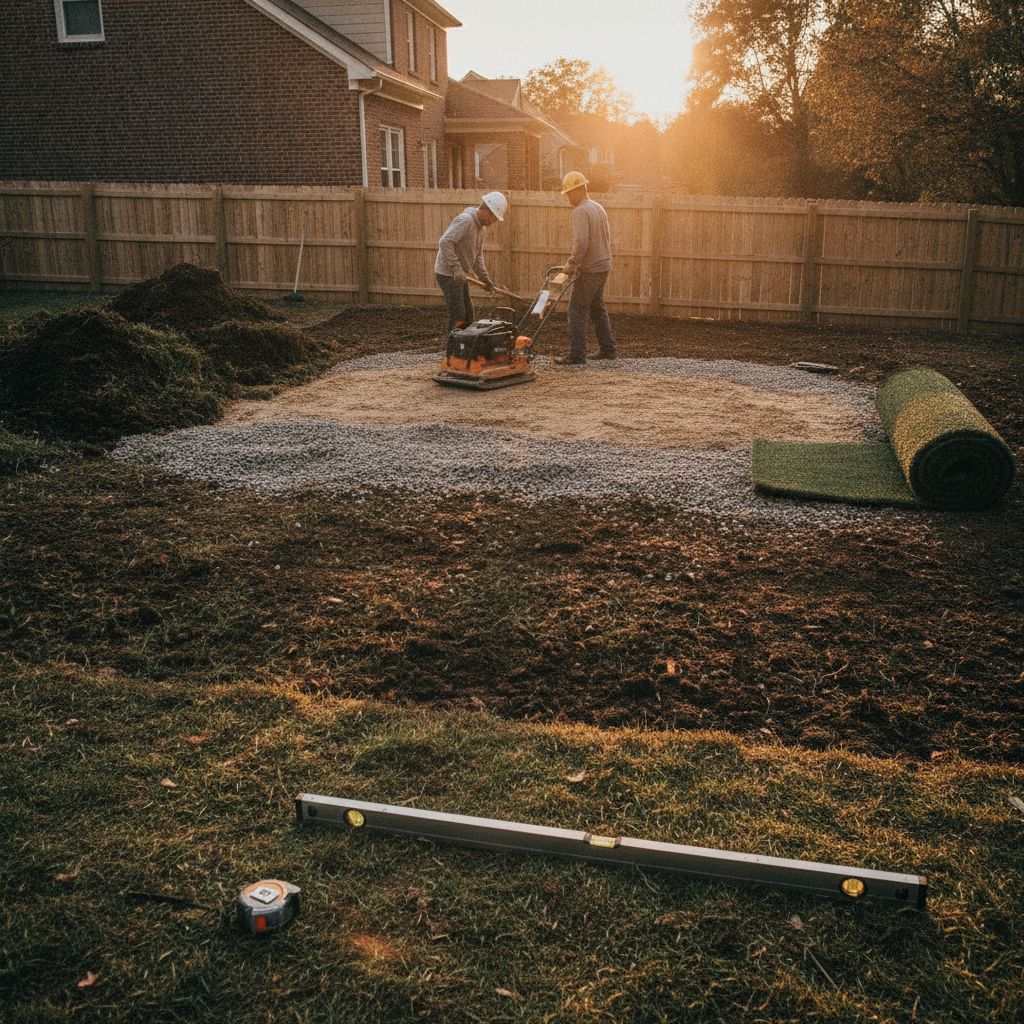
Proper sod removal in a residential yard means excavating to a depth of 3 to 4 inches minimum, sometimes more depending on the application. That depth gives you enough room to install a compacted aggregate base without raising the finished turf surface above your existing edging, walkways, or patio borders.
In Burke Centre, West Springfield, and other established Fairfax County neighborhoods where yards have decades of organic buildup, you may be working through heavy clay subsoil once you get below the turf layer. Clay holds water. If you don’t excavate deeply enough and replace that clay with a permeable base, you’re trapping moisture under your new turf — exactly the wrong outcome.
For most residential lawns in the area, excavation is done with a sod cutter machine. The removed sod gets hauled away as part of the installation — a reputable installer includes this in their scope. If anyone gives you a quote and tells you the debris removal is extra, that’s a yellow flag worth pressing on.
Step Two: Addressing the Native Soil — This Is Where DMV Conditions Matter
Northern Virginia soil is notoriously clay-heavy. Fairfax County’s native soil tends to drain slowly and compress unevenly. Before any base material goes down, the exposed subgrade needs to be evaluated and, in many cases, graded to direct water flow away from structures and toward designated drainage points.
If the subgrade has significant clay content or compaction issues, the right move is to add a layer of road base or Class II aggregate on top — typically crushed granite or decomposed granite, compacted in 2-inch lifts to achieve a firm, stable surface. Skipping this step and just laying aggregate over loose or clay-heavy soil creates a base that shifts seasonally, especially during the freeze-thaw cycles we see every winter in Burke and surrounding areas.
Some installers add a 3–4 inch layer of crushed miscellaneous base (CMB) or a comparable crushed stone product for standard residential applications. The material is compacted with a plate compactor to reach the right density — not just raked flat. There’s a real difference. Compaction is what prevents settling.
Step Three: Weed Barrier Installation — Getting It Right Matters More Than You Think
A commercial-grade weed barrier fabric goes down over the compacted base before turf installation. This isn’t the cheap landscape fabric you find at a home improvement store — it’s a geotextile membrane that blocks weed growth while still allowing water to pass through freely.
The fabric needs to be overlapped at seams by at least 6 inches and secured along the perimeter. If it’s installed too loosely or not anchored properly, it can shift under the turf and create visible rippling at the surface. This is a common issue when installers are moving too fast or using undersized crews.
One thing worth noting: in established neighborhoods across Fairfax County like Rolling Valley or Kings Park, existing root systems from trees and shrubs can keep pushing upward even after sod removal. A quality installer will treat the soil with a pre-emergent before laying the barrier in areas with heavy root competition. This is an extra step that not every company takes, but it matters for long-term weed suppression.
Step Four: Drainage Engineering — Not Just Sloping the Surface
Drainage isn’t just about sloping the turf surface to drain toward one end. In a properly prepared installation, the base itself is engineered to evacuate water at a high rate. Residential lawn turf installed over a correctly compacted crushed aggregate base will drain at rates well above what natural grass achieves — but only if the base material has adequate permeability and the grading is done right from the start.
In Fairfax County, where heavy spring rains can dump several inches of water in a short period, this matters. A base that holds water — even temporarily — creates conditions for mold, odor, and surface softening. Proper drainage engineering at the base prep phase is what prevents that.
For pet turf installations, the drainage specs go even further. Pet-friendly turf systems include a 5-layer drainage design with specialized infill and zeolite deodorizer layers, rated at 400+ inches per hour. That starts with the base — you can’t retrofit drainage performance into a turf system after it’s been installed over a poorly graded or low-permeability base.
What Proper Base Prep Should Cost — and What It Signals About Your Installer
Complete turf installation in Fairfax County, including sod removal, base prep, and turf material, typically runs $12–$25 per square foot depending on the application. If you’re getting a quote significantly below that range, base prep is almost certainly where corners are being cut. Excavation, debris hauling, aggregate material, compaction equipment, and labor all cost real money. A quote that skips those line items isn’t a deal — it’s a liability.
Ask your installer specifically: How deep are you excavating? What aggregate base material are you using? How is it compacted? What grade of weed barrier? If they can’t answer those questions in specific terms, you don’t yet have a basis for comparison between quotes.
HOA Considerations for Burke and Fairfax County Homeowners
If your home is in a HOA-governed community — and many Burke, Springfield, and Fairfax neighborhoods are — your turf installation may require architectural review committee approval before any excavation begins. Some HOAs in the area have specific requirements around grade changes, drainage impact on neighboring properties, and finished surface appearance. Getting that approval in advance protects you from having to reverse a completed installation. A local turf specialist familiar with Fairfax County HOA processes can help you prepare the documentation and project drawings needed for submission.
Frequently Asked Questions
How long does ground preparation take before turf can be installed?
For a standard residential backyard in Burke or Springfield — typically 500 to 1,500 square feet — ground prep including sod removal, base grading, and compaction usually takes one to two days before turf installation begins. Larger or more complex projects may require additional time.
Can you install artificial turf without removing the existing grass?
Technically possible in very limited situations, but not recommended for any permanent residential installation. Leaving organic material under turf traps moisture, promotes decomposition and odor, creates an unstable surface, and almost always leads to weed intrusion. Full removal is the right approach.
What happens to the soil that gets excavated?
A reputable installer hauls away the excavated sod and soil as part of the installation scope. This should be clearly stated in your contract. In some cases with very large projects, disposal fees may be itemized separately — ask about this upfront.
Does base preparation work the same way for a small townhome yard as a larger suburban backyard?
The same principles apply, but tight-access yards — common in Northern Virginia townhome communities — require smaller equipment and more manual labor, which can affect timeline and cost. An experienced installer will account for this in the site evaluation. Don’t assume a quote built for an open suburban yard applies to a townhome with gate-only access.
How do I know if my existing yard has drainage problems that need to be fixed during base prep?
If your current lawn holds standing water after rain, has chronically wet patches, or drains toward your home’s foundation, those are signs that your subgrade has drainage issues that need to be addressed — not just covered over. A site evaluation before installation should include a drainage assessment. At Grassify, we include this as part of the free consultation process.
Ready to Start Your Turf Installation the Right Way?
If you’re a homeowner in Burke, Fairfax, Springfield, or anywhere in Fairfax County thinking about artificial turf, the ground beneath your feet matters as much as the product on top of it. At Grassify, we’ve been doing this work in the DMV for over a decade, and we don’t cut corners on the phase that most homeowners never see. Request a free consultation and we’ll walk your property, assess your existing conditions, and give you a straight answer about what your installation actually requires — no upselling, no vague estimates.


