
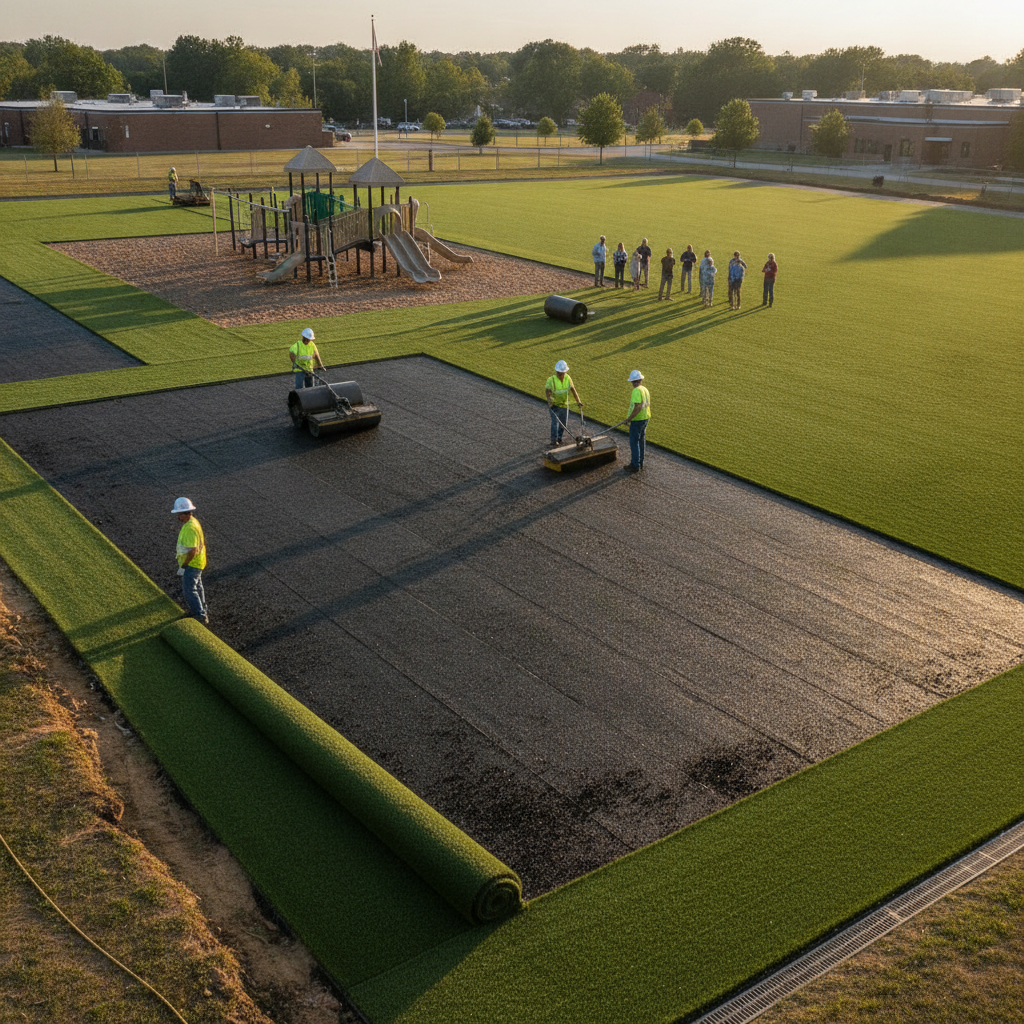
How Do You Install Artificial Turf on a Playground or School Field in Stafford, VA? What Parents and Administrators Need to Know
If you’re responsible for a school, daycare, or recreational facility in Stafford, VA and you’re considering artificial turf for your playground or field, the short answer is: yes, it’s absolutely the right move — but only if it’s done to spec. Playground turf isn’t the same product you’d put in a residential backyard. It requires CPSC-compliant shock-absorbing systems, independently verified critical fall height ratings, and drainage engineering that can handle Northern Virginia’s heavy spring rains without pooling water under a surface where children spend hours a day. Get those details right, and you get a surface that’s safer, lower-maintenance, and more accessible than natural grass. Get them wrong, and you have liability exposure and a product that degrades in two years.
Why Playground Turf Is a Completely Different Category
Most synthetic grass installers in the DMV area focus on residential lawns and pet runs. That’s fine — but playground and school field turf operates under a separate set of requirements that most general landscapers and even some turf companies simply aren’t equipped to meet. Here’s what sets it apart:
- CPSC Safety Standards: The Consumer Product Safety Commission publishes guidelines for playground surfaces, including requirements for impact attenuation — how well a surface absorbs the energy of a child falling from play equipment. Any turf used under or around climbing structures, swings, or slides needs to meet these standards.
- IPEMA Certification: The International Play Equipment Manufacturers Association offers third-party certification for playground surfacing materials. IPEMA-certified turf has been independently tested, not just rated by the manufacturer. That distinction matters when a parent or school board asks how you selected your surface.
- Critical Fall Height (CFH) Ratings: Every piece of play equipment has a maximum CFH — the height from which a child could fall. The turf system installed beneath it must be rated to absorb impact at or above that height. A six-foot CFH rating requires a significantly thicker and denser shock-absorbing pad than a four-foot rating. This is non-negotiable.
- ADA Accessibility: Under the Americans with Disabilities Act, playground surfaces must allow wheelchair and mobility device access. Properly installed synthetic turf on a firm, compacted base meets ADA surfacing standards. Loose-fill materials like wood chips do not.
What the Base Prep Actually Looks Like for a School or Rec Field in Stafford
Stafford and the broader Prince William County area see significant rainfall — particularly in spring — and the clay-heavy soil common in this region drains poorly on its own. For a playground or school field installation, the base prep process typically looks like this:
- Excavation: Existing vegetation, topsoil, and often 4–6 inches of subgrade material are removed and hauled off-site. The depth depends on the CFH requirements for the play equipment on site.
- Grading: The sub-base is graded to a 1–2% slope to move water toward designated drainage points. On a larger field, perforated drain pipes may be installed in a herringbone or grid pattern beneath the base.
- Compacted Aggregate Base: A layer of crushed aggregate — typically 3–4 inches of compacted Class II base material — is installed to create a firm, stable foundation. This is what prevents the surface from shifting or developing low spots under foot traffic.
- Shock Pad Installation: A certified foam or crumb rubber shock pad is installed directly over the aggregate base. This is the layer responsible for meeting CFH ratings. Pad thickness is specified by the equipment manufacturer’s fall zone requirements.
- Turf Installation: The synthetic grass is rolled out, seamed, and secured. Infill — typically sand or a sand/rubber blend — is then applied to weight the fibers and support the pile.
Skipping or shortcutting any of these steps doesn’t just reduce durability — it creates genuine safety liability. A reputable installer should be able to provide documentation at every stage, including compaction test results and shock pad certification numbers.
The Gap Most Competitor Installers Don’t Address: Long-Term Field Maintenance and Warranties
If you review what most synthetic turf companies serving the Fredericksburg and Stafford corridor publish about commercial playground installations, you’ll notice a consistent gap: they talk about the installation, but they say almost nothing about what happens over the following five to ten years. That’s a problem for school administrators and facility directors who need to plan budgets and manage maintenance contracts.
Here’s what long-term maintenance actually involves for a school or commercial playground surface:
- Infill replenishment: Over time, foot traffic and weather redistribute infill toward the perimeter. High-use zones under swings and at slide exits lose infill faster. Annual top-dressing with sand or rubber infill keeps the surface performing correctly and maintains CFH ratings.
- Seam inspection: Seams are the most vulnerable point of any turf installation. Freeze-thaw cycles — which Stafford and Fredericksburg see regularly from November through March — stress adhesive bonds between panels. Annual seam inspection prevents small separations from becoming trip hazards.
- Surface brushing: High-traffic synthetic turf needs periodic power brushing to keep fibers upright and distribute infill evenly. On a school field with daily use, this is typically done quarterly.
- Drainage testing: Heavy spring rains can compact infill and reduce drainage rates over time. A properly installed system should drain at 30+ inches per hour; if it’s pooling, that’s a sign the base or infill needs attention.
At Grassify, our commercial playground installations include a lifetime installation warranty on seams, edges, and base performance — and we walk facility managers through a documented maintenance schedule before we leave the job site. You should expect the same from any installer you consider. Learn more about our commercial playground turf systems here.
What a Realistic Budget Looks Like for a School or Daycare in Northern Virginia
Playground turf costs more per square foot than residential lawn turf — and that’s appropriate, because you’re paying for certified systems, not just green carpet. For CPSC/IPEMA-compliant installations in the Stafford, Fredericksburg, and broader Northern Virginia region, expect the following rough ranges:
- Basic playground area (up to CFH 6 ft): $18–$25 per square foot installed, including shock pad and infill
- Larger multi-use school field: Project totals vary widely depending on acreage, drainage complexity, and equipment fall zones — get a site assessment before requesting a number
- Timeline: A typical elementary school playground installation runs 5–10 business days depending on scope, weather, and site access
Be cautious of quotes significantly below this range. Companies cutting costs on playground projects are almost always cutting corners on the shock pad system, the base prep, or the turf product itself — none of which you want to discover after a child gets hurt.
HOA-Governed Communities and School Facilities: A Note on Approvals
Some school grounds and community recreation facilities in Stafford County and Prince William County operate under architectural review requirements — either through an HOA or a county facilities department. Before any turf project begins, confirm who has approval authority over the surface material and installation specifications. Grassify works with school administrators and facilities managers throughout the approval process, including providing product data sheets, safety certifications, and drainage documentation for review boards.
For residential communities in Fairfax County or elsewhere in Northern Virginia looking to upgrade their community play areas, the same certification requirements apply. See how we serve Fairfax County communities here.
Frequently Asked Questions: Playground Turf in Stafford, VA
Does artificial turf on a school playground require a permit in Stafford County?
In most cases, replacing a playground surface material does not require a building permit, but you should confirm with Stafford County’s Department of Planning and Zoning before starting any project. If the installation involves changes to drainage infrastructure or grading, a grading permit may be required. Your installer should be able to advise based on project scope.
How hot does playground turf get in a Virginia summer? Is it safe for kids?
This is a legitimate concern. Standard synthetic turf can reach surface temperatures 30–50°F above ambient air temperature on sunny days — which in a Virginia summer can push surface temps above 150°F. For playground applications, we recommend heat-attenuating infill options and shade structures over high-traffic zones. Scheduling active outdoor play during cooler morning hours is standard practice at most schools, regardless of surface material.
What’s the difference between CPSC-compliant and IPEMA-certified turf?
CPSC compliance means the product meets federal consumer safety guidelines. IPEMA certification means an independent third-party lab has tested the specific product and verified those claims. IPEMA-certified is the stronger standard and what most school districts and daycares in Northern Virginia require. Always ask for the actual certification number — not just a claim on a brochure.
How long does a commercial playground turf system last in Northern Virginia?
A properly installed system with a certified shock pad and quality synthetic grass typically lasts 12–18 years under heavy school-use conditions. The turf fibers and infill usually need attention before the base does. Annual maintenance significantly extends useful life and preserves the safety performance of the shock absorption layer.
Can artificial turf be installed on an uneven school field without full excavation?
In some cases, minor grading corrections can be made during base prep without full excavation — but if the existing ground has significant drainage problems, tree roots, or compacted soil, skipping excavation will cause problems within a few years. A site assessment will determine what’s actually needed. We don’t give installation quotes without a site visit for commercial projects.
Ready to Talk About Your School or Facility Project?
If you’re overseeing a playground renovation, school field conversion, or recreational facility upgrade anywhere in Stafford, Fredericksburg, or the surrounding Northern Virginia area, Grassify brings the certifications, local site experience, and straight-talking guidance that school administrators and facility directors need. We’re not a franchise operation sending out a national estimate — we’re a local crew that has worked through Fairfax County HOA approvals, Northern Virginia drainage challenges, and DMV freeze-thaw winters on hundreds of installations.
Get in touch for a no-pressure site consultation. We’ll walk the property with you, assess the drainage and grading realities, confirm what CFH ratings your equipment requires, and give you a clear, documented proposal. Request your free consultation here.


